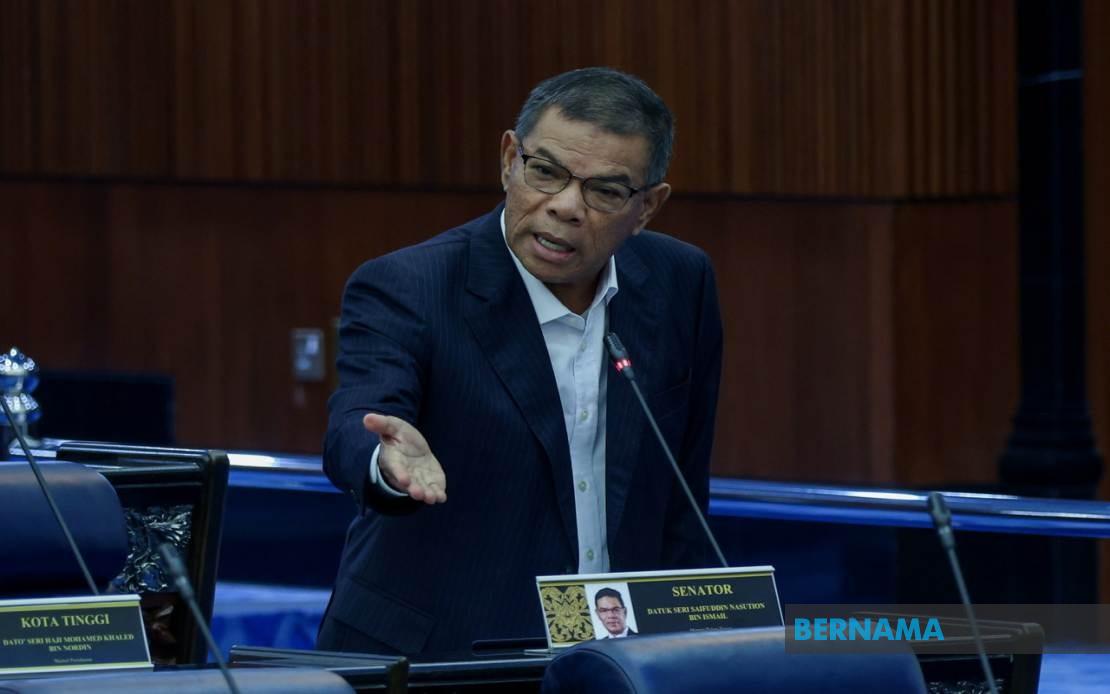
Prime Minister Datuk Seri Anwar Ibrahim has approved a RM22 million allocation to furnish the Border Control and Protection Agency (AKPS) with firearms and appropriate operational equipment, according to Home Minister Datuk Seri Saifuddin Nasution Ismail. The funding decision follows an urgent assessment of personnel safety requirements after an armed attack on a vehicle transporting one of the agency's senior commanders near Bukit Kayu Hitam in Kedah earlier this year. The minister disclosed the development during parliamentary questioning, positioning the investment as a critical response to operational vulnerabilities that have become increasingly apparent since AKPS began its duties.
Saifuddin Nasution explained that the urgent need for weaponry became evident following the February incident, which prompted him to petition the Prime Minister directly for enhanced protective measures. The RM22 million commitment, granted swiftly, reflects leadership recognition that personnel working at porous border zones face genuine security threats that require substantive remedial action. The allocation targets arming AKPS with an arsenal considered proportionate and operationally necessary for cross-border duties, where officers encounter diverse risks ranging from smuggling networks to transnational criminal activity. This marks a significant policy shift in equipping Malaysia's consolidated border enforcement apparatus with tools previously distributed across numerous fragmented agencies.
The parliamentary exchange arose when opposition lawmaker Datuk Seri Takiyuddin Hassan raised concerns about AKPS officers conducting border operations without standard protective equipment, including firearms and body armour. This gap in operational readiness has represented a morale and safety concern within the fledgling agency, particularly given the hazardous nature of border control work. The absence of weapons creates operational limitations when personnel encounter smugglers or criminal elements, forcing reliance on other agencies for armed response. Saifuddin Nasution's acknowledgment of these constraints and the allocation approval signal that the government intends to remove such impediments systematically.
A complexity underlying the firearms approval lies in AKPS's composite workforce. The agency draws personnel from multiple source organisations, including health ministry officials, police, customs, and immigration authorities. Not all these transferred staff possess firearms training or certification, creating a tiered operational structure. Saifuddin Nasution clarified that only trained segments, particularly law enforcement officers seconded from the police, would handle weapons. This necessitates careful implementation protocols to ensure that only qualified personnel access the new firearms inventory, requiring training infrastructure and oversight mechanisms to manage the expanded armament responsibly.
The Home Minister seized the opportunity to articulate a broader strategic rationale for AKPS's establishment, framing the agency as an integrity and efficiency tool. Consolidating border functions previously scattered across more than twenty government entities into a single operational body theoretically reduces bureaucratic layering and diminishes corruption vectors. When border control responsibilities span numerous agencies, processing becomes sequential and opaque, creating opportunities for informal arrangements and integrity breaches. A unified agency theoretically simplifies accountability, streamlines decision-making, and creates clearer institutional responsibility for border outcomes. Saifuddin Nasution contended that the structural reform should inherently strengthen governance standards at Malaysia's ports of entry.
In its inaugural operating year, AKPS has generated operational successes that buttress arguments for the agency's viability. The agency claimed credit for a major narcotics interdiction at Penang International Airport involving seized substances valued in the tens of millions of ringgit. Additionally, AKPS coordinated with partner agencies to detect e-waste smuggling operations at port facilities, demonstrating capacity for inter-agency cooperation and targeting sophisticated illicit commodity flows. These early achievements provide empirical grounds for supporting expanded resource allocation, showing that consolidation can yield tangible security results when provided adequate tools and coordination frameworks.
A secondary parliamentary query from Datuk Seri Shafie Apdal concerning constitutional implications revealed ongoing sensitivity around AKPS's establishment. Shafie Apdal sought reassurance that AKPS operations do not encroach upon constitutional protections or the special rights granted Sabah and Sarawak under the Malaysia Agreement 1963. Saifuddin Nasution provided categorical assurances that the Federal Constitution remains inviolate and that MA63 provisions safeguarding Sabahan and Sarawakian interests persist unchanged. He further noted that these constitutional questions had been thoroughly addressed and resolved during the legislative process before the AKPS Bill received parliamentary approval, suggesting that contemporary opposition centres on implementation rather than foundational policy objections.
The Home Minister positioned AKPS within a broader ecosystem of security-focused institutional consolidations that have proven effective in Malaysian governance. He cited the Eastern Sabah Security Command (ESSCOM) and the Malaysian Maritime Enforcement Agency (MMEA) as precedents demonstrating successful integration of multiple agencies into unified operational frameworks. Both entities emerged from recognition that fragmented security responsibilities create inefficiencies and gaps, requiring coordinated institutional arrangements. ESSCOM's operations in Sabah's security environment and MMEA's management of maritime zones illustrate how consolidation can enhance operational effectiveness when coupled with appropriate resourcing and clear mandate definitions. These examples strengthen the government's case that AKPS represents sound institutional design rather than governmental overreach.
The RM22 million allocation reflects a calculated investment in institutional consolidation and operational capacity-building. Beyond the immediate firearms acquisition, the funding suggests broader equipment procurement for AKPS personnel, from protective gear to detection technology. This comprehensive approach acknowledges that border security effectiveness depends on multiple technological and human resource factors operating synergistically. Providing officers with ballistic protection, appropriate weaponry, and modern surveillance or detection equipment multiplies operational impact compared to personnel working with inadequate tools. The investment signals government commitment to making AKPS a credible, capable entity rather than a nominal administrative reorganisation lacking genuine operational substance.
From a regional perspective, Malaysia's investment in border agency consolidation and modernisation reflects broader Southeast Asian patterns of institutional reform aimed at strengthening security architectures. Countries throughout the region increasingly recognise that transnational challenges—drug trafficking, wildlife smuggling, irregular migration, terrorism—require coordinated institutional responses rather than siloed agency structures. Malaysia's RM22 million commitment to arming and equipping AKPS positions the nation to address these challenges with greater institutional coherence than previously existed. For Malaysian stakeholders and regional observers, the approval demonstrates sustained policy commitment to making border security a priority despite competing budgetary pressures and governance complexities.
Implementation challenges remain substantial despite the funding approval. Training officer cadres to use firearms safely and lawfully requires substantial institutional investment beyond equipment procurement. Establishing appropriate command structures, rules of engagement, and accountability mechanisms for armed personnel presents complex operational questions. Additionally, sustaining political will for institutional reform as operational pressures mount will test government resolve. Nevertheless, the RM22 million allocation represents a tangible expression of government recognition that border security personnel require adequate tools and that consolidating fragmented agency responsibilities creates opportunities for more effective governance. The approval signals that AKPS, despite its infancy and constitutional controversies, has secured sufficient political support to enable substantive operational development.

