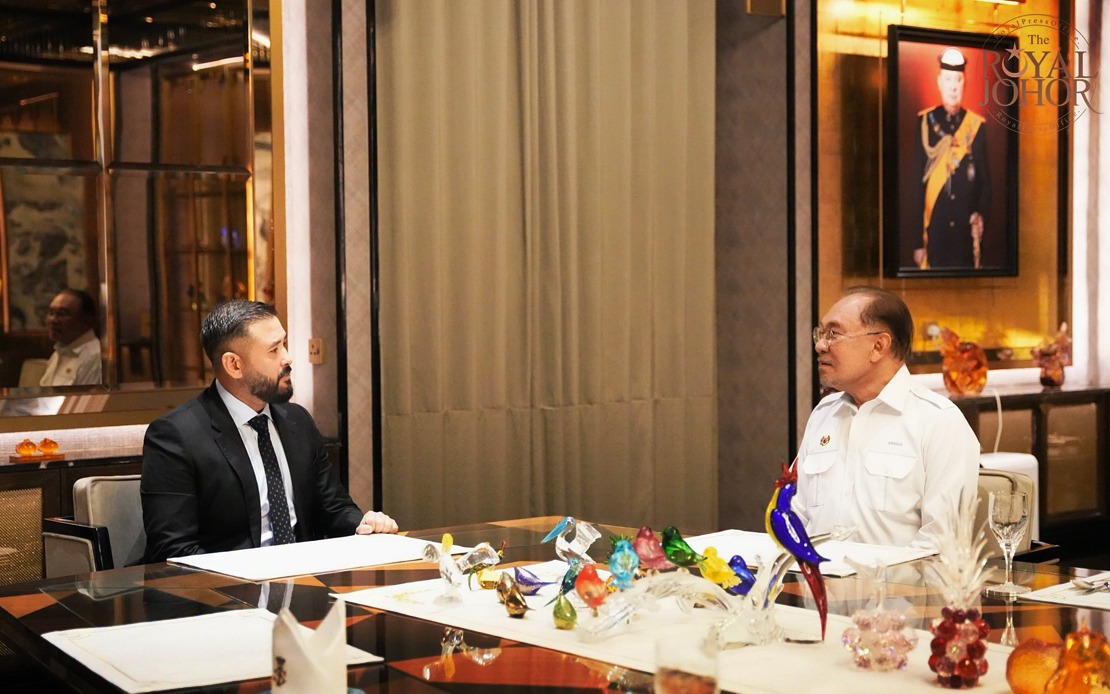
Prime Minister Datuk Seri Anwar Ibrahim seized the opportunity at a Pakatan Harapan candidate announcement in Johor to commend Tunku Mahkota Ismail for extending what he characterised as a symbolic gesture of goodwill. Speaking at the campaign event in Tangkak on June 22, Anwar framed the recent audience as evidence of institutional harmony at a time when electoral competition has begun heating up across Malaysian states, particularly in Johor where the 16th state election looms.
The Prime Minister's remarks carried a pointed political message directed at rivals who he suggested were invoking royal authority without proper restraint. Anwar specifically criticised opponents for citing the King's name in their campaigns while simultaneously avoiding substantive political debate, characterising such tactics as cowardly and inconsistent with democratic norms. By publicly acknowledging his own consultation with the Johor Regent and Sultan, Anwar positioned himself as the politician genuinely engaging with the monarchy through proper channels rather than exploiting royal symbolism for electoral gain.
During his audience with Tunku Mahkota Ismail, Anwar explained that he had used the occasion to brief the Regent on various federal development initiatives undertaken for Johor's benefit. This represents a common practice among sitting prime ministers to demonstrate to state-level royalty that the federal government remains attentive to regional development priorities. Such briefings serve both as courtesy and as an implicit assertion that the administration is actively delivering on governance commitments, a message particularly important in Johor given the state's economic significance and the sultanate's influential position within Malaysia's constitutional monarchy system.
Anwar's broader framing of federal-state relations emphasised a consultative philosophy between his government and Malaysia's Malay Rulers. He outlined an approach characterised by genuine dialogue, where disagreements can surface openly but are managed through respect for institutional prerogatives. This stance contrasts with more confrontational postures sometimes adopted during electoral cycles, when governments and opposition parties may attempt to marginalise royal perspectives or present the monarchy as aligned with particular political factions. By emphasising consultation, advice-seeking, and willingness to accept both commendation and reproof from the sultans, Anwar projected an image of institutional deference that appeals particularly to constituencies respecting traditional constitutional arrangements.
The presence of senior Pakatan Harapan figures including DAP secretary-general Anthony Loke Siew Fook and Amanah president Datuk Seri Mohamad Sabu underscored the coalition's united messaging on this theme. For a multiethnic, multireligious coalition encompassing largely non-Malay and non-Muslim majority parties, demonstrating respect for Malay-Muslim institutions carries considerable political weight. The gathering functioned as both a campaign event and a statement about how PH as the governing coalition envisions its relationship with constitutional monarchy, an especially delicate matter given the diverse political traditions represented within the alliance.
Anwar's reference to King Sultan Ibrahim was equally significant. By noting that disagreements and counter-views occur between the federal government and the sovereign, yet are addressed through proper consultation and respectful engagement, the Prime Minister addressed a recurring tension in Malaysian politics: the balance between executive authority and royal prerogative. His assertion that such exchanges occur in good faith, regardless of occasional differences, sought to normalise a professional relationship that transcends partisan competition.
The timing of these remarks, delivered during a state-level campaign event, reflected PH's strategic approach in Johor. The state remains politically contested terrain where the opposition retains significant support, and where demonstrations of federal competence and institutional harmony carry weight with voters concerned about governance stability. By positioning his administration as one that respects constitutional authority while delivering tangible benefits, Anwar attempted to consolidate support among traditionally-minded constituencies who value institutional continuity alongside development outcomes.
For Malaysian and Southeast Asian observers, the exchange illustrates the enduring importance of monarchy in Malaysia's political architecture. Unlike many democracies where heads of state function as ceremonial figureheads entirely removed from political discussion, Malaysia's sultans maintain formal constitutional powers and informal influence that politicians cannot ignore. This necessitates careful navigation by prime ministers and political leaders, who must demonstrate respect for royal authority whilst maintaining their own governing legitimacy—a balance that separates effective leadership from politically damaging conflicts.
Anwar's implicit critique of opposition parties invoking royal authority without direct engagement reflects a wider concern about the instrumentalisation of institutional actors. Political campaigns in Malaysia occasionally employ references to the monarchy in ways that suggest royal endorsement without explicit confirmation, a practice that strains relations and risks undermining institutional neutrality. The Prime Minister's public acknowledgment of his own consultations served partly as a corrective, establishing that genuine engagement with royalty requires formal processes and respectful dialogue rather than rhetorical invocation.
Looking forward, Anwar's emphasis on federal-state harmony and consistent consultation with the sultans sets expectations for how a PH-led government should conduct itself. For Johor voters and observers across Malaysia's other sultanates, these statements communicate that institutional relationships will remain respectful and properly channeled. This carries implications for regional governance, as states with powerful sultans like Johor, Selangor, and Kedah remain critical to federal political stability and electoral outcomes.

