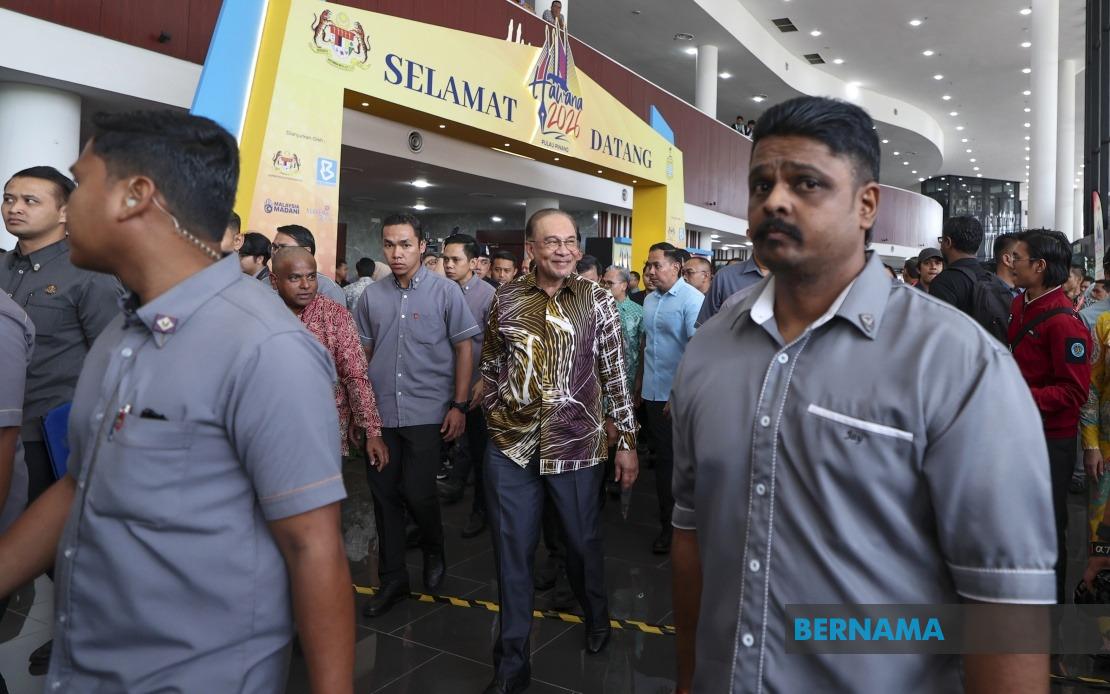
Prime Minister Datuk Seri Anwar Ibrahim has opened the HAWANA 2026 National Journalists' Day celebration at the PICCA Convention Centre @ Butterworth Arena in Penang, signalling the government's commitment to recognising the media industry's crucial role in democratic governance and public discourse. The Prime Minister arrived at 2.40 pm on June 20 to chair the main proceedings, underlining the significance the administration places on journalism and information integrity in an era of rapid digital transformation across Southeast Asia.
The event brought together an impressive assembly of regional and international dignitaries, reflecting the growing importance of media cooperation in the ASEAN region. Penang Chief Minister Chow Kon Yeow and Communications Minister Datuk Fahmi Fadzil received the Prime Minister alongside Communications Ministry secretary-general Datuk Abdul Halim Hamzah, demonstrating the state and federal government alignment on media sector development. The gathering illustrated how media issues have become central to regional diplomatic and governance conversations, with ASEAN nations increasingly viewing journalism standards as foundational to shared prosperity and stability.
International participation underscored the regional dimension of the celebration. Delegates from Timor-Leste, including Secretary of State for Social Communication Expedito Loro Dias Ximenes and TATOLI president Noemio Mateus Soares Falcao, travelled to Penang alongside Cambodia's Undersecretary of State at the Ministry of Information Prak Thaveak Amida and Laos' Permanent Secretary of the Cabinet Office of the Ministry of Technology and Communications Phuangpasert Keosouvanh. The attendance of representatives from major regional news agencies—including Indonesia's Antara News Agency, the Vietnam News Agency, and Xinhua News Agency—reflected the interconnected nature of contemporary journalism and the need for cross-border professional standards.
The Prime Minister took time to engage directly with the exhibition space, visiting booths and reviewing the HAWANA 2026 Photo Gallery positioned in the venue's foyer. This hands-on approach demonstrated engagement beyond ceremonial duties, allowing Anwar to interact with the tangible work of journalists and media organisations on display. Such interactions at national celebrations serve to reinforce government accessibility and understanding of sector-specific challenges that media practitioners face in their daily operations.
Central to the day's programme was the presentation of the HAWANA Award and the Special HAWANA Award to individuals whose careers have materially advanced journalism standards and broadened public understanding across critical issues. These honours recognise professional excellence within Malaysia's media ecosystem and provide role models for emerging journalists navigating increasingly complex information landscapes. The awards system functions as both recognition mechanism and industry standard-setter, elevating expectations for accuracy, professionalism and ethical conduct across newsrooms.
The Kasih@HAWANA Fund distributions announced during the ceremony reflected a social dimension to the celebration, directing resources toward media veterans who have served the profession with distinction. This initiative acknowledges the personal sacrifices many journalists make in pursuit of public service and provides tangible support to those who have dedicated careers to information dissemination. Such welfare measures strengthen sectoral cohesion and demonstrate that recognition extends beyond symbolic honour to material security for veteran practitioners.
Organised jointly by the Ministry of Communications and Bernama, Malaysia's national news agency, HAWANA has evolved into a significant annual gathering. The 2026 event, themed 'Media Integrity Strengthens Credibility', drew approximately 1,000 media professionals from Malaysia and overseas, creating a critical mass for substantive discussion about journalism's contemporary role. This scale of participation suggests growing recognition that media professionalism directly impacts public confidence in institutions and the quality of democratic deliberation across society.
The theme selection itself merits scrutiny, as it addresses persistent global anxieties about misinformation, disinformation and the erosion of trust in traditional media institutions. By foregrounding integrity as a credibility enabler, HAWANA 2026 positions ethical journalism as essential infrastructure for functional societies. For Malaysian readers and regional audiences, this framing acknowledges the heightened stakes in information ecosystems where coordinated falsehoods can rapidly spread through social media and where verification capacity struggles to keep pace with content volume.
The gathering functioned as a strategic platform for generating fresh approaches to contemporary journalism challenges, including coverage of climate change, economic inequality, technological disruption and transnational security concerns. By convening practitioners across multiple countries and news organisations, HAWANA 2026 facilitated knowledge-sharing about innovative reporting methods, collaborative investigative approaches and audience engagement strategies that transcend national boundaries. These cross-pollinations strengthen regional journalism capacity and demonstrate that news professionals increasingly view themselves as part of interconnected communities rather than isolated national sectors.
The presence of the Indonesian Journalists Association and the Ikatan Setiakawan Wartawan Malaysia-Indonesia, a joint professional body, further emphasised bilateral media cooperation. These associations function as professional guilds that establish and enforce ethical standards, advocate for press freedom and provide mutual support during crises affecting journalists. Their involvement in HAWANA highlights how Malaysia positions itself within regional media networks and professional structures that increasingly shape journalistic norms across Southeast Asia.
For Malaysian readers, the significance of HAWANA 2026 extends beyond ceremonial recognition to substantive questions about journalism's future amid technological change, economic pressures on traditional news organisations and evolving audience consumption patterns. The gathering provided an opportunity for the sector to collectively articulate professional standards that can compete with misinformation while maintaining editorial independence. As digital platforms increasingly determine what information reaches public consciousness, journalists and government officials alike recognise that maintaining professional integrity and public trust requires coordinated commitment to accuracy, transparency and ethical practice.

