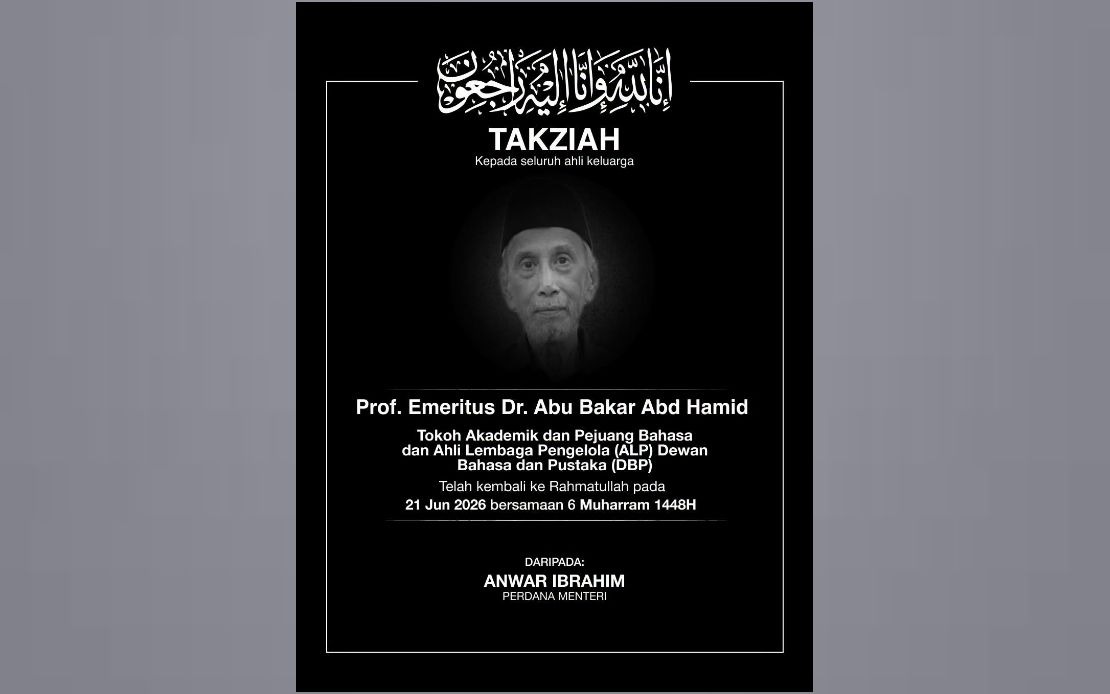
Prime Minister Datuk Seri Anwar Ibrahim has mourned the passing of Professor Emeritus Datuk Abu Bakar Abd Hamid, one of Malaysia's most distinguished scholars in Malay literature, describing his death as a profound loss to the nation's intellectual community. Through a Facebook statement, Anwar reflected on the contributions of the 87-year-old academic, who passed away unexpectedly on June 21 at his residence in Petaling Jaya, Selangor, following a sudden respiratory episode around 10.30pm.
Abu Bakar's legacy extends across multiple institutional pillars of Malaysia's education and cultural sectors. The Johor-born scholar served as deputy vice-chancellor at Universiti Malaya during his tenure from 1987 onwards, a position that granted him substantial influence over academic policy and institutional direction during a formative period for Malaysian higher education. Beyond his administrative roles, Abu Bakar was instrumental in the foundational work that led to the establishment of Universiti Kebangsaan Malaysia, serving as joint secretary of the committee tasked with creating the institution in 1968. His fingerprints remain visible on the structure and mission of what would become one of the nation's flagship universities.
Anwar's personal connection to Abu Bakar adds a human dimension to the broader institutional tribute. As a former student of the late professor, Anwar reflected on the qualities that distinguished Abu Bakar as an educator and intellectual mentor. His statement emphasised not merely the technical expertise Abu Bakar commanded, but his unwavering commitment to fostering a love of learning among those around him. The Prime Minister characterised Abu Bakar as someone whose passion for knowledge transcended the formal boundaries of academic disciplines, positioning him as a role model whose influence shaped generations of Malaysian scholars and public figures.
The late scholar's public service extended into the media landscape at a crucial juncture in Malaysia's development. From 1996 to 2000, Abu Bakar chaired the Board of Governors of Bernama, the Malaysian National News Agency, during a period when the country's information infrastructure was consolidating its institutional independence and professional standards. This position reflected broader recognition of his standing across multiple sectors—education, literature, and media—a testament to the respect he commanded across institutional boundaries.
Throughout his career, Abu Bakar accumulated numerous accolades and recognitions for his scholarly contributions to Malay literature. While the specific awards are not enumerated in detail, his consistent recognition suggests he maintained scholarly productivity and intellectual relevance across multiple decades, navigating shifts in academic fashion and institutional priorities. Such longevity in the recognition of excellence is relatively rare, indicating both genuine intellectual substance and an ability to contribute meaningfully to evolving literary and academic discourse.
The significance of Abu Bakar's work should be contextualised within the broader trajectory of Malay literary scholarship. He represents a generation of scholars who helped establish the intellectual foundations for Malay-language literature and criticism at the highest academic levels. This period, coinciding with Malaysia's post-independence nation-building, positioned literary scholars like Abu Bakar as cultural architects, helping to define and institutionalise what would constitute the canonical Malay literary tradition. His contributions, therefore, extend beyond individual publications or studies to shape the very frameworks through which subsequent generations understand and analyse Malay letters.
Abu Bakar's involvement in establishing UKM carries particular significance for understanding the trajectory of Malaysian higher education. The late 1960s represented a pivotal moment when the nation sought to create institutions that would reflect indigenous intellectual priorities and foster research grounded in local contexts and concerns. The university that emerged from the committee work that Abu Bakar helped shepherd became an institution distinctly shaped by these principles, and his contributions to that foundational vision remain embedded in UKM's institutional identity and mission.
The Prime Minister's statement, while brief, reflects the manner in which Malaysia's political and intellectual leadership honours those whose contributions span multiple generations and institutions. Anwar's characterisation of Abu Bakar as both respected teacher and passionate advocate for knowledge suggests a figure whose influence operated through personal example and institutional role-modelling as much as through formal administrative authority. This mode of influence—cultivating intellectual culture through individual example—may represent one of Abu Bakar's most lasting legacies, rippling through networks of former students now positioned across Malaysia's academic, cultural, and political structures.
Abu Bakar was laid to rest at Bukit Kiara Muslim Cemetery on June 24, following customary observances. His death concludes a remarkably productive lifetime of intellectual and institutional service, marking the end of an era within Malaysia's literary scholarship and higher education sectors. The tributes from senior political figures underscore the recognition that figures like Abu Bakar occupy irreplaceable roles within the cultural and intellectual fabric of the nation, and their passing represents not merely individual loss but the closure of a generational chapter in Malaysia's ongoing development as a knowledge-based society.

