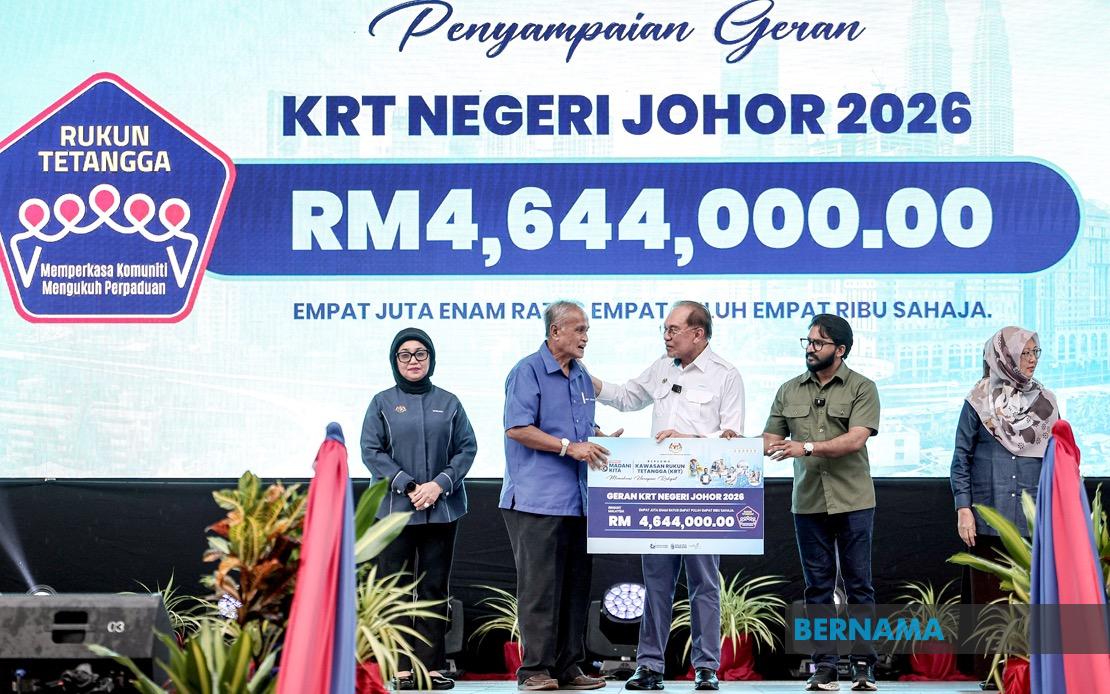
Prime Minister Datuk Seri Anwar Ibrahim has sanctioned a significant increase in annual funding for the country's Neighbourhood Watch Areas, lifting the grant from its long-standing RM6,000 ceiling to RM10,000 per unit. The enhanced allocation will take effect on January 1, 2027, marking the first substantial boost to these community-level organisations in a full decade. The announcement was made during the MADANI KITA Programme held at Dataran Segamat in Johor, attended by Deputy Minister of National Unity R. Yuneswaran and Deputy Minister of Domestic Trade and Cost of Living Datuk Dr Fuziah Salleh.
The stagnation of KRT funding at RM6,000 annually for ten years had increasingly become a concern for community leaders managing these grassroots institutions. These watches serve as crucial intermediaries between government agencies and residents, facilitating dialogue on security matters and neighbourhood welfare. The prolonged freeze on allocations had constrained their ability to undertake meaningful community projects and maintain operational capacity. The Prime Minister's decision acknowledges both the inflation-driven erosion of purchasing power and the rising demands placed on these volunteer-driven organisations to address contemporary community challenges.
Anwar emphasised that the KRT system plays an indispensable role in preserving the nation's social fabric by nurturing the spirit of muafakat—consensus and collective decision-making—alongside democratic participation and national unity. He characterised these watch groups as essential partners in helping security forces and government departments navigate grassroots-level issues that directly impact public safety and community cohesion. The increased funding is contingent on KRT units maintaining transparent reporting on their development initiatives and activities, establishing clear accountability measures for the disbursed funds.
The Prime Minister used the Segamat event to reinforce a broader message about Malaysia's foundational strength, rooted in its ability to sustain harmony across its ethnically and religiously diverse population since independence. He cautioned against weaponising differences in race, culture, and religion as divisive forces, instead framing this pluralism as a distinctive national asset that should be celebrated and protected. This framing reflects the government's emphasis on preserving social cohesion amid occasional communal tensions and polarisation witnessed across the region.
Beyond the KRT grant announcement, Anwar unveiled an immediate allocation of RM3.205 million for critical infrastructure repairs at Islamic educational institutions throughout Johor. The funding targets sixteen separate projects encompassing religious schools, madrasahs, learning centres, and Quranic memorisation facilities across districts including Batu Pahat, Muar, and Segamat. These upgrades prioritise enhancing the physical learning environment for students by addressing maintenance backlogs and facility deficiencies that had accumulated over time. The initiative reflects the government's commitment to strengthening the Islamic education sector, which serves tens of thousands of Malaysian students and contributes significantly to religious knowledge transmission and moral development.
The allocation underscores recognition that adequate facilities are integral to effective educational delivery, particularly in religious institutions where students often dedicate substantial time to intensive study programmes. By investing in infrastructure upgrades at these premises, the government aims to create more conducive study spaces that support both academic and spiritual development. For many students in Johor's Islamic educational ecosystem, improved facilities translate directly into enhanced learning outcomes and a more supportive institutional environment.
Additionally, Anwar approved RM1.0 million in immediate funding for essential and urgent maintenance work at Royal Malaysian Police quarters across Johor. This financial commitment acknowledges the necessity of maintaining adequate living conditions for law enforcement personnel who shoulder the responsibility of safeguarding national security and public order. The Prime Minister framed facility upgrades for security forces as integral to preserving their welfare and morale, recognising that adequate accommodation and working conditions are prerequisites for sustaining operational effectiveness and personnel retention.
These three distinct funding announcements—totalling over RM4.2 million—reflect a broader strategic approach prioritising grassroots community engagement, educational infrastructure, and security sector support. The KRT grant increase particularly resonates with efforts to decentralise governance and empower local communities to participate actively in addressing neighbourhood-level challenges. By strengthening watch groups' financial capacity, the government signals confidence in bottom-up community action as a complement to top-down security measures.
For Malaysian policymakers and community leaders, the KRT enhancement carries several implications. The RM4,000 increase—representing a 67 percent boost—substantially improves these organisations' ability to fund awareness campaigns, conduct training programmes, and undertake community development projects. Given that KRTs typically operate on tight volunteer-driven budgets, this funding expansion could catalyse greater activity levels and more ambitious community initiatives. However, the effectiveness of this investment will depend on how individual watch groups utilise the additional resources and whether adequate oversight mechanisms prevent misallocation.
The timing of disbursement—beginning January 1, 2027—provides planning certainty for KRT leadership and allows sufficient preparation time for programme development. This staggered implementation approach differs from immediate allocation, suggesting the government's intention to phase the funding in rather than create abrupt administrative disruptions. KRT coordinators nationwide will have months to develop spending plans and identify priority projects, maximising the developmental impact of the increased allocations.
Within the broader Southeast Asian context, Malaysia's approach of channelling development funding through grassroots community organisations reflects contemporary best practices emphasising local ownership and participatory governance. Many regional governments increasingly recognise that sustainable development and social stability emerge from empowering community-level actors rather than relying exclusively on centralised mechanisms. The KRT model, as enhanced through this funding decision, exemplifies this philosophy by positioning neighbourhood watch groups as key partners in advancing multiple development objectives simultaneously—from security enhancement to community cohesion to local infrastructure improvement.
The announcements collectively demonstrate the government's multi-dimensional approach to social stabilisation and community welfare. Rather than concentrating resources in single sectors, the strategy disperses investments across community policing infrastructure, Islamic education, and security personnel support, acknowledging that durable stability requires simultaneous attention to multiple institutional pillars. For Malaysian residents, particularly those in Johor where these announcements were made, the tangible outcomes should emerge progressively as KRT units activate expanded programmes, Islamic schools complete facility upgrades, and police personnel benefit from improved quarters.

