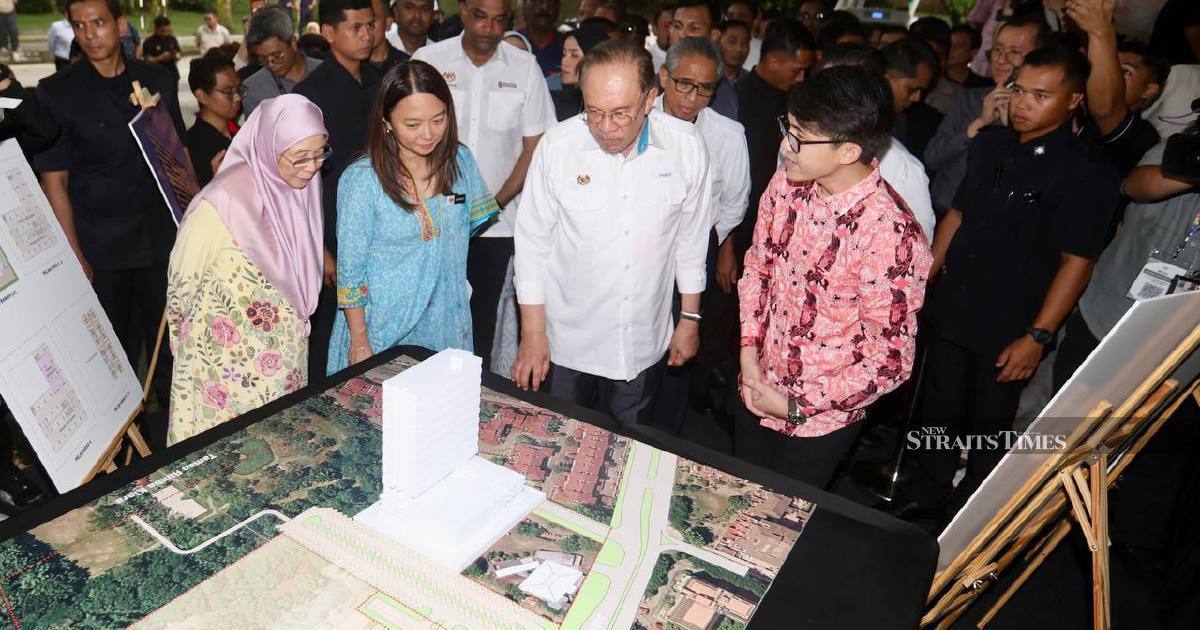
Prime Minister Datuk Seri Anwar Ibrahim has rejected contentions that his government has deprioritized the welfare of urban poor Malaysians, asserting instead that recent initiatives demonstrate a genuine commitment to advancing their opportunities and living standards. The Prime Minister's remarks come amid ongoing national discourse concerning housing affordability, employment prospects, and social mobility for lower-income households in major urban centres across the country.
The Bukit Kiara project, which has become central to the government's messaging on urban poverty alleviation, serves as the administration's flagship illustration of how development policies can simultaneously accommodate economic progress and protect vulnerable populations. By elevating this particular initiative in his defence, Anwar seeks to establish a tangible connection between policy rhetoric and implementation, offering citizens concrete evidence of programme outcomes rather than relying solely on political assertions.
For Malaysian policymakers, the tension between urban development and the needs of low-income communities represents a persistent challenge. Rapid urbanization and property sector expansion frequently create pressure on governments to prioritize investment flows and economic growth metrics, sometimes at the apparent expense of existing communities. The Prime Minister's intervention suggests awareness that public perception of government priorities has become strained, necessitating direct communication about the balance being struck.
The Bukit Kiara venture carries particular significance because it operates at the intersection of multiple policy objectives: addressing urban housing shortages, regenerating specified areas, and ensuring displaced or affected residents maintain pathways to stability. How such projects integrate safeguarding mechanisms—whether through affordable housing quotas, relocation assistance, employment provisions, or community engagement protocols—determines whether development genuinely benefits the urban poor or merely sidelines their concerns through incremental displacement.
Anwar's emphasis on this specific project reflects a broader governmental strategy to demonstrate social consciousness within capitalist economic frameworks. Rather than fundamentally questioning whether market-driven development inherently disadvantages lower-income populations, the approach emphasizes mitigation and targeted intervention, portraying the government as a moderating force ensuring markets deliver inclusive outcomes. This positioning carries implications for how Malaysian voters evaluate the administration's economic philosophy and priorities.
The urban poor constituency represents a politically significant demographic in Malaysia's major cities, where housing costs, transportation expenses, and cost-of-living pressures consume disproportionate income shares compared to wealthier households. Political formations competing for urban electoral support increasingly emphasize their commitment to this constituency, understanding that perceptions of neglect or exclusion can reshape voting patterns. Anwar's defensive posture suggests his coalition recognizes potential vulnerability on this front.
From a Southeast Asian perspective, Malaysia's approach to balancing urban development with low-income protection offers comparative insight into how regional governments navigate similar pressures. Indonesia's Jakarta, Thailand's Bangkok, and the Philippines' Metro Manila all grapple with rapid urbanization and affordable housing deficits. How Malaysian administrations design and implement solutions may influence regional policy thinking and set benchmarks against which other governments measure their own commitments.
The credibility of such claims ultimately depends on measurable implementation outcomes. Housing completions, occupancy rates among target demographics, employment generation for project participants, and community satisfaction surveys provide empirical grounds for evaluating whether assertions about protecting urban poor interests translate into lived reality. Without transparent data and independent verification, reassurances risk appearing performative rather than substantive.
Moving forward, the government's ability to demonstrate consistent commitment to urban poor advancement across multiple initiatives—not merely flagship projects—will shape public perception more powerfully than individual defences. Systemic challenges including minimum wage adequacy, housing affordability indices, and economic mobility require sustained policy attention rather than episodic project-based responses. How comprehensively the administration addresses these structural issues will determine whether contemporary development patterns genuinely benefit Malaysia's lower-income urban populations or reproduce existing inequalities through incremental mechanisms.
The Bukit Kiara project thus carries significance extending beyond its immediate geographic and demographic scope. It functions as a litmus test for broader governmental commitment to inclusive development, a symbol upon which broader political judgments about administration priorities ultimately rest. For Malaysian voters, particularly those struggling economically in urban centres, evaluating such claims requires examining both specific project mechanics and the wider policy ecosystem surrounding urban poverty reduction.