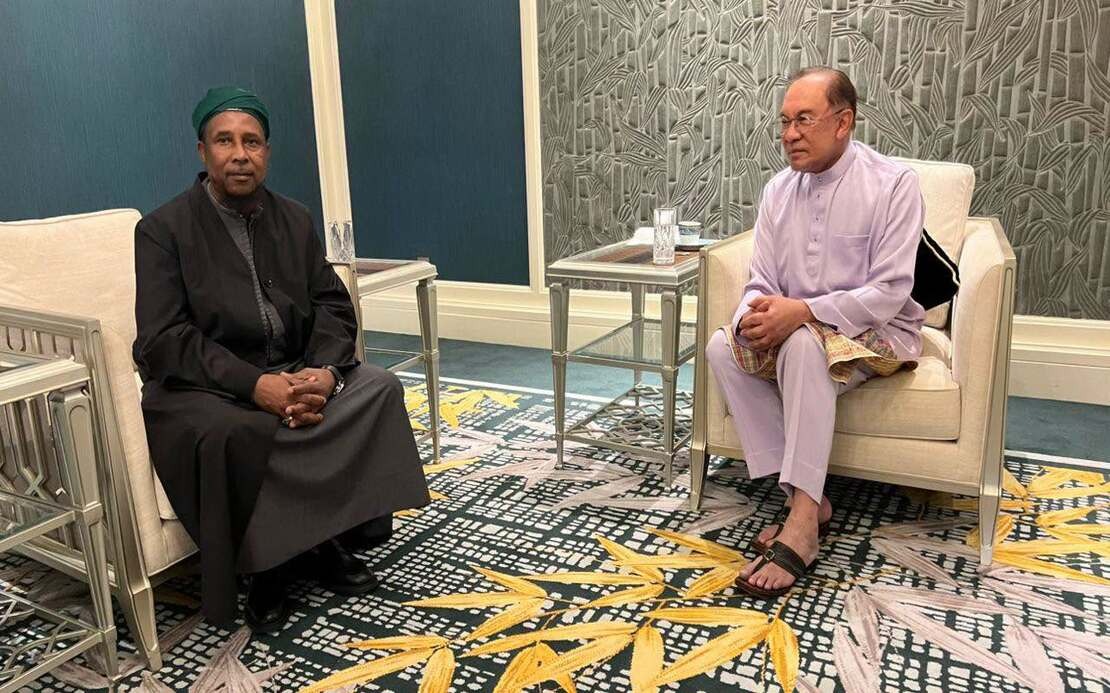
Prime Minister Datuk Seri Anwar Ibrahim formally received Gambian Islamic scholar Sheikh Muhammad Haydara Al-Jilani on June 26 as the visiting religious figure prepared to depart Malaysia after a month-long engagement across the country. The meeting, marked by its spiritual and diplomatic significance, highlighted the deepening connections between Malaysia and the broader Islamic world, particularly through grassroots religious education and interfaith understanding initiatives.
Sheikh Muhammad Haydara Al-Jilani had utilised his extended stay to conduct an extensive series of knowledge-sharing sessions and dhikr programmes—spiritual recitation gatherings central to Islamic devotional practice—at multiple locations throughout Malaysia. These activities represented more than ceremonial visits; they constituted a substantive effort to foster Islamic scholarship and community engagement across diverse Malaysian Muslim populations, from urban centres to regional areas.
The timing of the farewell audience carried additional resonance, coinciding with the Day of Ashura, a significant date in the Islamic calendar observed on the 10th of Muharram. This convergence was deliberate rather than coincidental, allowing the Prime Minister to leverage the occasion for spiritual reflection and communal prayers. During the meeting, Anwar requested that Sheikh Al-Jilani offer prayers specifically for Malaysia's continued prosperity, national peace, and the well-being of all Malaysian citizens.
Through his official Facebook statement, the Prime Minister articulated a vision of Malaysia as a nation deserving of divine blessing and protection. The phrasing reflected both personal piety and official recognition of Islam's institutional role in Malaysian public life, emphasising that national prosperity and social cohesion depend upon spiritual foundations and collective religious observance. Such sentiments resonate with Malaysia's constitutional framework, which recognises Islam as the federation's religion while protecting freedom of worship for other communities.
Sheikh Al-Jilani's month-long dakwah programme—dakwah referring to Islamic religious outreach and proselytisation—demonstrated the continued vitality of knowledge transfer between established Islamic centres and the Malaysian Muslim community. The Gambian scholar brought perspectives from West African Islamic traditions, enriching local understanding of Islamic jurisprudence, Quranic interpretation, and spiritual practice. For Malaysian Muslims, exposure to international Islamic scholarship reinforces the religion's universality while connecting local observance to global traditions.
The visit illustrates Malaysia's role as a hub for Islamic learning and dialogue within Southeast Asia. As a Muslim-majority nation with sophisticated Islamic institutions, Malaysia regularly hosts international religious scholars and facilitates knowledge-sharing programmes that elevate the intellectual discourse around Islamic teaching. Such exchanges also strengthen Malaysia's soft power in the Islamic world, positioning it as an intellectually engaged and spiritually committed member of the global Muslim community.
From a diplomatic perspective, hosting visiting Islamic scholars serves multiple purposes. It demonstrates Malaysia's openness to international engagement, particularly with African nations and the broader Organisation of Islamic Cooperation constituency. These interactions build relationships that extend beyond formal governmental channels, creating networks of religious scholars and community leaders who shape public opinion and cultural attitudes across borders. Gambia, as a West African Muslim-majority nation, represents an important constituency in global Islamic politics and development initiatives.
The farewell meeting also underscores how Malaysian political leadership, particularly Prime Minister Anwar, integrates Islamic values into public governance and national messaging. By personally receiving the visiting scholar and explicitly seeking prayers for the nation, Anwar demonstrates commitment to faith-based leadership while affirming that Malaysia's stability and progress rest upon spiritual as well as material foundations. This approach appeals to Malaysia's religiously conscious electorate while maintaining the secular constitutional framework that guarantees religious freedom.
The structured nature of Sheikh Al-Jilani's visit—with predetermined locations, coordinated gatherings, and official government acknowledgment—reflects Malaysia's sophisticated approach to managing religious activities and international Islamic engagement. Rather than allowing ad-hoc religious gatherings, the system ensures that knowledge-sharing occurs within recognised frameworks, maintains security and order, and aligns international Islamic engagement with broader foreign policy objectives. This institutionalisation of religious exchange demonstrates how modern Muslim-majority nations navigate between openness to Islamic scholarship and state governance concerns.
Looking forward, Sheikh Al-Jilani's departure marks the conclusion of one engagement but likely signals the beginning of sustained intellectual exchange between Malaysian and Gambian Islamic communities. The relationships forged during such visits often continue through correspondence, collaborative publications, and invitations for Malaysian scholars to visit Gambia. These networks contribute to a richer Islamic intellectual ecosystem across Africa and Asia, encouraging cross-continental dialogue on contemporary Islamic issues.
The meeting ultimately reflects the multifaceted nature of contemporary Islamic practice and state policy in Malaysia. Religious scholarship, diplomatic engagement, national spirituality, and public governance converge in these carefully orchestrated encounters. Prime Minister Anwar's personal involvement signals that Islamic knowledge and spiritual well-being rank among his administration's priorities, while the international dimension emphasises Malaysia's commitment to participating meaningfully in global Islamic discourse and maintaining strong relationships with Muslim-majority nations across continents.

