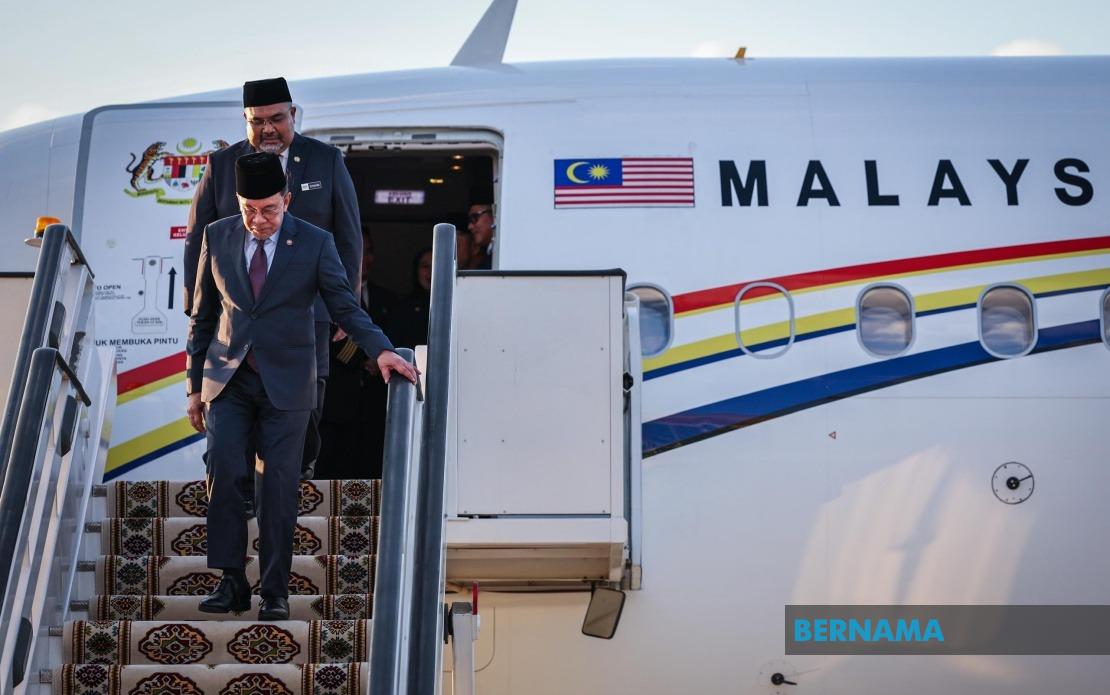
Prime Minister Datuk Seri Anwar Ibrahim touched down in Ashgabat on Monday evening to begin a two-day official visit to Turkmenistan, marking an important diplomatic engagement for Malaysia in Central Asia. The aircraft carrying the prime minister landed at Ashgabat International Airport at 8 pm local time, completing the second leg of his extended tour through the region after concluding a working visit to Kazan in the Republic of Tatarstan. The timing of the visit demonstrates Malaysia's strategic focus on deepening connections with energy-rich nations beyond Southeast Asia, at a moment when diversifying partnerships has become increasingly important for regional stability and economic growth.
Anwar was accompanied by a high-level delegation that underscores the economic dimensions of the visit. Minister of Investment, Trade and Industry Datuk Seri Johari Abdul Ghani and Minister of Economy Akmal Nasrullah Mohd Nasir travelled alongside the prime minister, signalling that trade negotiations and commercial opportunities will feature prominently in the bilateral discussions. Officials from the Prime Minister's Office and the Foreign Ministry completed the entourage, reflecting the comprehensive nature of diplomatic engagement that Malaysia intends to advance during these two days.
The visit comes at the invitation of Turkmenistan President Serdar Berdimuhamedov and represents a reciprocal gesture following the Turkmenistan leader's official visit to Malaysia in December 2024. This represents Anwar's maiden official visit to Turkmenistan as prime minister and marks only the fifth such visit by a Malaysian prime minister to the country, highlighting the relative rarity and significance of this bilateral engagement at the highest level.
Upon arrival, Anwar received a formal welcome from Malaysia's Ambassador to Turkmenistan Mohd Suhaimi Ahmad Tajuddin, while the Turkmenistan government delegation was represented by Guvanch Agajanov, Deputy Chairman of the Cabinet of Ministers for Oil and Gas. The composition of the welcoming committee from Turkmenistan's side indicates that energy and resource sectors will likely dominate the substantive discussions, reflecting both nations' commercial interests in these domains.
The programme for the remainder of Monday centred on cultural and diaspora engagement, with Anwar scheduled to attend a dinner reception with members of the Malaysian community and supporters of Malaysia-Turkmenistan relations. Such events serve dual purposes in diplomatic missions, allowing the prime minister to connect with citizens abroad while also facilitating informal networking that often yields valuable insights for official negotiations.
Tuesday's schedule has been structured to maximise bilateral engagement and demonstrate mutual respect between the two nations. The day will commence with a formal welcoming ceremony at the Presidential Palace hosted by President Berdimuhamedov, followed by a one-on-one meeting that provides space for confidential discussions on strategic matters. Bilateral talks will then proceed, where both governments are expected to sign a joint statement and exchange agreements and memoranda of understanding that have been previously negotiated by their respective teams.
The religious and cultural dimensions of the visit will receive attention when Anwar performs Friday prayers at the Turkmenbashi Ruhy Mosque, known locally as the Gypjak Mosque. This act carries symbolic weight in Muslim-majority nations and demonstrates Malaysia's respect for Turkmenistan's Islamic heritage, fostering goodwill beyond the strictly commercial sphere.
Economically, the relationship between Malaysia and Turkmenistan carries substantial weight that justifies high-level engagement. In 2025, Turkmenistan ranked as Malaysia's fourth-largest trading partner among Central Asian nations, with bilateral trade totalling RM75.80 million. Malaysian exports to Turkmenistan reached RM75.50 million, representing a notable nine per cent increase from the previous year. These figures, while seemingly modest compared to Southeast Asian trade volumes, indicate a growing trajectory that policymakers in Kuala Lumpur are keen to accelerate through direct engagement.
Petroliam Nasional Bhd, Malaysia's national oil company, has emerged as a major economic actor in Turkmenistan, representing the deepest manifestation of Malaysia's business interests in the country. Petronas has accumulated investments reaching RM52.73 billion in Turkmenistan since beginning operations in 1996, making the energy firm an essential bridge between the two nations' economies. This long-standing commercial presence provides a foundation for broader economic cooperation that extends well beyond the oil and gas sector.
The timing of Anwar's visit reflects Malaysia's broader strategy of strengthening ties with Central Asian nations at a moment when global geopolitics remains fluid. Central Asia's energy resources, geographic position along historic trade routes, and increasingly sophisticated economic capabilities make the region a priority for nations seeking to diversify partnerships and reduce dependence on any single trading bloc. For Malaysia, engagement with Turkmenistan carries implications for its positioning within broader Asian networks and its ability to access energy supplies through alternative channels.
The Malaysia-Turkmenistan Forum that will be jointly inaugurated by Anwar and President Berdimuhamedov at the Chamber of Commerce and Industry of Turkmenistan provides a platform for business communities from both nations to explore concrete collaboration opportunities. Such forums often catalyse private sector engagement that extends well beyond what government-to-government agreements alone can achieve, potentially opening pathways for Malaysian companies in sectors ranging from manufacturing and services to infrastructure and technology.
As Anwar concludes his Central Asian tour with this Turkmenistan visit, the diplomatic mission encompasses broader regional ambitions. The visit demonstrates Malaysia's capacity and willingness to engage with nations beyond its traditional Southeast Asian focus, while simultaneously advancing tangible economic interests through Petronas and other Malaysian enterprises. The press conference scheduled for the conclusion of the visit will provide an opportunity for Anwar to articulate Malaysia's vision for deepened engagement with Turkmenistan and reflect on the outcomes achieved during these two days of intensive bilateral engagement.