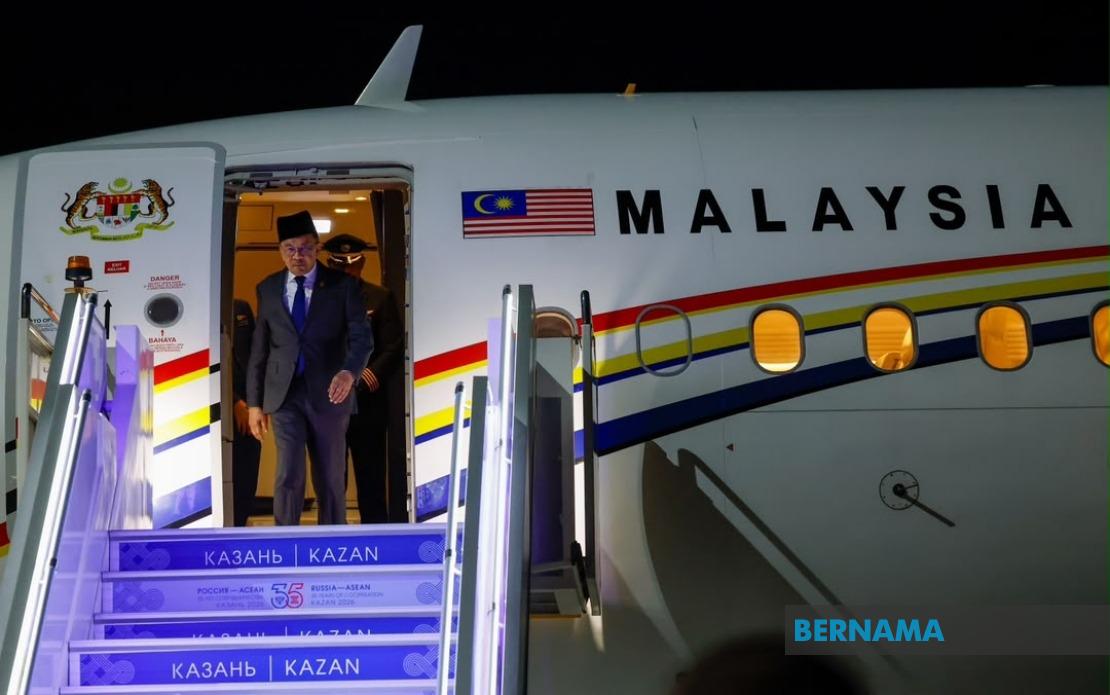
Prime Minister Datuk Seri Anwar Ibrahim touched down in Kazan on Sunday evening for a two-day working visit that will see him participate in the ASEAN-Russia Commemorative Summit scheduled for June 17-18. The aircraft carrying Malaysia's premier landed at Kazan International Airport at 10.20 pm local time, marking his arrival in the capital of Russia's Republic of Tatarstan ahead of high-level diplomatic engagements with regional and Russian officials.
The delegation accompanying Anwar reflects the economic and strategic significance of the visit. Alongside him were Minister of Investment, Trade and Industry Datuk Seri Johari Abdul Ghani and Minister of Economy Akmal Nasrullah Mohd Nasir, indicating that trade and investment discussions will form a core element of the working visit. Senior officials from the Prime Minister's Office and the Foreign Ministry completed the entourage, underscoring the whole-of-government approach Malaysia has adopted in managing its relationship with Russia and the broader ASEAN-Russia partnership framework.
Anwar's reception demonstrated the ceremonial importance accorded to the Malaysian delegation. Malaysia's Ambassador to Russia Datuk Cheong Loon Lai welcomed the prime minister, while the Russian side fielded a high-level welcoming committee that included the Minister of Digital Development of Tatarstan Ilya Nachvin, Kazan Mayor Ilsur Metshin, and protocol officials. This level of formal courtesy signals Moscow's commitment to maintaining robust engagement with ASEAN members, particularly Malaysia, which continues to play a bridging role within the Southeast Asian bloc.
The summit itself carries considerable symbolic weight for both parties. The gathering marks the 35th anniversary of ASEAN-Russia relations, which were formally established in Kuala Lumpur in 1991. Three and a half decades of diplomatic engagement have witnessed considerable evolution in ties, from Cold War-era suspicions to contemporary partnership frameworks that increasingly reflect shared regional and global interests. The Commemorative Summit provides an appropriate moment for both sides to reflect on achievements and recalibrate priorities for the next phase of cooperation.
The scope of planned discussions extends across multiple domains critical to Southeast Asian development and security. Officials have indicated that conversations will encompass trade and investment opportunities, energy cooperation, food security initiatives, digital economy advancement, science and technology collaboration, cultural exchanges, educational partnerships, and people-to-people engagement. For Malaysia specifically, energy cooperation and food security represent particularly salient concerns given the country's growing energy requirements and its vulnerability to global supply chain disruptions affecting agricultural imports.
Four major outcome documents are anticipated to emerge from the summit, collectively shaping the trajectory of ASEAN-Russia ties through 2030. The Kazan Declaration commemorating 35 years of relations will establish the political foundation, while the Joint Statement on Energy Cooperation addresses one of the region's most pressing needs. Additional accords covering cultural collaboration and a comprehensive implementation plan for the ASEAN-Russia Strategic Partnership 2026-2030 will provide operational guidance for the period ahead. These documents are intended to create scaffolding for sustained engagement across numerous sectors, building institutional resilience into the partnership.
From Malaysia's perspective, participation in this summit underscores the government's commitment to safeguarding ASEAN Centrality, the overarching principle that the Southeast Asian bloc should drive regional diplomacy rather than being shaped by external powers. By maintaining active engagement with Russia as a Dialogue Partner, Malaysia reinforces ASEAN's position as a forum capable of engaging multiple global actors without surrendering agency or independence. In an international environment marked by rising great power competition, this balancing act has become increasingly delicate and consequential.
Anwar's schedule in Kazan includes bilateral meetings with Russian President Vladimir Putin and with the Rais of the Republic of Tatarstan, alongside separate engagements with ASEAN counterparts. These conversations will address bilateral relations and matters of mutual concern, though Malaysia's stated focus areas—dialogue and peace advocacy, economic resilience promotion, energy and food security advancement, and deepening interpersonal connections—suggest a deliberate emphasis on pragmatic, development-oriented outcomes rather than geopolitical confrontation.
This Kazan visit represents Anwar's third journey to Russia since assuming office in November 2022, demonstrating the frequency with which bilateral engagement occurs at the highest level. His previous trips included attendance at the Eastern Economic Forum in Vladivostok in September 2024 and an official visit to Moscow in May 2025. During the Moscow visit, Anwar held substantive discussions with Putin covering trade expansion, investment facilitation, agricultural cooperation, educational exchanges, aerospace collaboration, and energy development. The pattern of successive visits suggests that neither government views the relationship as perfunctory, but rather as deserving continuous high-level attention.
For Malaysian observers and policymakers, Anwar's trajectory of engagement with Russia offers insight into how the government is navigating international relations during an epoch of geopolitical polarisation. Rather than aligning unequivocally with any particular bloc, Malaysia continues to cultivate working relationships with multiple powers, including Russia, while simultaneously maintaining core partnerships with traditional allies in the West and strengthening ties throughout Asia. This non-aligned posture, a legacy of Malaysia's founding principles, remains operationally viable primarily through consistent, serious-minded engagement of the sort exemplified by these regular high-level visits.
The summit's emphasis on practical cooperation areas—trade, energy, technology, culture—rather than military or security alliances reflects a shared interest between ASEAN and Russia in advancing concrete benefits for respective populations and economies. Energy cooperation is particularly significant for Malaysia and Southeast Asia more broadly, as the region seeks to balance decarbonisation imperatives with energy security and economic competitiveness. Similarly, digital economy advancement and technology collaboration align with Malaysia's broader Vision 2050 development agenda and efforts to position the country as a regional technology hub.
The timing of the summit, occurring amid sustained global uncertainties including geopolitical tensions and economic volatility, lends additional relevance to the partnership's renewal. Both ASEAN and Russia have compelling reasons to deepen economic interdependencies and institutional cooperation mechanisms that can weather international fluctuations. For Malaysia, leveraging these partnership frameworks to advance national development objectives while simultaneously strengthening ASEAN's collective voice represents a dual strategic imperative that Anwar's presence in Kazan exemplifies.