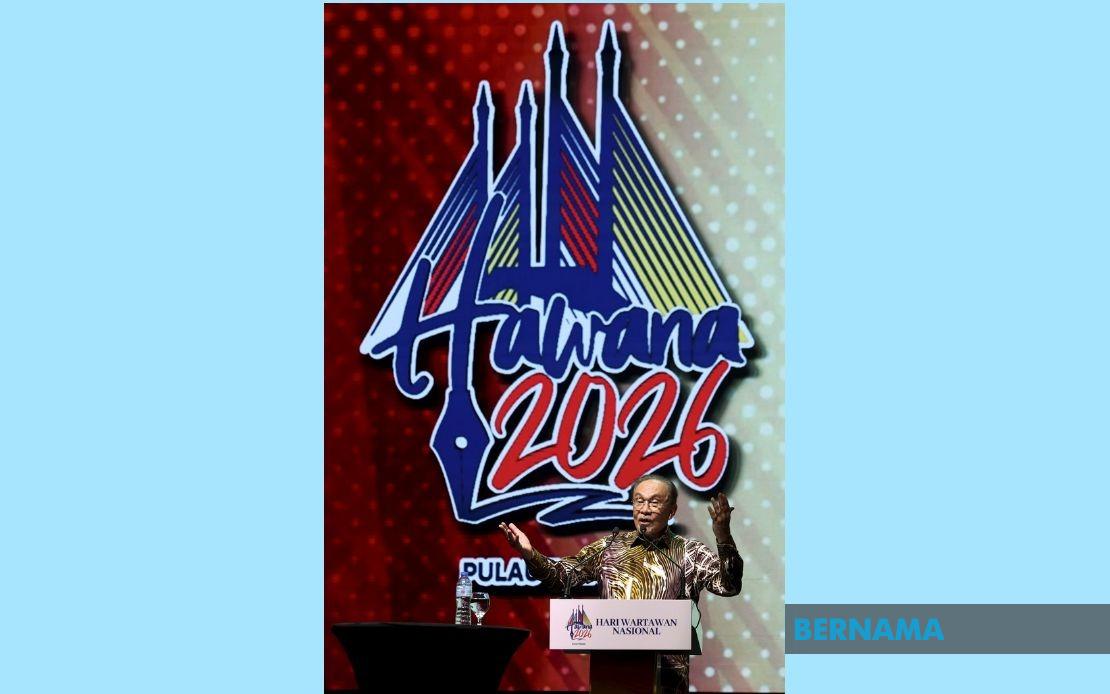
Prime Minister Datuk Seri Anwar Ibrahim has announced a fresh RM1 million injection into the Tabung Kasih@HAWANA welfare fund, reinforcing the federal government's commitment to supporting media workers facing financial challenges. The declaration came during his address at the National Journalists' Day (HAWANA) 2026 main event held at the PICCA Convention Centre in Butterworth on June 20, where the PM highlighted the growing importance of safeguarding the livelihoods of journalists and media professionals across the country.
The additional allocation represents a significant boost to a scheme that has already distributed RM2.26 million to 773 media practitioners since its inception. Speaking in his dual capacity as Finance Minister, Anwar framed the supplementary funding as a natural extension of the government's broader welfare agenda, describing it as an expression of "compassion and care" toward those working in the media sector. This positioning suggests the administration views media worker welfare as integral to its social safety net strategy, not merely a peripheral gesture.
Tabung Kasih@HAWANA was formally established in 2023 during that year's HAWANA celebrations with a specific mandate to address the economic vulnerabilities faced by journalists and former practitioners. The fund's scope is deliberately comprehensive, encompassing direct financial assistance, reimbursement for medical expenses, family welfare support, and other customised forms of aid. This multi-pronged approach recognises that media practitioners often face irregular income, insufficient health coverage, and other occupational hardships that distinguish their circumstances from conventional employment arrangements.
The HAWANA 2026 gathering itself attracted over 1,000 media professionals from Malaysia alongside international delegates from Timor-Leste, Cambodia, and Laos, underscoring the regional significance of Malaysia's media community and its connections across Southeast Asia. The event operated under the thematic framework of "Media Integrity Strengthens Credibility," a positioning that carries particular relevance given ongoing global concerns about journalism standards, misinformation, and the institutional pressures facing news organisations worldwide.
Among the senior officials present were Penang Chief Minister Chow Kon Yeow and Communications Minister Datuk Fahmi Fadzil, alongside various ministry officials and representatives from Malaysia's major media organisations. The participation of Communications Ministry leadership reflected the intergovernmental recognition that media welfare initiatives fall within the broader portfolio of efforts to strengthen journalism and information services. Bernama, Malaysia's national news agency, played a central organisational role, with its chairman Datuk Seri Wong Chun Wai and chief executive officer Datin Paduka Nur-ul Afida Kamaludin both prominent in proceedings.
For Malaysian readers and media professionals specifically, the announcement carries immediate practical implications. The RM1 million supplement represents tangible relief for journalists navigating an industry increasingly characterised by downsizing, wage pressures, and employment precarity. Given Malaysia's diverse media landscape spanning traditional print, broadcast, and digital outlets, the welfare fund provides a crucial safety net particularly for freelancers, contractors, and workers at smaller publications who typically lack access to formal corporate benefits.
The timing of the announcement also warrants consideration within Malaysia's broader media ecosystem. The government has in recent years sought to strengthen its relationship with the journalism community through various policy initiatives and funding mechanisms. By maintaining and expanding the Tabung Kasih@HAWANA even as media organisations themselves face economic headwinds, the administration signals sustained investment in journalism as a public good worthy of state support.
Regionally, Malaysia's welfare approach to media professionals reflects a broader Southeast Asian trend of governments recognising journalism as an essential service deserving protection. As misinformation proliferates and news organisations struggle financially across the region, initiatives like Tabung Kasih@HAWANA represent attempts to sustain professional journalism standards by ensuring practitioners can maintain reasonable economic security. This matters not only for Malaysian readers reliant on quality news but for the broader information environment across ASEAN.
The fund's expansion also highlights challenges facing the media sector that extend beyond Malaysia's borders. International media organisations, national outlets, and digital news platforms across Southeast Asia contend with declining advertising revenues, subscription model difficulties, and platform competition that has fundamentally altered journalism economics. By bolstering welfare provisions, governments can partially offset these structural pressures, though such measures remain insufficient without accompanying reforms to media business models and digital information markets.
Looking forward, the adequacy of RM1 million in additional annual allocation likely depends on both the scale of demand among eligible practitioners and the effectiveness of the application and assessment processes. The fund's track record suggests relatively robust uptake, with nearly 800 practitioners assisted within three years of launch. As media employment continues evolving and new categories of media workers emerge, particularly in digital and online journalism, the fund's administration may require periodic reassessment to ensure eligibility criteria remain contemporary and inclusive.
The PM's announcement ultimately reflects a recognition that journalism, despite its perceived challenges and controversies, remains a profession deserving institutional protection. In an era of digital disruption, economic uncertainty, and evolving media consumption patterns, welfare provisions for media workers represent an investment in the infrastructure of informed citizenship. Whether such measures prove adequate to sustain high-quality journalism in Malaysia remains an ongoing question, but their existence signals governmental acknowledgment of journalism's societal value.

