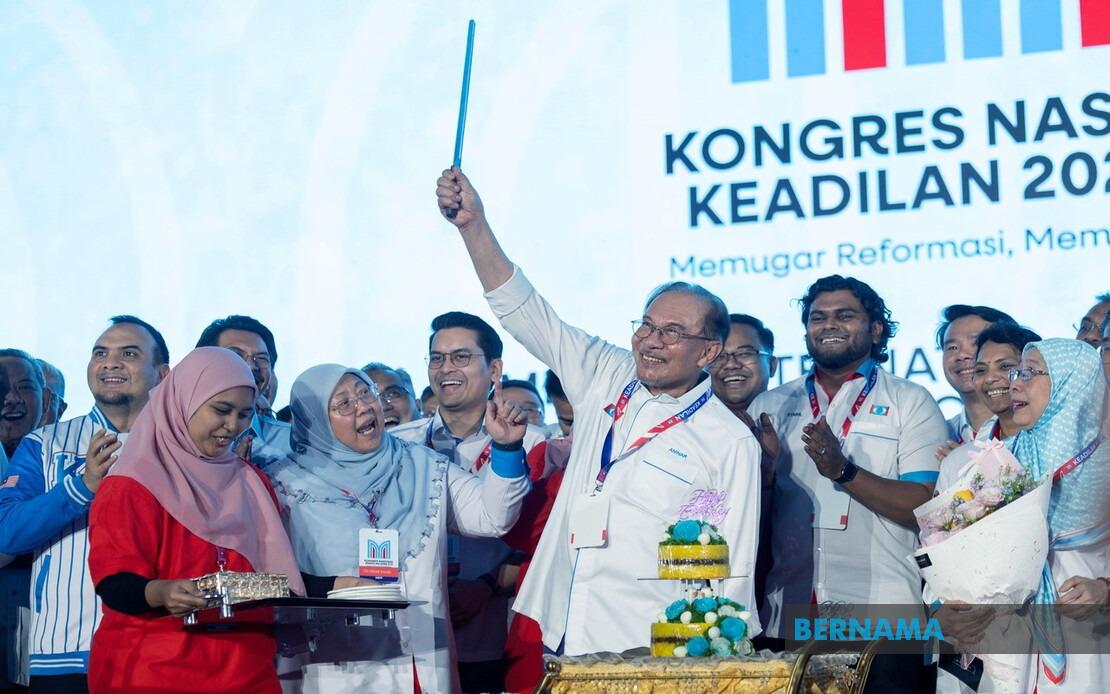
The PKR National Congress 2026 concluded in Melaka with party leaders presenting a carefully calibrated message: the coalition will remain steadfast in supporting the Unity Government framework while continuing to champion the reforms that have defined the party's identity since its establishment. PKR president Datuk Seri Anwar Ibrahim used his closing remarks to underscore this delicate balance, framing the party's participation in government not as a departure from core principles but as an opportunity to advance them from within the corridors of power.
Anwar's positioning reflects the complex political terrain that PKR navigates as a member of both the governing coalition and the opposition-origin Pakatan Harapan bloc. During the congress, he committed to defending the Unity Government arrangement—the controversial alliance between the long-ruling Barisan Nasional, Pakatan Harapan, and other coalition partners—as a vehicle for delivering economic growth and prosperity. Yet he also acknowledged a crucial reality: the sustainability of this arrangement depends substantially on UMNO and Barisan Nasional's commitment to the partnership. This acknowledgment serves as both an assurance to PKR's grassroots supporters and a gentle reminder to coalition partners about mutual accountability.
A significant portion of the congress agenda addressed concerns that PKR might lose its reformist edge through prolonged government participation. The party has long positioned itself as an agent of change within Malaysia's political system, and this self-identity remains central to its appeal among urban voters and younger Malaysians. PKR deputy president Nurul Izzah Anwar articulated this concern directly, arguing that the reform agenda cannot become dormant simply because the party now holds ministerial portfolios. She identified specific achievements—particularly the repeal of the Universities and University Colleges Act 1971—as evidence that meaningful reforms remain achievable within a government context, not merely from opposition benches.
The AUKU question itself illustrates both the progress PKR claims and the ongoing tensions within the coalition. Anwar provided explicit assurance that the government will not introduce replacement legislation that might curtail student activism and campus freedoms, positioning this stance as a victory for reform-minded governance. His commitment to raise the matter at Cabinet level suggests ongoing negotiations within the coalition on this sensitive issue. The decision to rely on existing criminal laws rather than restrictive student-specific legislation represents a philosophical shift in how the government approaches campus management, though critics may argue the distinction remains largely semantic given Malaysia's expansive sedition and security laws.
Beyond institutional questions of stability, the congress revealed PKR's concern with organisational readiness and political contingency planning. Party leaders explicitly stated that members should maintain preparedness for electoral contests or other political shifts without waiting for Parliament dissolution announcements. This messaging suggests internal acknowledgment of the coalition's fragility and the possibility of sudden political realignment. By emphasising organisational strength independent of electoral schedules, PKR is essentially hedging against the uncertainty that has characterised Malaysian coalition politics in recent years.
Gender representation in leadership emerged as another distinct priority during the congress sessions. PKR Wanita chief Fadhlina Sidek, who holds the influential Education portfolio, called for expanded space for women in decision-making roles within both party and government structures. This push reflects a broader recognition within PKR that demographic representation matters for legitimacy and policy responsiveness. Fadhlina also stressed the importance of institutional openness to criticism and feedback—a significant statement given Malaysian politics' traditional hierarchical structures. This emphasis on accepting scrutiny may reflect PKR's attempt to distinguish itself from older establishment parties often perceived as defensive and insular.
Among younger party members, the focus shifted toward economic and technological transformation. Angkatan Muda Keadilan highlighted strategic sectors including artificial intelligence, semiconductors, and biotechnology as areas where Bumiputera participation needs strengthening. This positioning acknowledges Malaysia's growing anxiety about technological competitiveness and economic relevance in the digital era. The youth wing also raised practical concerns affecting Generation Z workers—gig economy recognition, social protection gaps, skills development, and mental health support. These issues reflect evolving labour market realities that older policy frameworks struggle to address, and PKR's attention to them suggests recognition that maintaining youth support requires tangible responses to their actual economic circumstances.
The congress ultimately presented PKR as an organisation attempting to navigate a fundamental tension in Malaysian politics: how a party born from reform movements can remain credibly reformist while holding executive power within a coalition government that includes parties and politicians associated with the old political order. The messaging from this congress suggests PKR's strategy involves compartmentalisation—defending the coalition's political utility for stability while simultaneously claiming ownership of specific reforms and positioning itself as the conscience of the broader government arrangement.
For Malaysian observers and Southeast Asian analysts watching coalition dynamics, the congress demonstrated both the possibilities and limitations of consensus-based governance structures in Malaysia's polarised environment. PKR appears committed to making the Unity Government work, yet its explicit hedging about the arrangement's dependence on other parties' behaviour suggests the coalition remains conditional and potentially transient. The party's emphasis on reform credentials may reflect anxiety that prolonged association with an established power structure could erode its appeal, particularly among the urban middle-class and younger voters who have traditionally formed its electoral base. The congress thus functioned partly as reassurance to these constituencies that PKR's fundamental identity remains intact.

