The impeachment trial of Philippine Vice President Sara Duterte reached a critical juncture on Wednesday as her defence team launched a frontal challenge to the constitutional validity of the charges against her, contending that statements she made during a November 2024 online press briefing, while provocative, do not rise to the level of "other high crimes" that warrant removal from office under the 1987 Constitution. The legal strategy represents a fundamental dispute over what threshold conduct must cross to justify impeachment, reflecting deepening political divisions within the Philippine government that have implications for the entire region's democratic stability.
The defence focused its cross-examination of National Bureau of Investigation senior agent John Mark Calilung on dismantling the prosecution's narrative arc, which hinges on interpreting Duterte's public statements as evidence of an assassination plot. Defence counsel Mark Vinluan systematically challenged the evidentiary foundation, emphasizing that prosecutors had offered no documentation showing Duterte engaged a hired killer to eliminate President Ferdinand Marcos, his wife Liza Araneta-Marcos, or former House Speaker Martin Romualdez. The absence of concrete proof became the cornerstone of the defence strategy: if the video recordings do not demonstrate a completed or attempted murder contract, then interpreting them as such constitutes speculation rather than fact-finding.
Vinluan reframed Duterte's controversial November 23 remarks within a personal rather than governmental context, positioning the Vice President not as a state official abusing her position but as a family member responding to what the defence characterized as coordinated threats against her household. According to the defence narrative, Duterte had been subjected to what Vinluan described as unauthorized intelligence and surveillance operations by government agents, operations that exposed her extended family to genuine security risks and precipitated what the defence portrayed as justifiable anxiety and protective instinct. This recontextualization mirrors classical legal arguments that distinguish between statements made in an official capacity and those arising from personal distress, though applying such distinctions to a sitting Vice President invokes complex questions about when personal and governmental roles remain separable.
The defence introduced evidence regarding "Operation Romanov," presenting this alleged security threat as the immediate catalyst for Duterte's statements. Vinluan cited classified gazing reports purportedly documenting that Duterte's residences in both Davao and Manila had been profiled by state actors, and that security personnel loyal to the Vice President had been systematically removed. While the specific details of Operation Romanov remain classified, the defence's invocation of this program seeks to establish that Duterte's words emerged from verifiable concerns about her physical safety rather than from calculated malice or premeditated conspiracy. For Malaysian observers, this argument parallels domestic debates about security concerns and the boundaries of acceptable official speech, particularly in Southeast Asian democracies navigating tensions between executive power and institutional constraints.
The constitutional question animating the trial concerns the precise meaning of "other high crimes" in Article XI, Section 2 of the Philippine Constitution, a phrase that appears alongside more explicitly defined impeachable offences including treason, bribery, graft and corruption, and betrayal of public trust. The defence contended that Duterte's statements, even if ill-advised or intemperate, do not constitute high crimes in the constitutional sense because they lack the requisite elements of premeditation, state action directed toward criminal objectives, or abuse of official power for personal gain. This narrow interpretation of impeachable offences would substantially restrict the Senate's ability to remove an elected official for conduct deemed politically objectionable but not formally criminal.
The prosecution itself inadvertently bolstered the defence's constitutional argument when it acknowledged, during senator questioning by Risa Hontiveros on Tuesday, that Duterte's recorded remarks did not provide conclusive proof that she had actually contracted an assassin. Prosecution counsel Amando Ligutan instead framed the statements as part of a pattern demonstrating intent, a more speculative evidentiary standard that requires judges to infer criminal intent from public utterances rather than from overt criminal conduct. The defence seized upon this concession to argue that if the prosecution cannot prove the actual hiring of an assassin, then interpreting the statements as evidence of an assassination plot requires impermissible inferential leaps that exceed what the constitutional text contemplates.
The defence presented video evidence from the November 23 briefing itself, including footage of Duterte's chief of staff Zuleika Lopez, who was cited in contempt by the House investigating committee on that same day. According to the defence interpretation, Lopez's emotional breakdown during discussions of her planned transfer to a correctional facility in Mandaluyong City provided the temporal and emotional context that triggered Duterte's subsequent remarks. The defence team argued that Duterte's statements were not spontaneous threats but rather responses to what they characterized as systematic oppression of the Vice President and her staff by House representatives led by Joel Chua, who now sits among the impeachment prosecutors. This conflation of prosecution and persecution, if accepted, would frame the impeachment itself as a continuation of alleged political harassment rather than as a neutral constitutional process.
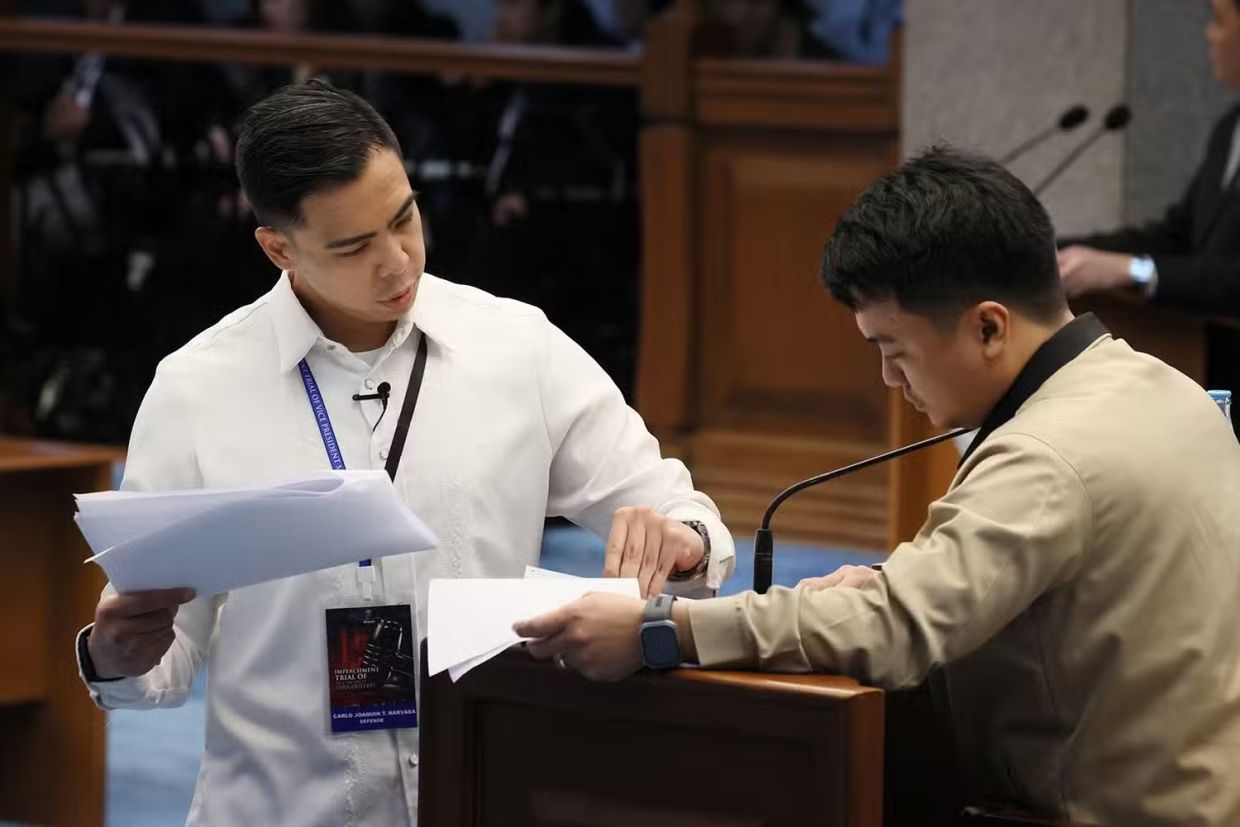
Defence lawyer Carlo Narvasa challenged the investigative methodology employed by the National Bureau of Investigation, noting that the agency conducted its inquiry motu proprio, meaning without a formal criminal complaint filed by the alleged victims. Significantly, Narvasa highlighted that neither President Marcos, First Lady Araneta-Marcos, nor former Speaker Romualdez had personally appeared before the NBI to provide sworn statements regarding the alleged threats. Calilung acknowledged under cross-examination that he possessed no personal knowledge of any of the three targeted individuals filing criminal complaints, and that the agency's revised affidavit from February 10, 2025, conspicuously lacked statements from the offended parties or from journalists who attended the press briefing. This evidentiary void becomes crucial: a prosecution case depends partly on the testimony and verification of the persons allegedly threatened, and their apparent distance from the investigative process raises questions about whether the threats were perceived as serious enough to warrant official complaint.
The questioning of Calilung exposed structural weaknesses in the prosecution's investigative foundation that the defence team systematically exploited. When Narvasa pointedly asked "Did you really investigate this case?" the prosecution objected before the witness could respond, preventing what might have been a damaging admission. Calilung subsequently explained that he executed an affidavit attesting to minutes from investigators' interviews rather than conducting the investigation himself, effectively establishing that his testimony derived from compiled reports rather than from direct evidence-gathering. He added that the NBI complied with Department of Justice requirements and secured a certification regarding the sufficiency of its preliminary investigation, but this bureaucratic compliance does not necessarily establish the investigative rigor that constitutional impeachment proceedings arguably demand.
Senator Francis Escudero, presiding over the impeachment court, intervened to redirect questioning when discussions became excessively abstract, noting that counsel should not pose questions requiring legal conclusions—such determinations belong to closing arguments and judicial deliberation. When Senator Hontiveros asked whether the defence contended that grave threats could be justified if legitimate reasons motivated them, Narvasa declined to adopt that position, instead maintaining that the conduct at issue did not constitute impeachable high crimes regardless of underlying justifications. This refusal to argue justification preserves the possibility that even if personal fear motivated Duterte, such motivation remains legally irrelevant if the underlying conduct falls outside the constitutional scope of impeachable offences. The distinction matters substantially because it prevents the trial from devolving into a debate about reasonableness or understandable emotional responses, keeping focus on whether the constitutional threshold for removal has been crossed.
The defence strategy reflects a broader jurisprudential stance that impeachment, as a mechanism for removing elected officials, requires conduct that transcends political disagreement or even verbal indiscretion to reach the level of high crimes threatening constitutional order. By systematically undermining the evidentiary chain and emphasizing the absence of direct victim testimony, by recontextualizing Duterte's statements as personal expressions rather than official acts, and by highlighting investigative gaps and procedural irregularities, the defence team constructs an alternative narrative in which the prosecution's case rests on inference, interpretation, and political motivation rather than on factual proof of criminal conspiracy. For Southeast Asian observers, the trial illustrates how impeachment mechanisms designed as checks on executive excess can themselves become weaponized in political conflicts, raising questions about institutional safeguards and the appropriate evidentiary standards that democratic trials must maintain.
The proceedings underscore deeper questions about the relationship between democratic accountability and constitutional process in the Philippine system. If the Senate impeachment court ultimately concludes that Duterte's statements, however inappropriate or intemperate, do not constitute high crimes under the Constitution, the verdict would establish important precedent constraining the grounds on which sitting vice presidents can be removed. Conversely, if the court determines that threatening statements made against the President and First Lady do constitute impeachable conduct, the decision would expand the constitutional grounds for removal beyond the explicitly enumerated categories. Either outcome carries implications extending far beyond Duterte's immediate political fate, affecting how future administrations navigate the boundaries between acceptable political speech and conduct warranting impeachment, and influencing the broader stability of presidential systems throughout the region.

