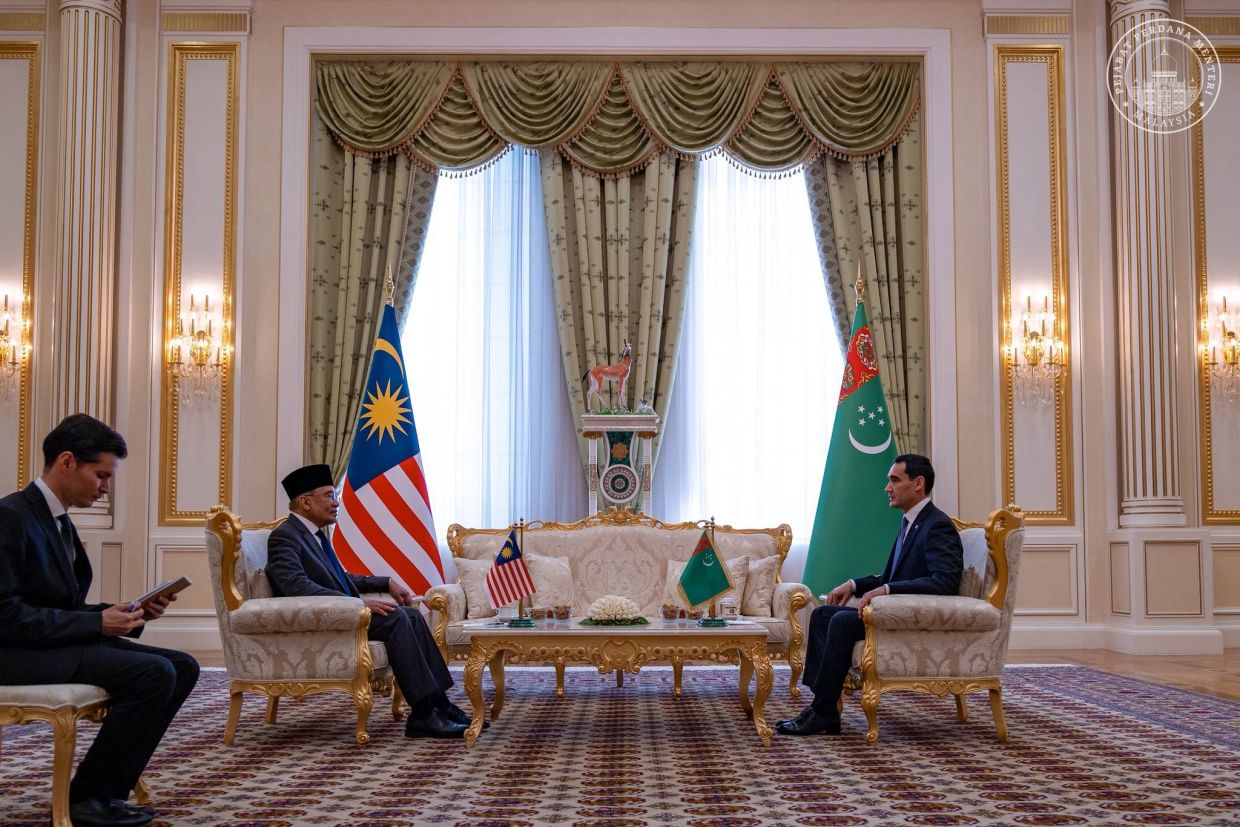
Prime Minister Datuk Seri Anwar Ibrahim and Turkmenistan President Serdar Berdimuhamedov jointly endorsed a landmark strategic partnership between PETRONAS and Turkmenistan's authorities during an official ceremony in Ashgabat, signalling Malaysia's deepening commitment to Central Asian energy markets and long-term bilateral cooperation. The agreement represents a watershed moment for two nations whose partnership spans three decades in the energy sector, one of the most strategically important pillars of their bilateral relationship.
The timing of this initiative carries symbolic weight, as it arrives at a juncture marking three decades of Malaysia-Turkmenistan collaboration in energy development. According to the Prime Minister's Office, this latest accord builds upon a foundation of established trust and shared objectives in resource management and technological advancement. The partnership is positioned not merely as a contractual arrangement between corporate and state entities, but as a reflection of deeper governmental commitment to sustained economic engagement across multiple sectors.
Central to the agreement's appeal is Malaysia's proven expertise in complex energy operations and project management at a global scale. PETRONAS, as Malaysia's national petroleum corporation, brings decades of experience extracting, processing, and transporting hydrocarbon resources across diverse geographical and political contexts. This institutional knowledge becomes particularly valuable in Turkmenistan, where resource extraction challenges require sophisticated technical solutions and rigorous operational standards. The partnership signals confidence in Malaysian capabilities to operate competitively alongside other international energy majors vying for opportunities in Central Asia.
Turkmenistan's natural gas sector remains among the world's most underdeveloped reserves relative to its resource base, holding some of the planet's largest proven gas deposits. The country has long sought international partnerships to unlock this potential, which could generate substantial economic returns and geopolitical influence through energy exports. PETRONAS's involvement opens pathways for Malaysian capital and expertise to participate in developing these resources, potentially generating revenue streams and technological spillovers that benefit both nations.
The investment landscape reflects Malaysia's strategic positioning within this partnership. PETRONAS has accumulated RM52.73 billion in total investments across Turkmenistan since establishing operations there in 1996, making it among the company's most substantial commitments to any single nation. This substantial capital deployment demonstrates long-term confidence in the commercial viability of operations and the stability of the bilateral investment framework. Such commitment also positions PETRONAS as one of the most significant foreign investors in Turkmenistan's energy sector.
Bilateral trade metrics underscore the economic interdependence developing between the nations. In 2025, Turkmenistan ranked as Malaysia's fourth-largest trading partner specifically among Central Asian countries, with bilateral commerce reaching RM75.80 million. Malaysian exports to Turkmenistan totalled RM75.50 million, representing a nine percent increase year-on-year. While these figures appear modest in absolute terms compared to Malaysia's trade relationships with major economies, they illustrate steady growth and suggest expanding commercial interactions across sectors beyond energy.
The strategic partnership carries implications for Malaysia's broader positioning within Central Asia and its diversification away from overdependence on Southeast Asian and East Asian markets. Central Asian nations, particularly energy exporters like Turkmenistan, represent frontier markets with significant growth potential as global energy demand transitions and diversifies. Malaysian companies that establish strong footholds now may benefit from first-mover advantages as these markets develop further and regional connectivity infrastructure improves.
From Turkmenistan's perspective, the arrangement provides access to Malaysian expertise in downstream operations, liquefied natural gas technology, and international energy market navigation. Malaysia's experience exporting LNG and managing complex energy supply chains offers practical models applicable to Turkmenistan's development objectives. The partnership potentially accelerates Turkmenistan's integration into global energy markets while reducing reliance on traditional regional partners.
The MADANI government's framing of this partnership emphasises several interlocking benefits beyond simple commercial exchange. Knowledge transfer mechanisms embedded within the agreement facilitate technology diffusion that strengthens Malaysian capabilities while improving Turkmenistan's operational sophistication. Human capital development emerges as another significant dimension, with partnership structures typically enabling Malaysian and Turkmen professionals to gain cross-cultural expertise and technical skills applicable to future career advancement.
Prime Minister Anwar's official visit to Ashgabat, spanning two days and including formal reception ceremonies and bilateral consultations, signals the diplomatic weight Malaysian leadership attaches to Central Asian relations. Such high-level engagement typically precedes expanded cooperation beyond the immediate partnership announcement, potentially encompassing infrastructure development, educational exchanges, and broader developmental assistance frameworks.
The partnership's public articulation as strengthening international confidence in Malaysian capabilities deserves scrutiny. Energy sector partnerships function as signals to global capital markets regarding a nation's operational competence and geopolitical stability. By demonstrating that PETRONAS can secure major commitments in geographically remote, strategically significant energy markets, Malaysia positions itself as a reliable partner capable of executing large-scale infrastructure projects and managing international commercial relationships across diverse contexts.
For Southeast Asian observers, Malaysia's Central Asian engagement offers lessons regarding economic diversification and market hedging. As Myanmar's instability, South China Sea tensions, and regional competition for natural resources intensify, developing alternative partnerships and energy supply sources becomes strategically prudent. Malaysia's Turkmenistan investments represent portfolio diversification at the national level, reducing vulnerability to disruptions within traditional trading spheres while generating political influence in emerging regional architectures.
Moving forward, the strategic partnership between PETRONAS and Turkmenistan will likely expand beyond initial parameters as both parties identify additional collaboration opportunities. LNG development, downstream petrochemical integration, and joint exploration initiatives could emerge as secondary phases of cooperation, each building upon institutional relationships and trust developed through initial partnership execution. The three-decade foundation provides confidence that this latest accord reflects genuine, enduring commitment rather than transactional opportunism.

