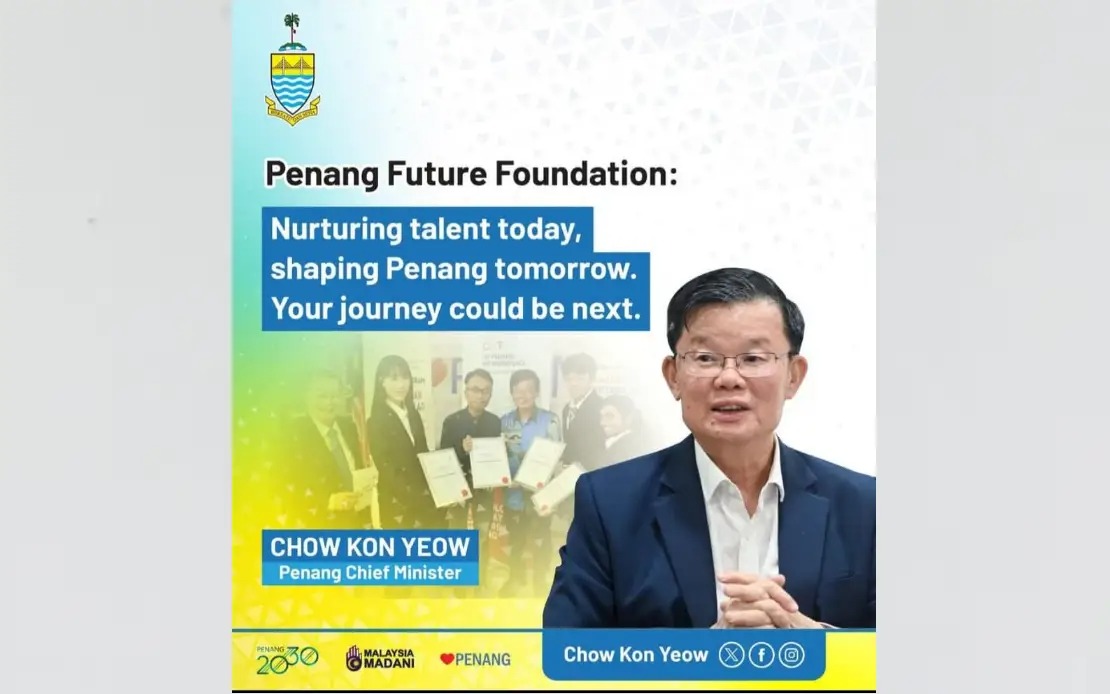
The Penang Future Foundation, a state government-backed talent initiative established in 2015, has provided approximately RM47.7 million in scholarship support to 863 Malaysian students over the past nine years. Now in its 11th year of operation, the foundation continues to serve as a strategic mechanism for attracting and retaining academic talent to strengthen Penang's competitive position in Malaysia's knowledge economy. Chief Minister Chow Kon Yeow outlined the foundation's significance as the state positions itself for sustained growth and increased foreign investment, emphasising that securing a reliable pipeline of qualified professionals has become essential to meeting industry demand across multiple sectors.
The foundation operates through a partnership model that draws funding from both government and private sector stakeholders, reflecting a collaborative approach to human capital development. This dual-source funding structure allows the initiative to scale its reach beyond what public resources alone could support, while aligning scholarship offerings with the actual skills gaps that employers in Penang identify. The diversity of funding sources also ensures that the programme remains responsive to changing labour market needs, as private sector partners can signal where talent shortages are emerging across their industries.
In the 2025 intake cycle, 58 students from varied socioeconomic and academic backgrounds received foundation scholarships, with particular emphasis on fields identified as critical to economic transformation. The foundation has concentrated its support on Science, Technology, Engineering, Mathematics, Accountancy and Finance—disciplines that align directly with Penang's strategic pillars in electronics manufacturing, semiconductor design, business process outsourcing, and emerging digital sectors. This targeted approach ensures that scholarship investment translates into workforce development in areas where the state faces genuine skills constraints and where graduates are likely to find immediate employment opportunities.
Chow's statement underscores a strategic reality facing Malaysian states competing for regional and global investment: talent retention is increasingly a critical factor in location decisions by multinational corporations and technology firms. Penang, which has historically relied on its manufacturing sector and increasingly on higher-value services, cannot afford significant brain drain of its brightest graduates to Kuala Lumpur or overseas opportunities. By investing substantially in scholarships, the state signals commitment to nurturing local talent while creating pathways for top students to build careers within the state's expanding economy.
The foundation operates two distinct scholarship tiers designed to accommodate different academic performance levels while maintaining rigorous selection standards. The PFF Penang Scholar programme targets high-achieving students with a cumulative grade point average of 3.67 or above, reserving premium support for the top academic performers. Meanwhile, the PFF Mutiara Scholar track welcomes applicants with CGPA between 3.00 and 3.66, expanding access to capable students who may face financial constraints or who attended schools with fewer advanced academic resources. This tiered structure reflects contemporary scholarship best practice, which recognises that merit extends across a range of excellent students and that financial barriers, not ability, often determine who can access tertiary education.
The accessibility of the programme across Malaysia, rather than restricting awards to Penang residents, reflects the state's confidence in its ability to attract talent from beyond its borders. By opening applications to qualified students nationwide, the foundation competes for the nation's brightest minds while effectively functioning as a talent magnet. Students choosing Penang scholarships are more likely to pursue their tertiary studies at Penang-based institutions or to seek employment within the state upon graduation, creating a virtuous cycle of brain gain and economic strengthening. This national recruitment strategy positions Penang as a major player in Malaysia's talent marketplace, comparable to how research universities worldwide recruit internationally to strengthen their academic and economic ecosystems.
The timing of the 2026 scholarship cycle announcement reflects deliberate planning to capture applications during the academic year when secondary and tertiary students are making critical decisions about their educational paths. The application window of July 15 to August 5 aligns with the period when Malaysian Form Six and secondary students are completing their examinations and making university choices, ensuring maximum visibility among the target demographic. This scheduling demonstrates that the foundation operates with institutional sophistication, timing its outreach to intercept students at the precise moment when scholarship information becomes most relevant to their decision-making process.
The RM47.7 million aggregate investment over nine years represents substantial public-private resource commitment to a single talent development initiative, signalling the Penang state government's prioritisation of human capital formation. To contextualise this investment: the per-student scholarship cost averages approximately RM55,150, a figure that compares favourably with annual tuition at Malaysian private universities and reflects realistic support for tertiary education costs. The foundation's ability to sustain this scale of investment across nearly a decade indicates stable funding commitment rather than project-based spending, allowing the initiative to develop institutional capacity and graduate cohesive alumni networks.
For Malaysian students considering scholarship applications, the PFF represents an important funding avenue beyond the conventional routes of MARA, JPA, and other federal schemes. The foundation's focus on commercial and technical disciplines addresses sectors where employment prospects remain robust and where graduate salaries are competitive. Students in the upper secondary levels contemplating their university pathways should note that Penang-based scholarships carry the implicit advantage of potentially lower living costs compared to studying in Kuala Lumpur, while still providing access to quality tertiary institutions and internship opportunities within a rapidly developing economic hub.
The foundation's emphasis on STEM fields reflects a national imperative that extends beyond Penang. Malaysia's transition toward higher-value manufacturing and digital services requires substantially more graduates in engineering, computer science, and mathematics than current pipelines are producing. By concentrating scholarship resources on these disciplines, the Penang Future Foundation addresses not just state-level skills gaps but also contributes to addressing national shortages. This alignment between state initiative and national workforce development needs creates positive externalities that benefit the broader Malaysian economy.
Looking forward, the expansion trajectory implied by the foundation's growth suggests that Penang views talent development as integral to its economic strategy rather than a secondary social programme. The consistent year-on-year award increases and the sophistication of the tiered scholarship structure indicate an institution maturing into a significant player in Malaysia's human capital formation landscape. As the state pursues ambitious economic diversification targets and seeks to position itself as a centre for semiconductor design, fintech, and advanced services, the scholarship foundation functions as both a practical talent pipeline and a symbolic commitment to investing in young Malaysians' futures. For the 2026 intake, prospective applicants should visit the foundation's website to understand eligibility criteria and application procedures before the August 5 deadline.

