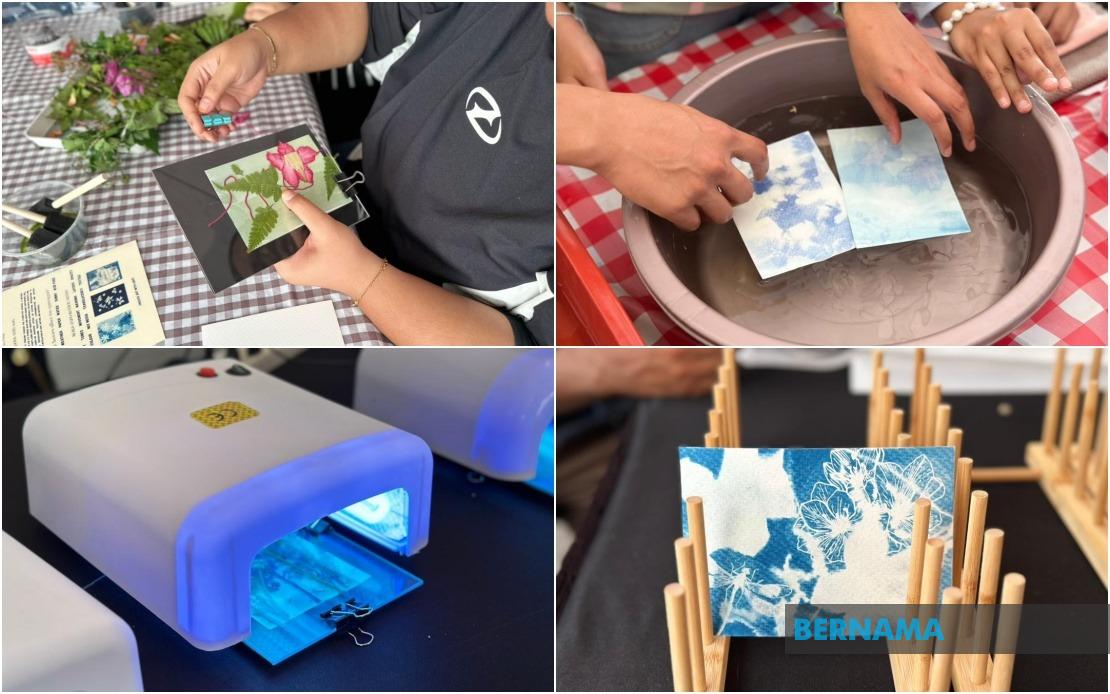
For Puteri Mas Aishah Ramyusnali, sunlight is not merely a daily backdrop to life but a collaborator in artistic creation. The 24-year-old Penang-born cyanotype practitioner harnesses the sun's energy as an integral element of her printmaking process, transforming what most people take for granted into a vehicle for exploring humanity's relationship with nature. Her work represents an emerging movement among Malaysian artists who are revisiting and reimagining historical techniques as contemporary tools for environmental dialogue.
Cyanotype, a photographic printing process that originated in the 19th century, operates on deceptively simple principles that mask profound creative possibilities. The technique requires coating paper with a light-sensitive chemical solution, then placing natural objects—leaves, flowers, feathers—directly onto the treated surface. When exposed to ultraviolet radiation from the sun for approximately ten to fifteen minutes, a chemical reaction occurs that fixes the silhouette of these objects onto the paper. The subsequent washing process, involving both acidic and alkaline solutions, gradually reveals the process's characteristic striking blue tone, a hue so distinctive it has become synonymous with the entire medium.
Puteri Mas Aishah's entry into cyanotype came roughly three years ago during her postgraduate studies at Universiti Teknologi MARA, where she is currently pursuing a Master of Fine Arts and Technology. Rather than approaching the technique as a historical curiosity, she has engaged with it as a methodological framework for investigating environmental consciousness. Her engagement deepened significantly during industrial training, when she discovered that introducing the process to workshop participants created profound moments of awareness. The hands-on experience of waiting for the sun's work to manifest, of understanding how weather and atmospheric conditions directly influence artistic outcomes, proved transformative not only for participants but for Puteri Mas Aishah herself.
What distinguishes her practice is the conscious attention she brings to variables that industrial art production typically seeks to eliminate or control. Weather conditions become not obstacles to overcome but integral creative factors. Cloud cover, time of day, seasonal variations in UV intensity, and even humidity levels all contribute to the final aesthetic result. She emphasises that higher ultraviolet exposure generally produces more vibrant, deeply saturated blue tones, while overcast conditions yield softer, more muted results. This interdependence between artistic outcome and environmental conditions creates a feedback loop that encourages practitioners to develop genuine attentiveness to their surroundings.
The workshops she conducts, initially facilitated through collaboration with art studios and galleries across Shah Alam and the broader Selangor region, serve as public engagement platforms rather than simple skill-transfer sessions. Participants—many encountering the process for the first time—experience firsthand how their creative agency operates within environmental constraints rather than in opposition to them. This pedagogical approach counters the prevailing contemporary assumption that technological mastery represents the pinnacle of artistic achievement. Instead, cyanotype practice suggests that creative power can emerge from working with natural systems rather than dominating them.
The technique's revival within contemporary Malaysian art circles reflects broader global trends toward sustainable and eco-conscious creative practice. As environmental concerns increasingly shape cultural discourse, artists across Southeast Asia are exploring methodologies that inherently integrate ecological awareness into the creative process itself. Cyanotype offers particular resonance because it requires no electricity, no elaborate chemical processing facilities, and minimal resource expenditure beyond paper, basic photosensitive compounds, and sunlight—the most abundant resource in the Malaysian climate.
Puteri Mas Aishah's work gained public visibility through her participation in the RIUH Pi HAWANA Carnival at the PICCA Convention Centre in Butterworth, where she conducted interactive sessions introducing the broader Penang community to the medium. These public demonstrations serve important advocacy functions, particularly given her stated concern that young people increasingly regard art as peripheral to serious cultural or environmental concerns. She articulates a vision of artistic practice as fundamentally integrated with daily existence and ecological responsibility.
Her concern about public perception of art's societal value touches on a significant cultural conversation in Malaysia. The dominance of STEM-focused educational pathways and economic priorities has historically marginalised creative disciplines as supplementary rather than essential. Yet Puteri Mas Aishah argues, through both her practice and her public messaging, that artistic engagement offers singular pathways toward developing environmental literacy and ecological consciousness. When young people participate in cyanotype workshops, they experience directly how natural systems operate, how their actions produce material consequences, and how aesthetic value can emerge from collaboration with environmental processes rather than conquest of them.
The Master of Fine Arts and Technology programme at Universiti Teknologi MARA, where Puteri Mas Aishah studies, represents institutional recognition that contemporary art practice increasingly requires technological sophistication alongside traditional craft knowledge. Her particular trajectory—combining cyanotype's historical methodology with contemporary concerns about environmental connection—exemplifies how Malaysian art education is evolving to address 21st-century challenges. The programme positions graduates to contribute to cultural conversations about sustainability, technology ethics, and human-environment relations.
Moving forward, Puteri Mas Aishah envisions cyanotype practice extending beyond individual artistic expression toward community-based environmental education. Her hope that the discipline might cultivate broader societal benefit reflects a philosophical position that art operates most meaningfully when it generates awareness and behavioural change. In the Malaysian context, where rapid urbanisation and climate challenges increasingly threaten environmental stability, such artistic interventions offer valuable counternarrative to technology-centric development models. By demonstrating that profound creative and educational experiences can emerge from working with natural light and simple materials, cyanotype artists like Puteri Mas Aishah contribute to reimagining humanity's relationship with nature—not through abstract environmental messaging, but through direct, tangible, sun-exposed artistic practice that makes ecological interdependence visible, immediate, and beautiful.

