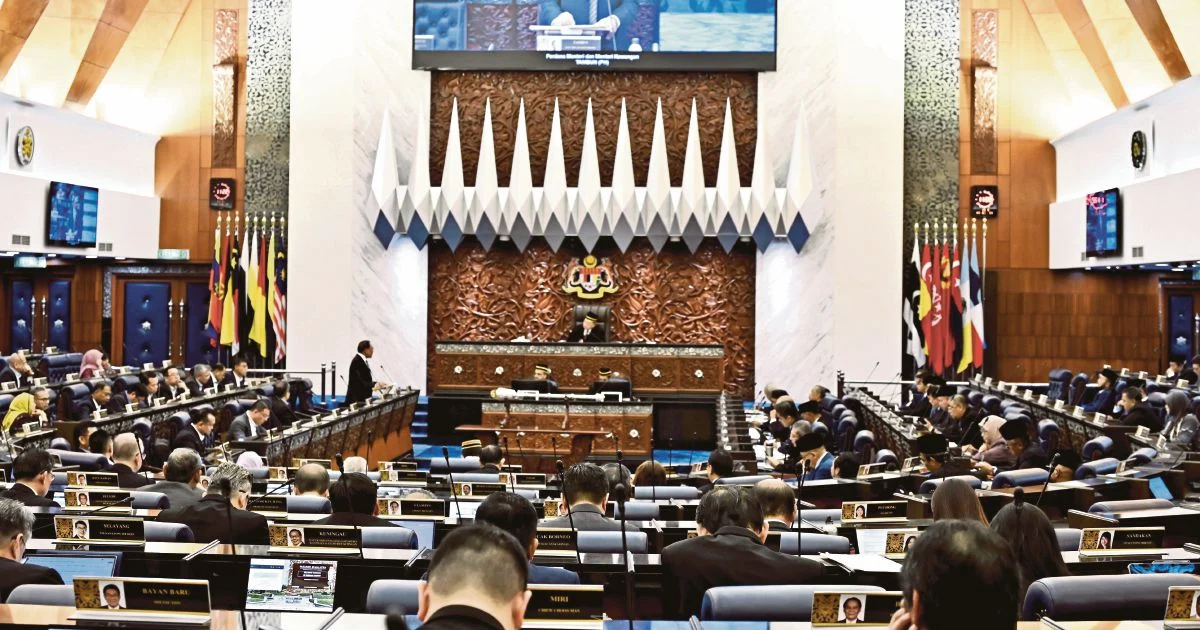
The Dewan Rakyat witnessed an unusually turbulent opening to parliamentary proceedings on a single issue—tensions simmering within the Malay-Muslim political alliance that currently anchors the government. Within sixty minutes of the sitting commencing, lawmakers locked horns over allegations that one coalition partner was marginalizing another, a confrontation that laid bare the precarious balance holding together the ruling administration.
Takiyuddin Hassan, representing the opposition, seized on what he characterized as bullying behaviour within the government coalition, specifically targeting the relationship between PAS and Bersatu. His intervention was calculated to expose fissures that have become increasingly visible to political observers tracking the fragile equilibrium of Malaysian governance. The accusation struck at the heart of how power-sharing arrangements function within the bloc that commands parliamentary control.
The government backbencher who responded did so defensively, suggesting that such charges were exaggerated or politically motivated. This defensive posture itself reflected an awareness that accusations of internal domination have gained traction among rank-and-file members and observers alike. The exchange demonstrated how sensitive coalition dynamics have become, with even parliamentary discussion of these tensions provoking sharp rejoinders rather than calm clarification.
For Malaysian political analysts, the outburst offered fresh evidence of strains that periodically surface between PAS—the Islamist party with deep grassroots networks—and Bersatu, the newer entity built largely around former Prime Minister Mahathir Mohammad and his political allies. The relationship has oscillated between cooperation and competition since Bersatu's formation, with questions about resource allocation, ministerial positions, and ideological direction creating recurring friction points.
The timing of this parliamentary explosion carries significance. Coalition governments in Malaysia have historically been vulnerable to internal division when perception of unfair treatment spreads among smaller partners. Previous administrations have fractured precisely when junior coalition members felt overshadowed or denied promised ministerial portfolios and developmental allocations. Takiyuddin's intervention suggested that opposition strategists are attuning themselves to these vulnerabilities, ready to amplify grievances that might already exist beneath the surface.
Bersatu, as the numerically smaller but politically strategically positioned party, occupies an awkward middle ground. The party holds sufficient seats to matter in parliamentary mathematics, yet operates under the shadow of larger coalition partners whose constituencies command more electoral weight. This structural disadvantage creates perpetual tension in negotiations over cabinet positions, budget allocations, and policy direction. PAS, with its formidable party apparatus and substantial parliamentary representation, naturally wields greater gravitational force within coalition discussions.
The heated exchange also illuminates broader challenges confronting Malaysian coalition governance. Multi-party arrangements require elaborate protocols for distributing benefits equitably and managing expectations transparently. When these mechanisms falter—or when parties perceive they are receiving less than promised—tensions metastasize rapidly. The fact that such friction spilled into public parliamentary debate suggests that private mediation mechanisms may have broken down or been insufficient to contain the dispute.
For observers monitoring coalition stability, this incident reinforces what many have suspected: that the government's parliamentary majority, whilst commanding sufficient numbers formally, rests atop an increasingly complicated landscape of internal bargaining and mutual suspicion. Each major decision faces potential delays as coalition partners demand consultations, advance notice, or guarantees regarding their interests. This governing dynamic, whilst not unprecedented in Malaysian politics, has demonstrable impacts on administrative efficiency and the pace of policy implementation.
The opposition's readiness to weaponize coalition tensions reflects tactical sophistication. Rather than merely criticizing government policies on substantive grounds, opposition lawmakers now explicitly point to governance dysfunction rooted in coalition management failures. This argumentative approach potentially carries greater resonance with voters concerned about government effectiveness, as it touches on structural rather than merely ideological grievances.
Looking forward, managing such internal coalition dynamics will prove critical to government stability. Political analysts suggest that without robust inter-party frameworks for resolving disputes and fairly distributing spoils of office, the coalition partnership risks accelerating deterioration. The parliamentary outburst serves as a public symptom of deeper tensions that private mechanisms may be struggling to contain. For Malaysia's political system, the ability of governing coalitions to manage internal contradictions whilst maintaining external unity remains perhaps the paramount challenge to sustained administrative continuity.

