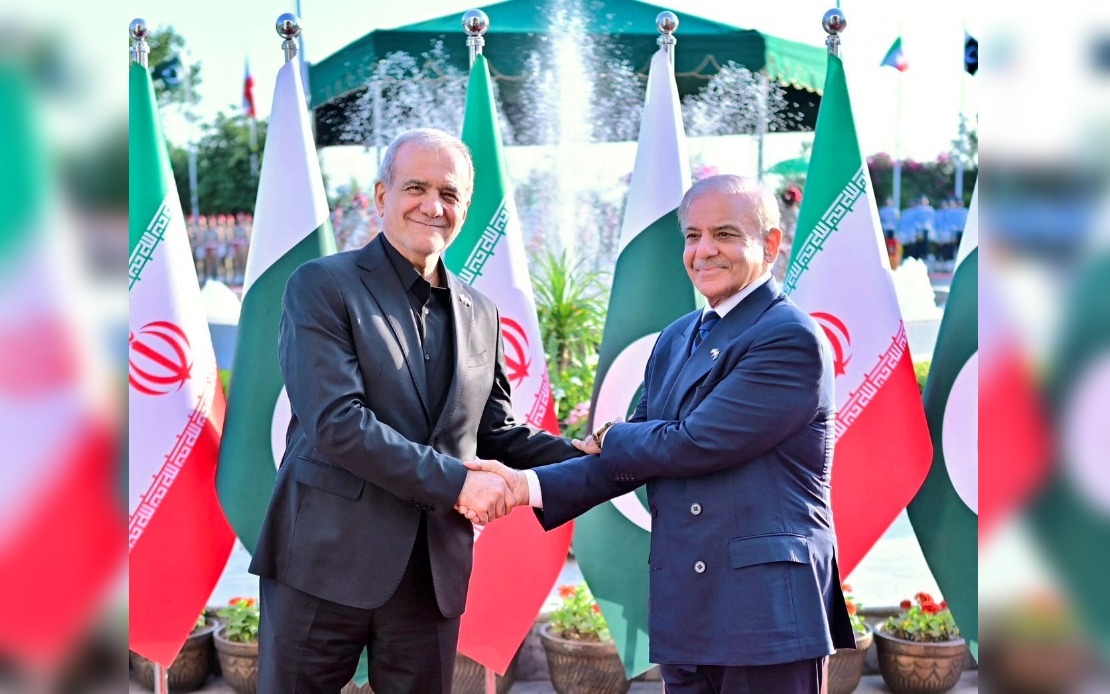
Pakistan's Prime Minister Shehbaz Sharif has given explicit backing to Iran's ballistic missile programme, arguing that such weapons fall outside the scope of the recent understanding between Tehran and Washington. During talks with visiting Iranian President Masoud Pezeshkian in Islamabad, Sharif stressed that Iran should not face discriminatory treatment regarding its military capabilities, particularly when other nations possess similar arsenals without international objection.
The missile question was entirely absent from discussions leading to the memorandum of understanding signed by Iran and the United States on June 17, according to Sharif's account. He underscored that Tehran's delegation showed no inclination to place the topic on the negotiating table, positioning missile development as a matter of national sovereignty rather than international concern. This framing is significant for understanding how Pakistan views its role as a neutral mediator—by excluding military matters from peace talks, Islamabad has preserved space for Iran to maintain its defence posture independently of US-Iran diplomacy.
Sharif's remarks reflect Pakistan's delicate balancing act in the region. Having facilitated both a ceasefire between Iran and the United States in April and this month's broader agreement, Islamabad has positioned itself as a trusted broker despite its own complex relationship with Washington and regional security dynamics. The Pakistani leader expressed gratitude for Iran's confidence in his government's mediation, specifically crediting Foreign Minister Ishaq Dar and Chief of Army Staff Field Marshal Syed Asim Munir for their contributions to the diplomatic effort. This public acknowledgment elevates Pakistan's diplomatic profile while reinforcing ties with Tehran at a moment when regional stability remains fragile.
The timing and context of Sharif's remarks carry weight in an increasingly unstable Middle East. Iran views its missile arsenal as essential to national survival, particularly following February attacks attributed to both Israel and the United States. These strikes demonstrated Tehran's vulnerability to conventional military superiority and reinforced Iranian leadership's conviction that missile capabilities serve as a deterrent against further external aggression. Within this strategic environment, Pakistan's endorsement of Iran's weapons programme signals that major regional powers regard such defence measures as legitimate and necessary rather than destabilising.
International backing for Iranian missiles has gained unexpected momentum. US President Donald Trump recently conceded that prohibiting Iran from possessing ballistic weapons while other nations retain them creates an inherent inequity. Speaking in Paris on June 17, Trump acknowledged that if countries such as Russia, China, and North Korea maintain missile arsenals, denying Iran similar capabilities appears fundamentally unfair. This rhetorical shift, coming from Washington's most hawkish recent administration, suggests the US-Iran understanding may represent a genuine recalibration of American policy in the region rather than a temporary pause.
During the joint news conference, President Pezeshkian articulated Iran's security doctrine with unmistakable clarity. He framed missile defences as non-negotiable elements of Iranian sovereignty, warning that without such capabilities Iran would face the fate of Gaza—implying comprehensive destruction and overwhelming military subjugation. This stark comparison highlights how Iran's leadership views the current geopolitical moment: as an existential struggle in which defensive capabilities mean the difference between independence and subjugation. For Malaysian and Southeast Asian observers, Pezeshkian's comments underscore how Middle Eastern powers perceive their strategic situation far more gravely than Western capitals might suggest.
Pakistan's reception of the Iranian president demonstrated the importance Islamabad attaches to this partnership. Six Pakistani Air Force fighter jets escorted Pezeshkian's aircraft into Pakistani airspace, while President Asif Ali Zardari and Prime Minister Sharif greeted him personally. A formal 21-gun salute accompanied the state visit, according ceremonial protocol typically reserved for close allies or important diplomatic moments. Such pageantry, while symbolic, communicates Pakistan's commitment to the Iran relationship at a time when external pressures—particularly from Washington and its regional partners—create incentives to distance itself from Tehran.
Sharif's comments also acknowledged broader regional spoilers intent on undermining the nascent US-Iran détente. He identified Israel as the principal obstacle to sustainable peace in West Asia, citing its ongoing military operations in Lebanon and Palestine as evidence of commitment to conflict rather than resolution. This frank assessment, delivered by a leader whose own country maintains complex relations with Israel through its diaspora communities and defence partnerships, reflects how the Iran agreement has shifted regional diplomatic language. Where previous Pakistani statements emphasised balance between all parties, Sharif's remarks now locate Israeli actions as fundamentally incompatible with peace.
The implications for Southeast Asia merit careful consideration. Malaysia, which maintains diplomatic ties across the Middle Eastern spectrum, observes these developments as indicators of shifting great power competition in strategically vital waters. Pakistan's enhanced role as a regional mediator potentially affects the balance of influence across the Indian Ocean and Arabian Sea. Should Pakistan consolidate its position as broker between Iran and the United States, it gains leverage with both Washington and Tehran—leverage that extends to questions affecting maritime trade, energy security, and strategic alignments that touch Malaysian interests directly.
Further, the exclusion of missile capabilities from peace negotiations establishes a precedent that may influence future regional agreements. If military arsenals remain outside diplomatic settlements, regional powers retain unilateral authority to develop weapons systems according to their own security assessments. For smaller nations like Malaysia, this dynamic underscores the limitations of international agreements in constraining great power military behaviour and the enduring centrality of raw military capability in determining regional outcomes. Pakistan's articulate defence of Iran's weapons programme thus represents not merely bilateral diplomacy but a statement about the structure of international relations in which military strength ultimately determines security outcomes.

