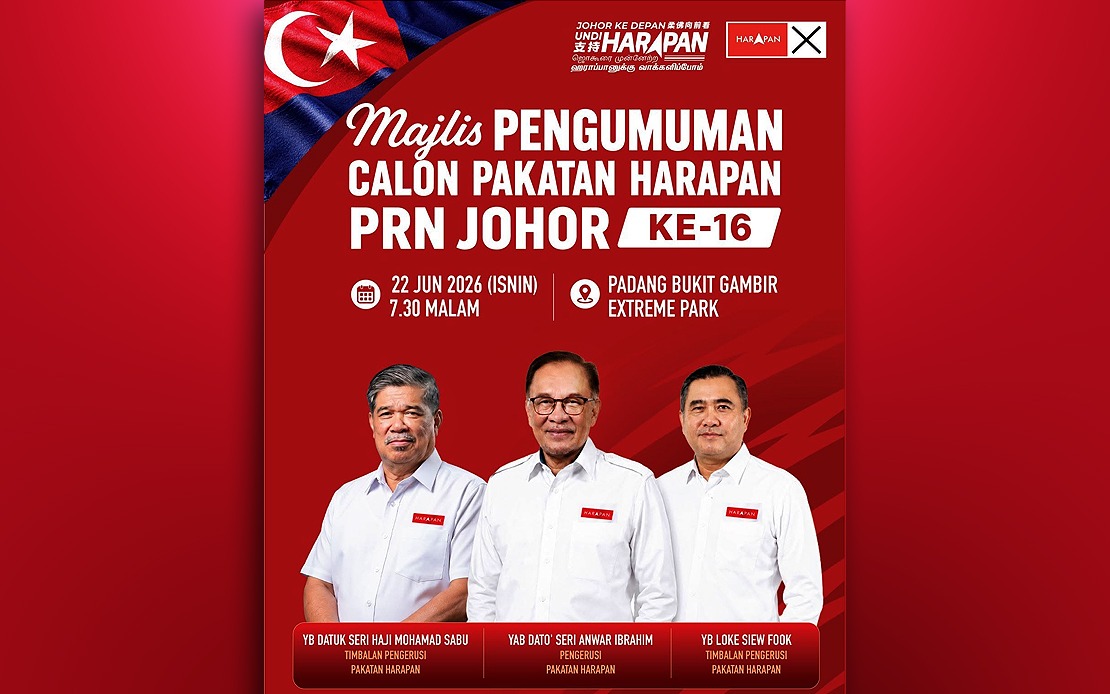
Pakatan Harapan will unveil its manifesto for the Johor state election in the days following the nomination process, PKR vice president Datuk Seri Amirudin Shari revealed at a candidate announcement event in Tangkak on June 22. The coalition plans to release its platform, branded 'Johor Ke Depan', after the Election Commission's scheduled nomination day on June 27, positioning the document as a forward-looking blueprint for the state's development and governance.
The manifesto represents a strategic move by the opposition coalition to frame its electoral offering around proven administrative accomplishments in other Malaysian states. Rather than presenting theoretical proposals, Amirudin emphasized that the coalition's document would be rooted in tangible achievements and ongoing initiatives in Selangor, Penang, and Negeri Sembilan. This approach attempts to counter scepticism about PH's ability to govern Johor by pointing to measurable results in states where the coalition currently holds office or has held it recently.
The timing of the manifesto release holds political significance in the compressed campaign calendar. With nomination day set for June 27, early voting scheduled for July 7, and polling day fixed for July 11, the window for campaigning is notably narrow. By postponing the manifesto announcement until after nominations close, PH gives itself several days of campaign time with its full platform in play, potentially maximizing media coverage and voter engagement in the crucial final stretch before the election.
The manifesto's framing as 'Johor Ke Depan'—forward for Johor—signals the coalition's intention to position itself as the agent of progressive change in the state. This branding echoes similar campaign messaging across PH's efforts in different states, emphasizing development, prosperity, and improved governance. For Johor, a state with significant economic importance as a manufacturing and logistics hub adjacent to Singapore, the emphasis on comprehensive development plans carries particular weight in appealing to both urban and rural constituencies.
Amirudin's remarks came during an event where the coalition formally announced its candidates for the election, with senior PH leadership in attendance. PH chairman Datuk Seri Anwar Ibrahim, DAP secretary-general Anthony Loke, Amanah president Datuk Seri Mohamad Sabu, and numerous other party leaders were present, underlining the high-profile nature of the coalition's push in Johor. The gathering reflected the coalition's determination to mount a serious challenge to the governing Barisan Nasional and Perikatan Nasional in the state.
For Malaysian voters evaluating their options, the pending manifesto carries significance beyond mere campaign literature. The document will presumably address issues directly affecting Johor residents, including infrastructure development, economic opportunities, education, healthcare, and social welfare. Given that PH has detailed records in states like Selangor and Penang, the manifesto can be cross-referenced against actual performance, providing voters with a basis for assessing whether the coalition's promises are likely to translate into action.
The emphasis on proven track record reflects a conscious strategy to counter narratives of inexperience or unreliability. In Selangor, currently governed by PKR under Amirudin's stewardship before his move to the federal level, and in Penang under DAP administration, PH can point to fiscal management, infrastructure projects, and policy initiatives as evidence of competence. Whether such comparisons will resonate with Johor voters, particularly those in areas where the incumbent government's performance is regarded positively, remains an open question.
The Johor state election assumes heightened importance within Malaysia's political landscape as a potential indicator of broader electoral sentiment. As one of the country's largest and most economically significant states, results here could influence perceptions of which coalition is gaining or losing momentum nationally. For PH, particularly with Anwar Ibrahim's presence in federal office, demonstrating electoral strength in Johor would validate its broader political narrative and strengthen its hand in potential future negotiations or elections.
The coalition's approach to manifesto presentation also reflects lessons learned from previous campaigns. By detailing achievements in other states rather than making speculative promises, PH attempts to ground its political messaging in observable reality. This strategy carries risks, however, as it invites scrutiny of governance records in Selangor, Penang, and Negeri Sembilan, where opposition parties and critics have raised concerns about various policy areas and administrative decisions. Johor voters will likely weigh both the successes and shortcomings highlighted in those records when evaluating PH's suitability to govern their state.
With the election calendar compressed into a tight two-week window, the manifesto announcement will be one of the final major campaign events before voting begins. The document's reception—both from voters and from media analysis—could significantly shape the final push of campaigning. In the context of Malaysia's evolving political landscape, where electoral preferences have demonstrated volatility in recent years and where coalitions remain competitive, the manifesto will serve as a concrete expression of PH's vision for Johor and a touchstone for evaluating the coalition's campaign effectiveness.

