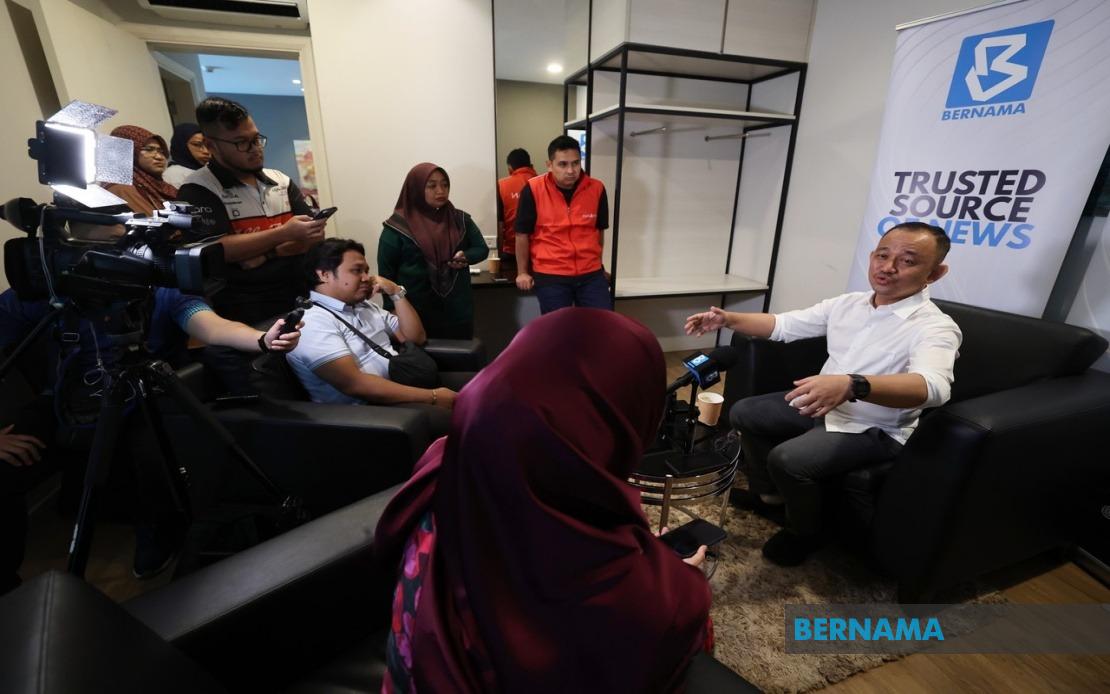
Pakatan Harapan has made clear its commitment to respecting the Sultan of Johor's constitutional authority in appointing the state's next Menteri Besar, should the coalition win in the upcoming 16th Johor state election. The statement, delivered by Dr Maszlee Malik, the coalition's candidate for the Puteri Wangsa state seat, underscores PH's recognition of the traditional role of the Malay ruler in determining executive leadership at the state level. This approach signals a deliberate distance from the kind of political manoeuvring that often surrounds such high-stakes administrative appointments in Malaysian electoral cycles.
Dr Maszlee's comments came in response to persistent speculation on social media platforms naming him among potential contenders for the Menteri Besar position should Pakatan Harapan emerge victorious. Rather than engage with such conjecture, he redirected focus toward the coalition's broader electoral strategy and commitment to governance. His measured response reflects a shift in how opposition coalitions frame their relationship with constitutional monarchies, particularly in states where Malay rulers retain significant institutional power. By publicly delineating the boundaries between party strategy and royal prerogative, PH appears intent on avoiding accusations of overreach or disrespect toward established state institutions.
The distinction between party preference and constitutional authority carries particular weight in Johor, a state where the Sultan commands considerable respect and political influence. Malaysian constitutional frameworks preserve substantial discretionary powers for state rulers in matters of government formation, a legacy of the Federal Constitution's recognition of hereditary monarchies within a constitutional framework. For Pakatan Harapan, emphasising this deference becomes strategically important in a contest where legitimacy and institutional respect form crucial battlegrounds. The coalition's willingness to foreground the Sultan's role suggests confidence in its electoral prospects while simultaneously demonstrating political maturity regarding the limits of party authority.
Pakatan Harapan's campaign narrative deliberately downplays personalised leadership, with Dr Maszlee framing the coalition's approach around collective capability rather than individual prominence. He characterised the party's extensive roster of candidates across all 56 state seats as a unified force, employing the metaphor of Marvel's Avengers to convey the idea of complementary strengths working in concert. This repositioning away from personality-driven politics reflects lessons learned from previous electoral cycles and attempts to build a more institutional brand of opposition politics. By refusing to name-check potential Menteri Besar candidates, the coalition seeks to maintain flexibility while emphasising that election outcomes should hinge on policy platforms and collective governance capacity rather than factional backing for specific individuals.
The timing of this clarification, issued ahead of the polling date of July 11 with early voting beginning July 7, demonstrates PH's awareness of how contemporary political discourse unfolds through digital channels. Social media speculation about leadership appointments can crystallise into broader narratives about ambition, entitlement, or disrespect toward constitutional norms. By proactively addressing such chatter through mainstream media engagement, Dr Maszlee sought to reframe the conversation and foreclose certain lines of attack. This media strategy reflects the increasingly sophisticated understanding among Malaysian political actors of how information flows shape electoral perceptions, particularly among younger voters who consume news primarily through digital platforms.
For Malaysian voters observing these developments, the statement carries implications beyond mere procedural courtesy. It signals that Pakatan Harapan views cooperation with hereditary institutions as compatible with democratic governance and reform agendas. This represents an evolution from earlier opposition positioning that sometimes positioned itself against traditional power structures. The coalition's explicit acknowledgment of the Sultan's constitutional prerogative, rooted in the State Constitution framework, reassures constituencies that might worry about radical institutional disruption. In Johor particularly, where royal authority retains deep historical and cultural resonance, this positioning proves tactically significant.
The broader context of Johor state politics adds additional dimensions to Pakatan Harapan's calculated deference. The state has long been regarded as a Barisan Nasional stronghold, and any coalition seeking to govern must navigate not only electoral mathematics but also the intricate relationships between party politics and state institutions. The Sultan's demonstrated willingness to engage in consultations with various political actors has previously served as a stabilising mechanism in Malaysian politics. By explicitly ceding appointment authority to the Palace, Pakatan Harapan positions itself as a constitutionally respectful actor, potentially appealing to voters who value institutional continuity even as they contemplate change at the electoral level.
Dr Maszlee's emphasis on teamwork and collective service delivery, in place of spotlight on individual ambitions, also reflects awareness of voter fatigue with internal party feuding and leadership contests that dominate electoral discourse. Malaysians have witnessed recurring cycles of post-election disputes over top positions, sometimes creating governance instability and public disenchantment. By demonstrating in advance that leadership appointments will follow constitutional procedures rather than factional negotiations, PH attempts to reassure voters that a change of government need not entail prolonged uncertainty or institutional conflict. This framing positions the coalition as mature and governance-focused rather than merely power-seeking.
The statement also carries significance for Southeast Asian regional politics, where questions of civil-military relations and institutional power-sharing remain perpetually salient. Malaysia's approach of embedding strong roles for hereditary monarchies within democratic frameworks offers a distinct model compared to other regional systems. Pakatan Harapan's explicit recognition of constitutional monarchical prerogatives thus demonstrates how Malaysian parties navigate the tension between democratic majoritarianism and institutional pluralism. This balance, maintained through explicit public acknowledgment of boundaries, becomes particularly important in states like Johor where royal authority commands deep legitimacy.
Moving toward the election campaign's final week, PH's positioning on this issue establishes important parameters for post-election discourse. Should the coalition succeed in forming government, it will have created expectations around respecting constitutional processes and deferring to the Sultan's judgment. This precommitment, made public and on record, limits the coalition's subsequent room for manoeuvre in ways that opposition parties traditionally avoid. Yet such a strategic choice reflects confidence about electoral prospects and determination to govern in ways that transcend mere factional interest. The Johor state election thus becomes more than a contest for legislative seats; it represents a test of whether Malaysian political actors can maintain institutional respect while pursuing democratic change, a question with implications extending well beyond one state's boundaries.

