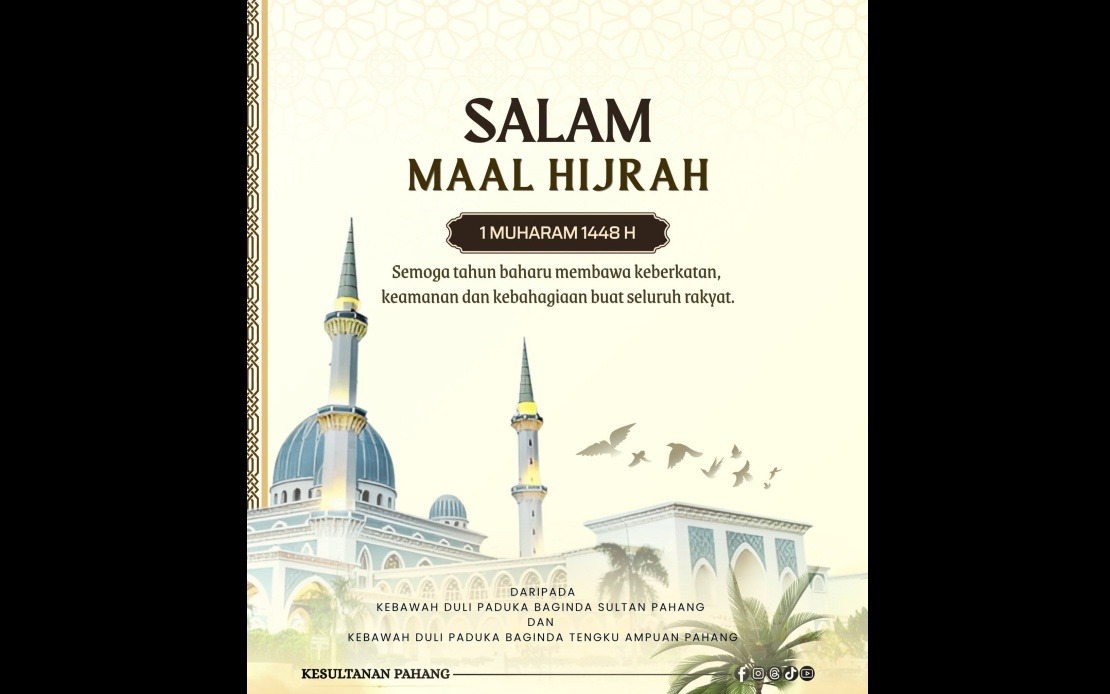
Pahang's royal household has marked the arrival of the Islamic year 1448 Hijrah with an appeal for spiritual renewal and communal solidarity among the state's Muslim population. Al-Sultan Abdullah Ri'ayatuddin Al-Mustafa Billah Shah and Tunku Azizah Aminah Maimunah Iskandariah conveyed their seasonal wishes through the Kesultanan Pahang's official social media channels, setting the tone for how the occasion is being observed across the east coast state.
The royal message, shared on the palace's Facebook platform, articulated a traditional sentiment underlying the Islamic calendar milestone: that the new year represents an opportunity for believers to seek divine favour through increased devotion and ethical conduct. By publicly extending these greetings, the Sultan and Tengku Ampuan signalled the continued cultural and spiritual significance of Maal Hijrah observance among Malaysian Muslim communities, reinforcing institutional recognition of Islamic occasions alongside secular holidays.
Pahang Menteri Besar Datuk Seri Wan Rosdy Wan Ismail amplified this message in his own statement, framing the new year as a watershed moment for personal and collective transformation. His emphasis on renewing resolutions and strengthening faith positioned Maal Hijrah not merely as a calendar marker but as an invitation for believers to audit their spiritual commitments and recommit to Islamic principles. This framing aligns with broader Southeast Asian interpretations of the hijra narrative, which extend beyond historical commemoration to encompass contemporary aspirations for moral improvement.
The Menteri Besar's invocation of the Prophet Muhammad's Hijrah journey—the foundational Islamic migration from Mecca to Medina—carried particular resonance for a diverse state like Pahang. By drawing parallels between that historical transformation and the need for present-day positive change, Wan Rosdy connected spiritual heritage to practical governance objectives. His reference to strengthening unity and instilling integrity directly addressed contemporary concerns about social cohesion and institutional trust in Malaysian public administration.
Wan Rosdy's statement further wove together religious obligation with civic responsibility, arguing that charitable deeds and faith renewal should translate into tangible improvements in state governance and public welfare. This integration of Islamic values with development priorities reflects how Malaysian political leadership increasingly frames religious occasions as platforms for articulating vision statements about progress and inclusive growth. For Pahang specifically, a state with significant rural populations and ongoing development challenges, such messaging carries weight in connecting spiritual aspirations to material improvements residents expect from their leaders.
The public nature of these greetings, disseminated through Facebook rather than traditional press releases alone, demonstrates the evolving channels through which Malaysian institutions engage citizens during religious observances. Direct posting to social platforms allows royal and executive figures to communicate authentically with followers, bypassing traditional media filters while reaching digitally active segments of the population. This approach has become standard practice across Malaysian state governments seeking to maintain relevance and accessibility among younger demographics.
Maal Hijrah observance across Malaysia typically encompasses both private spiritual practices and public festivities, though celebrations vary by state and community. Pahang's official messaging this year emphasised the inward-looking dimensions of the occasion—personal renewal, strengthened faith, and heightened charitable consciousness—rather than secular festivities. This spiritual emphasis aligns with conservative Islamic thought prevalent in certain segments of Malaysian society, particularly on the peninsula's east coast where traditional religious scholarship maintains considerable influence.
The timing of these greetings in mid-June 2024 reflects the lunar Islamic calendar's progression relative to the Gregorian year, positioning Maal Hijrah 1448H in the northern hemisphere summer. For Malaysian Muslim communities, the occasion arrives during the school holiday period, potentially facilitating family-centred observances and community gatherings. The official messages from Pahang's leadership thus arrive at a moment when many residents have increased opportunities for reflection and religious engagement.
The repeated emphasis on unity and collective progress in both royal and executive statements suggests intentional messaging strategy among Pahang's leadership. In a multiethnic state where Muslims constitute the majority but significant non-Muslim minorities exist, emphasising inclusive development and shared prosperity serves diplomatic functions beyond religious communities. Framing Islamic occasions as opportunities for state-wide advancement rather than exclusively communal celebrations reflects Malaysia's constitutional architecture, which recognises Islam's special position while guaranteeing minority religious freedom.
Wan Rosdy's specific reference to Allah's mercy, blessings, and protection carries theological significance rooted in Islamic teaching about divine sustenance and guidance. By invoking these concepts in a public governance context, the Menteri Besar positioned spiritual supplication alongside administrative effort, suggesting that state success emerges from combining human initiative with divine assistance. This theological framing resonates deeply within Malaysian Muslim political culture, where religious language legitimises policy objectives and demonstrates leaders' spiritual grounding.
The Maal Hijrah messages from Pahang's leadership contribute to broader Malaysian observance of the Islamic calendar, which government institutions and private organisations increasingly commemorate through official statements and special events. Unlike Hari Raya Aidilfitri or Aidiladha, which feature extended public holidays and widespread festivities, Maal Hijrah remains primarily a day of spiritual reflection, though some workplaces and educational institutions declare public holidays. Official greetings from senior leaders thus play outsized roles in drawing public attention to the occasion and articulating its contemporary significance.
For regional observers, Pahang's approach to Maal Hijrah greetings illustrates how Southeast Asian Muslim-majority nations integrate religious observance with governance messaging. The combination of royal and executive statements, transmitted via social media to geographically dispersed populations, represents a distinctly contemporary form of institutional religiosity. It demonstrates neither secularist marginalisation of Islamic occasions nor theocratic subordination of state functions to religious authorities, but rather pragmatic integration of religious life into multifunctional governance communication.