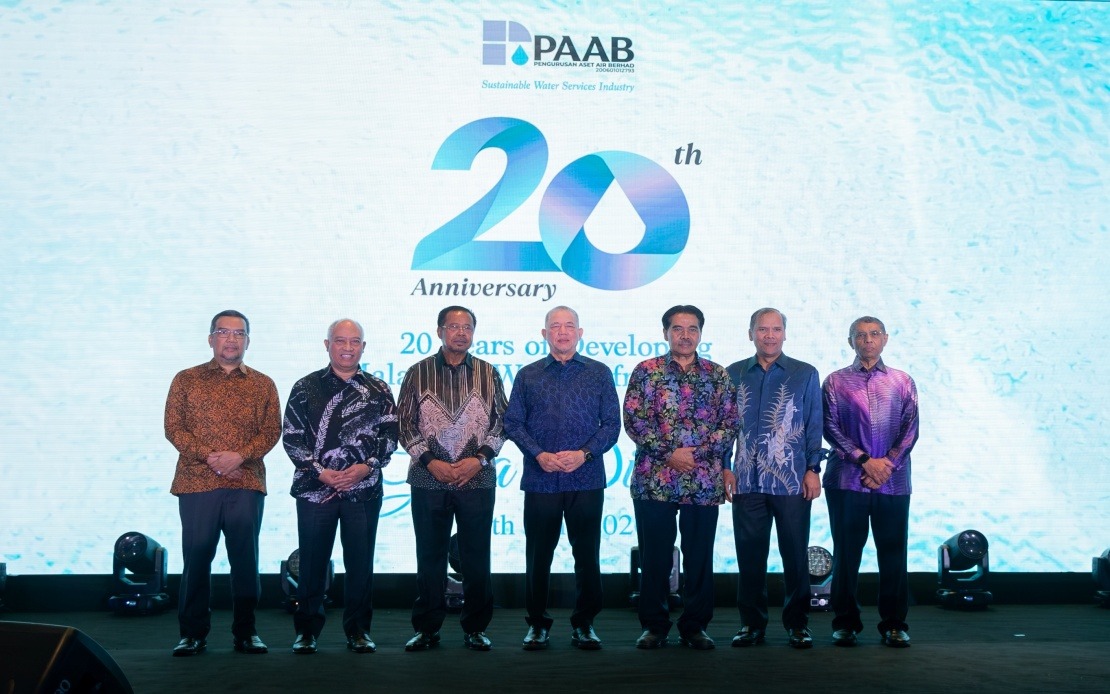
Malaysia's state-owned water asset manager Pengurusan Aset Air Berhad (PAAB) has reached a significant milestone with its 20th anniversary this month, underscoring two decades of institutional effort to modernise the country's water infrastructure and bolster supply resilience. Since its establishment on May 5, 2006, as a wholly owned subsidiary of the Minister of Finance Incorporated, PAAB has served as the financial backbone of the national water services industry, channelling capital into loans and infrastructure projects that have reshaped how Malaysians access clean water.
The sheer scale of PAAB's financial commitment reflects the magnitude of the transformation undertaken. The organisation has financed the assumption of water industry loans totalling RM23.04 billion whilst simultaneously deploying RM23.84 billion in capital expenditure for infrastructure development. Combined, these financing and investment activities amount to RM46.88 billion, positioning PAAB as one of Malaysia's most consequential infrastructure financing vehicles and demonstrating the long-term commitment required to modernise essential services across a geographically dispersed nation.
The tangible outcomes of this investment are evident in the progress made under the National Water Services Industry Restructuring Plan, which ten states have now formally adopted. The restructuring has yielded concrete results: PAAB and its partner operators have completed 21 water treatment plants with aggregate daily capacity of 2,085 million litres, constructed 42 storage tanks holding 783 million litres, and upgraded or extended 3,263 kilometres of pipeline infrastructure nationwide. These figures represent not merely engineering statistics but the foundation of reliable water access for millions of Malaysians across multiple states.
Deputy Prime Minister Datuk Seri Fadillah Yusof, who serves concurrently as Energy Transition and Water Transformation Minister, underscored the urgency of accelerating water sector progress when officiating PAAB's 20th anniversary dinner. Fadillah highlighted a critical vulnerability in Malaysia's water system: the national non-revenue water rate stands at approximately 40 per cent, meaning that two-fifths of treated water is lost through leakage, theft, or measurement inaccuracy before reaching consumers. This loss rate, he emphasised, demands immediate coordinated action rather than reliance upon long-term strategies extending to 2050.
The context for this urgency is Malaysia's competitive position in attracting foreign direct investment in capital-intensive sectors. Large multinational corporations operating data centres and advanced manufacturing facilities require assured supplies of both electricity and water. Supply disruptions triggered by leakage and inadequate infrastructure would undermine Malaysia's value proposition as a reliable investment destination. Fadillah's remarks implicitly acknowledged that water security has become a competitive economic issue, not merely a public health concern, and that addressing non-revenue water losses directly supports Malaysia's economic growth trajectory.
Fadillah's statement that a ten-year timeframe remains insufficient to resolve water losses reflects systemic coordination challenges across Malaysia's federal structure. Water services, whilst falling under federal jurisdiction through the Minister of Energy Transition and Water Transformation, require cooperation from state governments and numerous federal agencies. The deputy prime minister called for immediate coordinated action to prevent public supply disruptions, signalling concern that incremental progress may be insufficient to avert crises in water-stressed regions during peak demand periods or drought conditions.
PAAB chairman Datuk Seri Jaseni Maidinsa articulated the organisation's long-term strategic framework as a phased roadmap culminating in Full Cost Recovery by 2050. This pathway comprises four distinct phases: Migration spanning 2008 to 2020, Stabilisation from 2021 to 2030, Consolidation during 2031 to 2040, and Full Cost Recovery from 2041 to 2050. Each phase represents progressively higher levels of financial self-sufficiency for water operators, reducing dependence upon government subsidies whilst theoretically improving operational efficiency and maintenance standards. The model reflects international best practice in utility sector reform, though implementation across Malaysia's varied economic conditions presents substantial challenges.
The RM23.84 billion capital expenditure programme is distributed across three delivery stages, revealing the multi-year nature of infrastructure modernisation. Completed projects handed to operators have consumed RM8.33 billion, reflecting successful implementation of treatment plants, storage facilities, and transmission pipelines. Projects currently under construction account for RM1.84 billion, indicating an active pipeline of work. The remaining RM13.67 billion resides in design and planning stages, suggesting that significant infrastructure expansion remains in early phases and will require sustained financing over coming years.
For Malaysian consumers and businesses, PAAB's two-decade record demonstrates substantial progress in water supply quality and reliability, yet the 40 per cent non-revenue water rate signals incomplete modernisation. Urban areas served by efficient operators have experienced improved water security, whilst some rural and developing regions continue experiencing supply volatility. The restructuring plan's geographic coverage—ten states have signed on—leaves gaps in several states, indicating uneven implementation across Malaysia's peninsular and East Malaysian jurisdictions.
The intersection of water reform with Malaysia's energy transition agenda introduces additional complexity. Fadillah's emphasis on data centres and high-growth sectors reflects a strategic pivot toward technologies requiring substantial water inputs alongside clean energy. This convergence means water infrastructure investment must simultaneously address legacy system deficiencies whilst expanding capacity for emerging industries. The 2050 timeline for full cost recovery assumes stable technological and economic conditions, yet emerging sectors may require infrastructure configurations unanticipated when PAAB's roadmap was originally conceived.
Looking forward, PAAB faces the paradox inherent in infrastructure management: the organisation must demonstrate success through stable, affordable water supply for the public whilst implementing price adjustments necessary to achieve full cost recovery by 2050. This balancing act requires sustained political commitment and public acceptance of tariff increases, both of which remain uncertain given Malaysia's history of water subsidy debates. The 20-year perspective suggests transformation is a marathon requiring institutional continuity, sustained capital flows, and coordination across multiple governance levels—all areas where Malaysian water sector reform has historically encountered friction.
The celebration of PAAB's anniversary thus marks not only historical achievement but a midpoint assessment of Malaysia's water transformation trajectory. With the migration and early stabilisation phases substantially completed, attention shifts toward consolidation and the harder work of sustaining investment momentum whilst managing political pressures around tariffs and affordability. The next decade will determine whether PAAB's restructuring plan successfully positions Malaysia's water infrastructure to support both demographic growth and economic transition, or whether fragmentation and underinvestment continue limiting sector potential.

