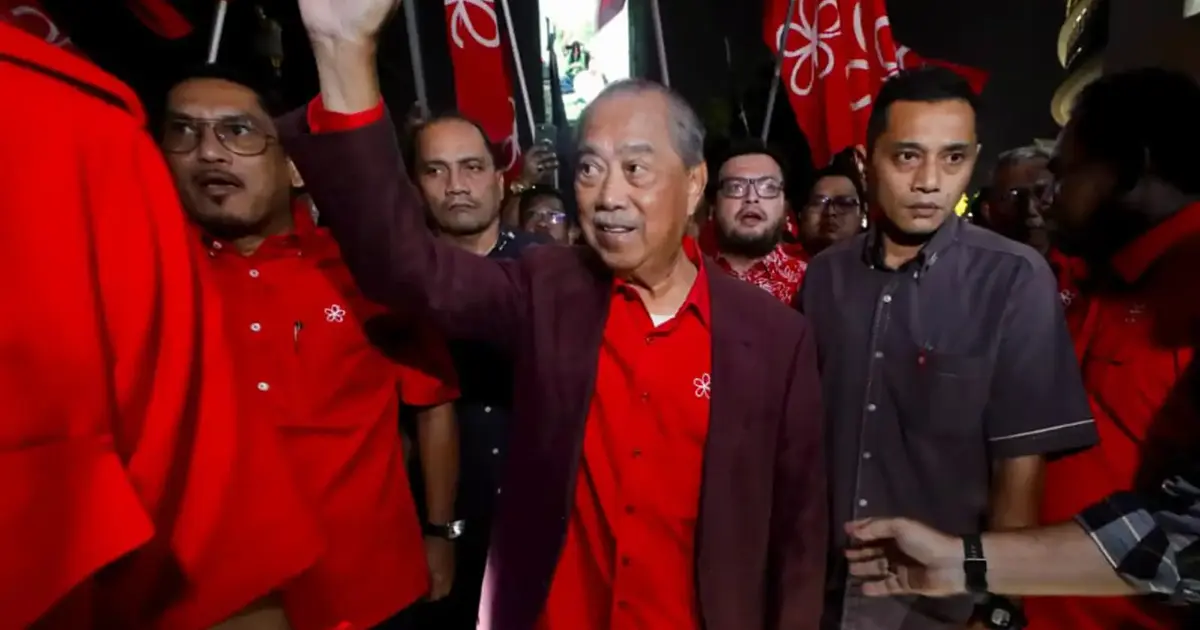
Bersatu experienced a significant show of unity as more than 200 party members assembled to demonstrate backing for party chairman Muhyiddin Yassin in advance of a crucial gathering that will reshape the party's political trajectory across two important states.
The gathering underscores the internal consolidation Bersatu seeks as it confronts multiple strategic challenges simultaneously. The timing reflects the party's determination to present a cohesive front while addressing divisive questions that have occupied much of the party machinery's attention in recent months. Leadership demonstrations of this scale serve as a barometer of party morale and factional alignment, particularly significant given Bersatu's historical susceptibility to internal fractures.
The pivotal meeting agenda encompasses preparations for forthcoming state elections in Johor and Negeri Sembilan, contests that carry outsized significance for Bersatu's relevance in Malaysian electoral politics. These states represent distinct political landscapes: Johor possesses Malaysia's largest electorate and serves as a traditional barometer of national sentiment, while Negeri Sembilan presents a more compact but strategically important arena where Bersatu aims to consolidate influence. The electoral outcomes in these jurisdictions will substantially determine whether Bersatu can translate its national political positioning into tangible state-level representation.
Beyond electoral logistics, party strategists must recalibrate Bersatu's relationship with PAS, the Islamist party that remains both potential partner and competitor depending on constituency and electoral arrangement. This relationship has proven increasingly complex, oscillating between cooperation and tension across different political contexts. The fundamental question occupying party minds concerns whether closer alignment with PAS serves Bersatu's interests or whether the party should pursue a more independent electoral strategy that emphasises its distinct positioning within Malaysia's fractious political centre.
For Malaysian observers, Bersatu's trajectory carries implications extending well beyond the party itself. Founded by Muhyiddin Yassin following his departure from UMNO in 2016, Bersatu has attempted to occupy a distinct space in Malaysian politics, presenting itself as a Bumiputera-focused party offering an alternative to UMNO's established dominance. However, the party has struggled to translate this positioning into consistent electoral performance, instead oscillating between government participation and opposition roles as coalitions shifted and reformed across multiple election cycles.
The current consolidation effort reflects awareness that upcoming state elections represent a critical juncture. Bersatu's performance in Johor and Negeri Sembilan will largely determine whether the party can claim genuine independent strength or remains fundamentally dependent on coalition partners for electoral viability. This distinction matters immensely for the party's internal dynamics and its capacity to negotiate effectively within broader political coalitions. Weak state-level performance would reinforce perceptions that Bersatu functions primarily as a vehicle for individual leadership rather than as an institution commanding independent grassroots support.
The gathering also addresses practical questions regarding candidate selection, campaign strategies, and resource allocation across constituencies where Bersatu contests. These details prove mundane compared to higher-level strategic considerations, yet they ultimately determine electoral outcomes. Consensus among party members concerning these operational matters provides the foundation for effective campaign execution.
Regionally, Bersatu's internal stability and electoral performance carry broader significance for Southeast Asia's political landscape. Malaysia's multiethnic democracy continues experimenting with coalition arrangements and party system configurations, offering insights applicable to neighbouring democracies navigating similar complexities of ethnic politics, religious governance, and institutional accountability. The mechanics of how Bersatu navigates its internal challenges and external electoral contests illuminate broader patterns of political party evolution in developing democracies.
The assembly of over 200 party members itself represents a statement about factional balance within Bersatu. Should the gathering have exposed significant divisions or generated public disagreements, such divisions would immediately circulate through Malaysian political commentary and opposition channels. The apparent unanimity instead suggests that Muhyiddin Yassin maintains sufficiently consolidated control to proceed with party business without publicly visible dissent. This stability remains provisional, dependent entirely on whether electoral performance validates the strategic directions endorsed during such gatherings.
The meeting's discussion of PAS relations particularly warrants scrutiny. Coalition mathematics in Malaysian politics frequently compel parties occupying similar demographic spaces to negotiate power-sharing arrangements despite philosophical differences or electoral competition. Whether Bersatu positions itself as subordinate to PAS within a broader Islamist coalition, as an equal partner, or as an independent competitor will substantially affect both parties' electoral viability and their respective membership morale. Members gathering to demonstrate support for Muhyiddin likely do so with expectations that his leadership will craft arrangements maximising Bersatu's autonomy and electoral prospects.
As Malaysian politics heads toward state election cycles, Bersatu's successful navigation of these internal and external challenges will considerably influence the broader political landscape. The party represents sufficient electoral weight that its positioning affects coalition possibilities and government formation scenarios at both state and national levels. The members who gathered to show support for Muhyiddin essentially invested their political futures in his strategic vision, making party performance in the coming state elections consequential for both individual members and the broader political system.