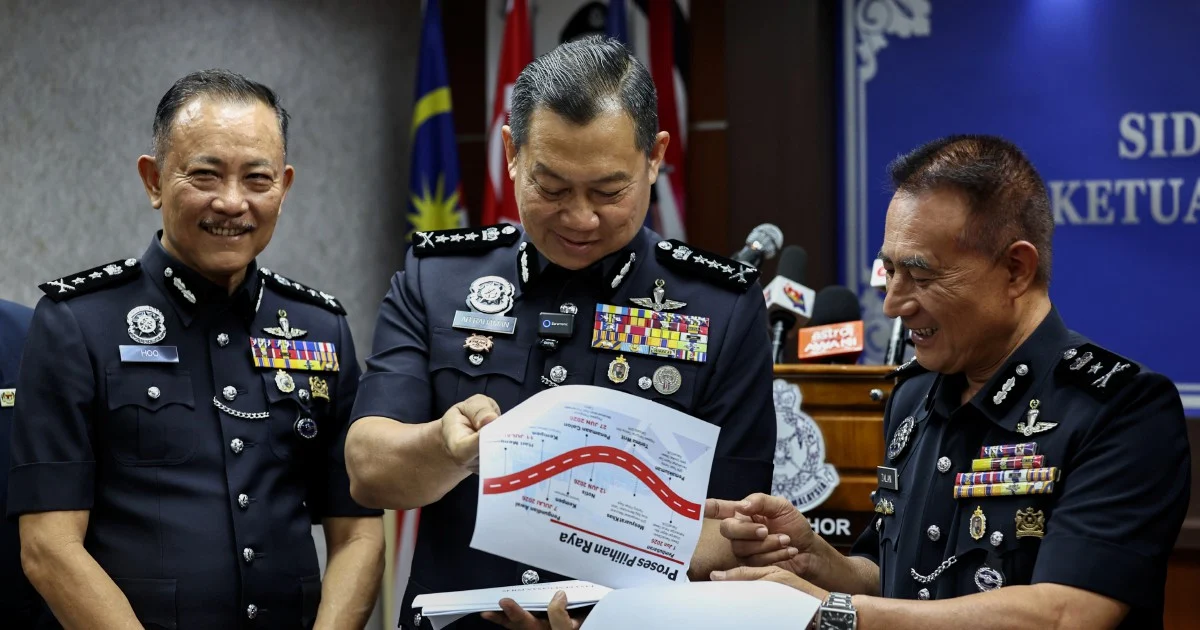
Johor's police force is rolling out one of the largest security operations for a state election, deploying over 11,000 officers to safeguard the electoral process during the 16th Johor state election. The massive police presence underscores official concerns about potential disorder and reflects the seriousness with which authorities are treating the democratic exercise in Malaysia's southernmost state, a political battleground that has witnessed competitive campaigns in recent years.
The deployment strategy represents a comprehensive security footprint that extends across the entire state. Police have methodically identified 39 hotspots—locations deemed vulnerable to unrest, crowd control issues, or electoral violations—that will be subject to intensified monitoring and rapid response capabilities. This targeted approach combines broad presence with concentrated attention on areas where tensions are historically highest or where particular operational challenges have been anticipated.
The identification of these hotspots reflects extensive intelligence gathering and operational experience from previous elections. Security planners have drawn on historical patterns of electoral incidents, demographic data, and real-time intelligence to pinpoint areas requiring special attention. Such precision in security deployment represents an evolution in Malaysian electoral management, moving beyond uniform distribution of resources toward data-informed positioning that allows authorities to respond more effectively to potential flashpoints.
The scale of this operation carries significant implications for Johor residents and the broader Malaysian electoral landscape. An election involves hundreds of polling stations distributed across constituencies ranging from urban centres like Johor Baru to rural areas in the interior. Managing such geographical diversity while maintaining security standards demands substantial human resources and logistical coordination, explaining the scale of police mobilisation.
Johor's strategic importance as a major industrial and commercial hub makes its election particularly sensitive from a national perspective. The state generates substantial economic activity and hosts significant investments, meaning electoral stability here affects broader market confidence and business operations. This economic dimension compounds the political stakes, elevating the security threshold and justifying the resource commitment.
The deployment reflects contemporary global trends in election security. Many democracies worldwide have expanded police and security presence during voting periods, responding to perceived threats ranging from organised disruption to electoral fraud. Malaysia's approach aligns with these international practices whilst acknowledging local contexts and constitutional frameworks that guarantee peaceful, orderly elections as fundamental to the nation's democratic system.
For ordinary voters, the heightened security presence is intended to create a safe environment for exercising their franchise. Citizens navigating to polling stations will encounter increased visible police presence, checkpoint procedures, and enforcement of electoral regulations. Whilst such measures can potentially create procedural friction or perceptions of surveillance, authorities argue that the deterrent effect and rapid-response capacity justify any minor inconveniences for voters.
The identification of 39 specific hotspots also indicates confidence in Johor police's analytical capabilities and intelligence networks. Such precision targeting suggests police have moved beyond generic security protocols toward sophisticated threat assessment. This capability building reflects investment in police training, intelligence infrastructure, and inter-agency coordination that extends beyond election periods but becomes particularly visible during high-stakes political events.
From a regional perspective, Johor's elections increasingly attract attention beyond Malaysia's borders. The state's economic ties with Singapore and its role as a transport and logistics gateway to Southeast Asia mean that electoral stability here has cross-border implications. Disruptions could affect supply chains, investment flows, and the broader security environment in one of Asia's most strategically significant sub-regions.
The deployment timeline and coordination with other agencies—including electoral commission officials, local authorities, and potentially armed forces assets—requires meticulous planning. Police must balance their security mandate with maintaining electoral integrity, ensuring that the security presence itself does not inhibit voter turnout or become perceived as politically biased toward particular candidates or coalitions.
These security preparations also signal to Johor's diverse population—encompassing multiple ethnic groups, religious communities, and socioeconomic backgrounds—that the state government and police take their safety seriously. In plural societies like Malaysia, perceptions of fairness and even-handedness in security operations are crucial for post-election legitimacy and social cohesion, regardless of which coalition ultimately claims victory.
Looking forward, the lessons learned from this election will likely inform future security planning for Johor and other states. If the operation proceeds smoothly with minimal incidents, it validates the data-driven approach to hotspot identification and suggests this model could be refined and potentially adopted elsewhere. Conversely, any significant incidents would trigger reviews of the strategy and possibly lead to further adjustments in how Malaysian states approach electoral security.

