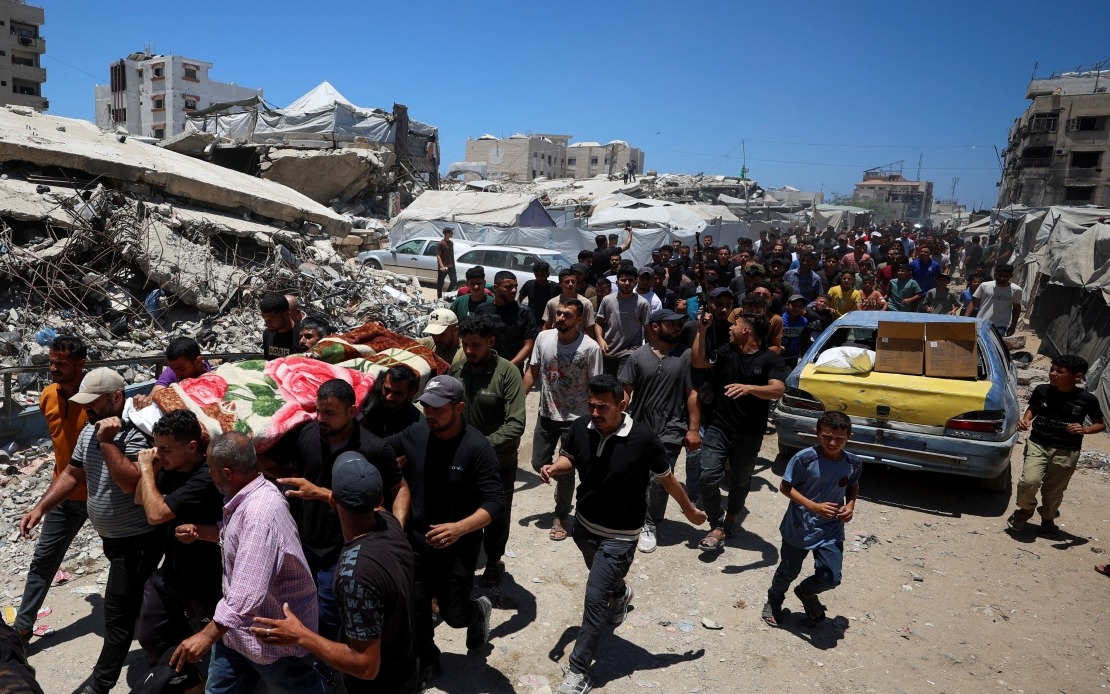
Israeli military operations have claimed the lives of 1,021 Palestinians since the implementation of the Gaza ceasefire, according to a situation report released by the Palestinian Prime Minister's Office this week. This grim figure brings the total death toll in the enclave since October 2023 to 73,032, underscoring the scale of the conflict that has ravaged the territory. The report, issued through the Government Communication Centre, paints a bleak picture of conditions on the ground despite the ceasefire arrangement, raising troubling questions about the sustainability of any peace accord when military operations continue unabated.
The humanitarian landscape in Gaza has continued its downward trajectory, with the Palestinian authorities documenting persistent Israeli bombardments alongside severe restrictions on the flow of aid into the territory. Clean water shortages have reached critical levels, forcing the vast majority of Gaza's population to depend almost entirely on humanitarian assistance for their survival. These restrictions on aid delivery operate at multiple levels—from border controls to movement limitations within the territory—creating a cascading effect that leaves entire communities isolated from basic supplies. The deterioration is particularly acute in areas that have experienced intense military operations, where the combination of destruction and access denial creates conditions approaching complete humanitarian collapse.
Nearly one million Palestinians are currently sheltering in makeshift tent camps following the widespread destruction wreaked by Israeli military operations. According to the Palestinian authorities, 76.6 percent of Gaza's housing stock has been either destroyed or severely damaged, displacing families who had already endured years of economic hardship and political instability. This scale of residential destruction is without precedent in recent Middle Eastern conflicts and has created an unprecedented humanitarian emergency. The tent cities represent not temporary displacement but rather a fundamental restructuring of Palestinian life, where entire families—multi-generational households—now live in canvas shelters without proper sanitation, electricity, or protection from the elements.
Recent Israeli military actions have extended across multiple population centres within Gaza, with reported air and drone strikes targeting Nuseirat, Al-Mawasi, Khan Younis, and Gaza City. Each of these operations has resulted in civilian casualties and compounded the existing humanitarian hardships facing residents. The pattern of strikes suggests ongoing military objectives despite the ceasefire framework, raising questions about the true scope and enforceability of any agreement. International observers and humanitarian organizations have documented the civilian toll, with particular concern over attacks on densely populated areas where the distinction between military and civilian targets becomes increasingly blurred.
Children have borne a disproportionate toll in the conflict's continuation. According to UNICEF, 265 Palestinian children have been killed and more than 400 others wounded since the ceasefire announcement. These figures represent not abstract statistics but the loss of an entire generation's future potential, with trauma and displacement affecting hundreds of thousands more young people who have survived the immediate violence. The psychological impact on children who have spent formative years under bombardment extends far beyond the conflict itself, with long-term developmental and mental health consequences that will persist for decades. International child welfare organizations have raised alarms about the conditions in which these children are now living, with reports of malnutrition, disease, and developmental delays becoming increasingly common.
Humanitarian access remains severely constrained despite international pressure for unrestricted aid delivery. Oxfam brought concerns directly to the United Nations Security Council, documenting how Israeli restrictions continue to block the movement of life-saving assistance throughout Gaza. The organization's testimony highlighted that even when aid does enter the territory, distribution networks remain fragmented and insufficient to meet the population's needs. This artificial scarcity creates secondary crises—malnutrition, preventable disease outbreaks, and the breakdown of basic services that depend on fuel and medical supplies. The humanitarian organizations working on the ground report that the restrictions are not incidental to military operations but rather appear to be a structural feature of the Israeli approach to Gaza.
Beyond Gaza, the occupied West Bank faces its own escalating crisis of displacement and dispossession. The Office of the United Nations High Commissioner for Human Rights has documented a significant increase in forced displacements across the West Bank, including East Jerusalem, driven by settler violence, home demolitions, movement restrictions, and forced evictions. These actions represent a troubling expansion of conflict dynamics beyond Gaza into the larger Palestinian territories. The pattern suggests a broader strategy of territorial reorganization affecting millions of Palestinians across multiple jurisdictions. For Southeast Asian observers, this expansion of the conflict beyond a single enclave underscores the potential for regional destabilization and humanitarian emergencies that could strain international resources and diplomatic capacity.
Agriculture and livelihoods have suffered catastrophic damage through the actions of Israeli settlers and occupation forces. The Palestinian Ministry of Agriculture documented the destruction of 7,258 trees, including 1,270 olive trees—crops that represent centuries of Palestinian cultivation and represent crucial economic assets for rural communities. The estimated losses total approximately US$5.17 million, a figure that understates the actual economic impact when considering lost harvests, diminished export capacity, and the destruction of agricultural infrastructure. Additionally, arson attacks have targeted religious sites, including two mosques in Jiljilya and Mazra' al-Nubani, suggesting a deliberate campaign to damage civilian and cultural infrastructure. These attacks on agricultural resources and religious buildings represent an assault on Palestinian economic survival and cultural identity.
Military operations in the northern West Bank have displaced thousands of Palestinians from refugee camps in Jenin, Tulkarem, and Nour Shams since the beginning of 2025. More than 33,000 Palestinians have been forced from these established communities, creating new refugee flows and straining already-limited shelter and service capacity. These camps represent decades-old Palestinian communities with established institutions, schools, and social networks. Their destabilization adds another layer to the humanitarian crisis, as displaced persons from these areas often lack basic documentation and access to services in new locations. The displacement appears systematic rather than incidental to specific military objectives, suggesting deliberate population movement strategies.
Conditions in Israeli detention facilities have deteriorated significantly, with Palestinian prisoners' institutions documenting overcrowding, disease spread, and inadequate medical care. Reports indicate that detention facilities are operating well beyond designed capacity, creating conditions that pose serious health risks to detainees. The spread of infectious diseases within confined spaces has become a documented concern, with inadequate sanitation and healthcare exacerbating health crises. International monitors have raised concerns about the lawfulness of extended detention without trial and the conditions under which Palestinians are held. These detention practices represent another dimension of the broader conflict affecting Palestinian civilians and creating additional humanitarian concerns.
Despite the security environment and financial constraints, the Palestinian education system has continued to function, preparing approximately 91,000 students for this year's General Secondary Education Examination. Notably, around 37,000 of these students in Gaza are taking examinations electronically for the third consecutive year, a testament to educational resilience amid crisis. The ability to sustain educational continuity represents a crucial investment in Palestinian future development, yet the examination process itself occurs within an environment of trauma, displacement, and material deprivation. The examination system's continuation underscores Palestinian determination to maintain normalcy and educational progress despite circumstances designed to disrupt civilian life. For the broader region, the persistence of Palestinian educational institutions demonstrates the long-term commitment to institutional survival that will shape post-conflict reconstruction and development.

