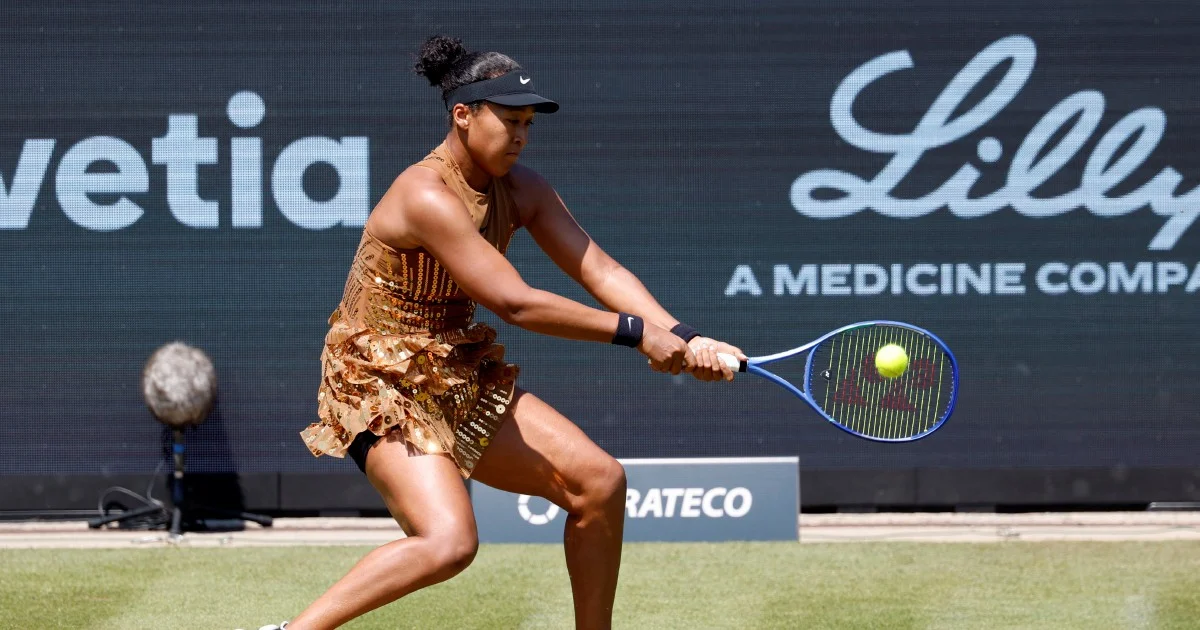
Naomi Osaka has achieved a significant milestone in her professional tennis career by securing a place in her first grass court final. The four-time Grand Slam champion dispatched China's Wang Xinyu in commanding fashion at the Bad Homburg tournament in Germany, marking a breakthrough moment on the surface that has historically presented fresh challenges throughout her career.
Osaka's advancement represents more than just another tournament progression. Her dominance over Wang demonstrated the Japanese star's growing confidence and technical adaptability on grass, a surface where her powerful baseline game must be adjusted and complemented with approach play, net skills, and serve-and-volley sequences. The victory underscores her capacity to compete across all court types at the highest level, a quality that distinguishes the sport's truly elite players from specialists.
For context, Osaka's career has been predominantly built on hard court success, where her thunderous groundstrokes and aggressive baseline positioning have consistently overwhelmed opponents. Her four Grand Slam titles—the 2018 and 2020 Australian Opens, the 2020 US Open, and the 2021 US Open—were all contested on hard courts. This limitation to a single surface, while still phenomenally successful, had occasionally invited scrutiny about the comprehensiveness of her game and her capacity to win on different terrains.
The Bad Homburg tournament, officially known as the Billie Jean King Tennis Center at Bad Homburg, holds particular significance in the women's tennis calendar. Held in the weeks immediately preceding Wimbledon, it serves as a crucial preparation event for players seeking to fine-tune their grass court tactics and build momentum heading into tennis's most prestigious championship. Osaka's final appearance here positions her with valuable rhythm and confidence as she looks ahead to her Wimbledon campaign.
Wang Xinyu, the Chinese competitor who fell to Osaka, has been developing into a formidable presence on the professional circuit. However, the gulf in experience and big-match temperament between a four-time Grand Slam winner and a rising player typically manifests in precisely these circumstances—during high-pressure knockout encounters at significant tournaments. Wang's loss, while disappointing, represents the reality of facing one of the sport's established champions in a final-four scenario.
Osaka's path to the final also reflects broader trends in women's tennis regarding player longevity and comeback narratives. The Japanese star had taken extended breaks from competition in recent years to address mental health concerns and maintain overall wellbeing, receiving widespread support from the tennis community and beyond. Her return to competitive tennis and her capacity to still compete at the highest level demonstrates that these breaks, rather than diminishing her competitive edge, may have contributed to her sustained excellence.
The grass court surface itself remains one of tennis's most unpredictable variables. Its reduced bounce, faster pace, and reward for aggressive tactics combine to create a unique competitive environment. Players accustomed to dictating points from the baseline must rapidly incorporate serve-dominated strategies and net aggression into their tactical arsenals. Osaka's success here suggests she has successfully integrated these elements without abandoning the baseline strength that defines her fundamental game.
For Malaysian and Southeast Asian tennis enthusiasts, Osaka's continued excellence carries particular resonance. As a non-European, non-American champion competing at the sport's highest level, she represents the globalisation of elite professional tennis and demonstrates that sustained excellence can emerge from any corner of the world. Her mental health advocacy has also resonated across the region, where similar conversations are increasingly gaining traction within sporting contexts.
The Bad Homburg final itself now becomes a focal point for grass court specialists and observers seeking to understand which players possess the complete skillset necessary to contend for major honours. Osaka's participation elevates the tournament's profile significantly, and whichever opponent she faces across the net will understand the magnitude of confronting a player of her pedigree and current form. The final represents an opportunity for Osaka to claim a significant title on a surface where she had previously achieved limited success, potentially reshaping perceptions of her all-court capabilities heading into the year's remaining major championships.

