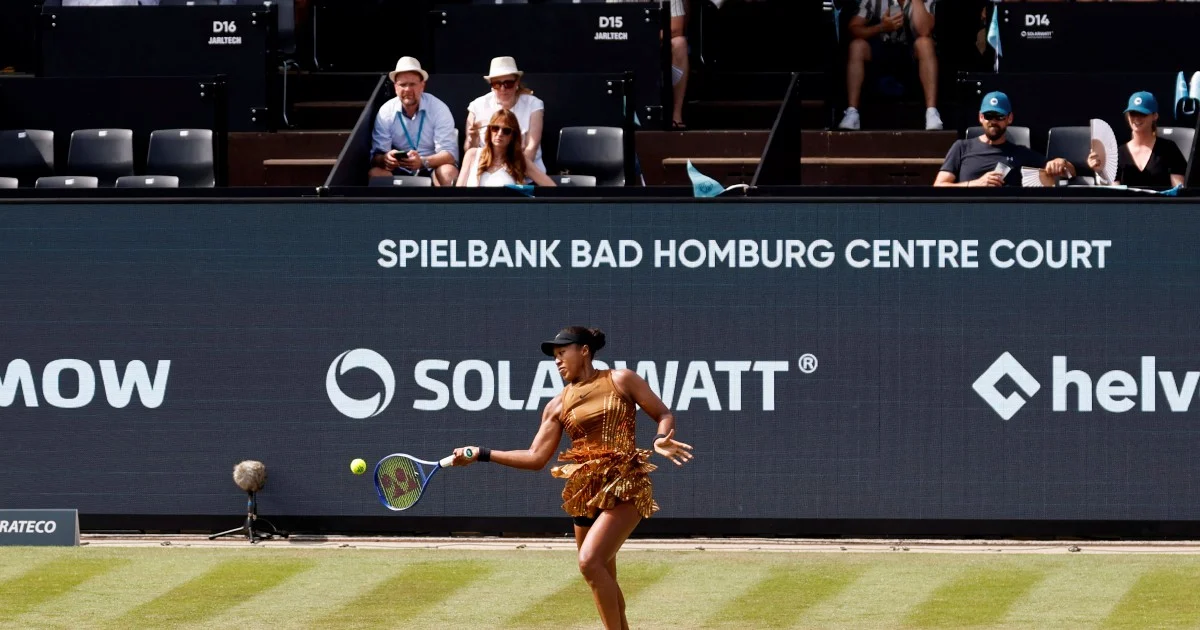
Naomi Osaka advanced to the quarter-finals of the Bad Homburg grass-court tournament in Germany on Tuesday, dismissing Belgian opponent Elise Mertens with a convincing 6-3, 6-3 victory in their second-round encounter. The Japanese star, who had shown signs of struggle early in the match, ultimately demonstrated the composure and court craft needed to maintain her progress through the draw.
Osaka's performance reflected a familiar pattern in her recent tournament appearances—a hesitant opening to proceedings followed by growing command as the match progressed. The early unease, compounded by oppressive heat conditions at the German venue, might have unsettled her against a competitive opponent in Mertens, but the former world number one managed to find her rhythm and impose her game with increasing authority.
The tournament's grass surface, while traditionally one of Osaka's preferred playing environments, initially appeared to cause her some adjustment difficulties. Grass-court tennis demands precise footwork and a willingness to take calculated risks at the net, elements that require immediate comfort with the court conditions. Osaka's opening set showed some of the typical rustiness that grass demands, yet she avoided the crisis moments that might have extended the contest.
Mertens, a seasoned campaigner on the professional circuit who has reached career highs of number 13 in the world rankings, arrived at Bad Homburg seeking to make inroads in a tournament that attracts elite competition. The Belgian player's combination of defensive consistency and occasional aggressive flair has troubled many opponents, but on this occasion, Osaka's superior court positioning and cleaner striking in the critical moments proved decisive.
The weather conditions at Bad Homburg can be particularly challenging for players accustomed to different climatic zones. The combination of heat and humidity, which intensified during the afternoon session when Osaka played, typically favors players with superior movement and lower energy expenditure. Osaka's ability to manage these environmental demands while maintaining focus suggests she is settling into the grass season with growing confidence, despite the initial wobbles.
Osaka's pathway to the quarter-finals represents meaningful progress as she continues her rehabilitation journey following recent inconsistent results on hard courts. The Bad Homburg tournament, held annually since 1995, sits among Europe's premier pre-Wimbledon competitions and provides crucial preparation time on grass before the All England Club championship. For Osaka, reaching the latter stages here offers both ranking points and, importantly, the psychological advantage of competitive match play on the surface.
The victory over Mertens showcased Osaka's capacity to win without necessarily playing her best tennis—a hallmark of experienced champions. Rather than waiting for perfect execution, she managed the match intelligently, reducing unforced errors in the second set while capitalizing on her opponent's difficulties in constructing sustained attacking sequences. This pragmatic approach differs markedly from her earlier career pattern, where she often required rapid ascendancy to secure confidence.
For Malaysian and broader Southeast Asian readers, Osaka's campaign in Germany offers a useful barometer of her form heading into Wimbledon, a Grand Slam where grass-court specialists often prove formidable. While the region boasts emerging players like Zheng Qinwen of China, Osaka's experience and multiple major titles remain benchmarks for aspiring tennis nations across Asia. Her progression through these competitions demonstrates the value of methodical preparation and the importance of tournament play in fine-tuning readiness for larger stages.
Osaka's continued presence in major tournaments and her ability to overcome in-match struggles speaks to both her technical foundation and her evolution as a competitor. The trajectory of her season will be worth monitoring closely, particularly as the grass-court circuit condenses toward Wimbledon. Her advancement at Bad Homburg suggests she possesses sufficient comfort on the surface to pose genuine threats in the tournament's remaining rounds and beyond.

