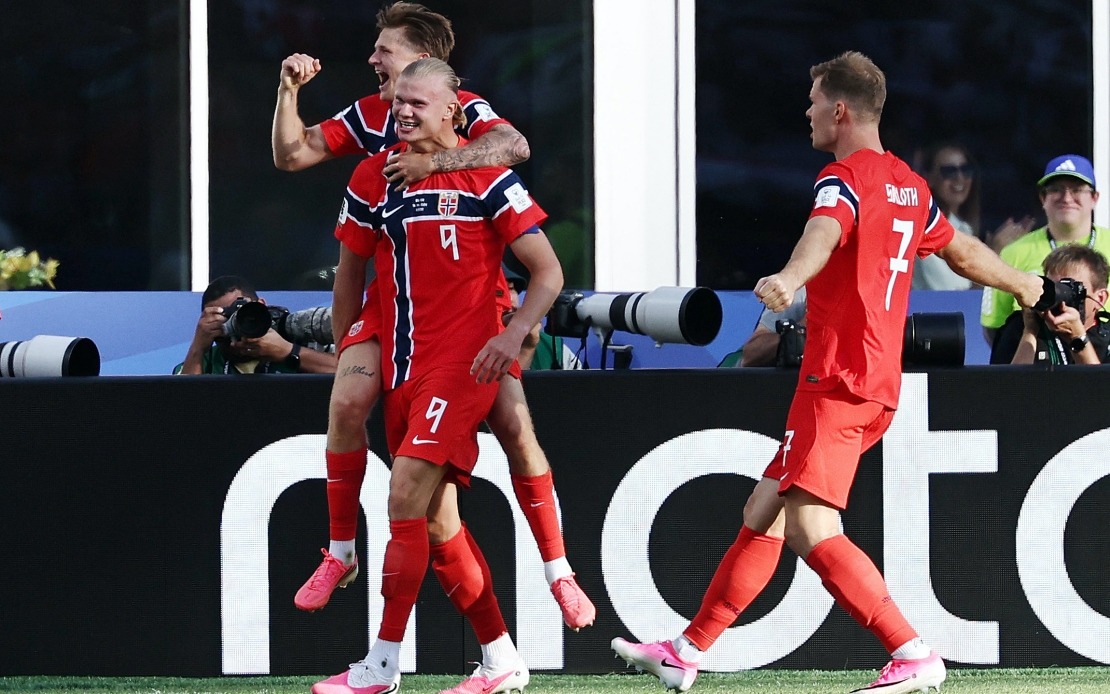
Norway enters the knockout stages of the World Cup with a distinctive narrative woven through its squad: three players are competing to accomplish what their fathers could not three decades ago. Erling Haaland, Alexander Sørloth and Kristian Thorstvedt carry the weight of family ambition as they seek to guide their nation deeper into the tournament than Alf-Inge "Alfie" Haaland, Gøran Sørloth and Erik Thorstvedt managed in 1994, when Norway exited at the group stage on home soil in the United States.
Norway's explosive opening performance set the stage for redemption, with the team demolishing Iraq 4-1 in their first match. This commanding display provided immediate evidence that the current squad possesses the quality to achieve what eluded their predecessors nearly three decades earlier. The victory represents not merely a strong tournament start but symbolic validation that this generation of Norwegian talent can push further than the 1994 contingent, whose campaign ended without reaching the round of 16.
For Haaland in particular, the generational contrast carries peculiar resonance. The Manchester City striker has already surpassed his father's playing career trajectory, establishing himself as one of world football's most lethal marksmen. When shown archival photographs of Alf-Inge Haaland from the 1994 tournament, the younger Haaland expressed amusement at his father's appearance, remarking on how youthful and long-haired he looked in images from three decades past. This generational mirror reflects both the passage of time and the natural evolution of professional football.
Sørloth, plying his trade at Spanish powerhouse Atletico Madrid, carries similar emotional investment in the tournament. He has spoken openly about the profound pride of competing at a World Cup, acknowledging his father's foundational influence on his footballing education. The Atletico forward has emphasized that his father taught him the fundamental principles that undergird his professional career. For Sørloth, participating at the world's premier sporting event represents a convergence of personal aspiration and family legacy, creating motivation that extends beyond typical tournament competition.
Sørloth's earliest World Cup memory offers insight into how family connections with the tournament shaped the current generation. He recalled watching the 2002 World Cup in Japan and South Korea while on holiday in Denmark with his family, remembering vividly the excitement of witnessing the tournament unfold alongside his father. Such moments, seemingly ordinary to outside observers, appear to have crystallized his determination to reach the World Cup stage himself and to perform at a level that honors his father's participation while transcending it.
Norway's path forward presents realistic opportunities for these players to exceed their fathers' achievement. The squad faces Senegal on Monday in a fixture where qualification to the knockout rounds becomes attainable. Subsequently, the group stage concludes against France, a traditional powerhouse that will test Norwegian mettle. However, the infrastructure of the tournament structure means that even progression from the group stage would represent advancement beyond the 1994 generation, creating a clear threshold for generational success.
The broader context of Norwegian football enthusiasm amplifies the significance of this World Cup moment. The country's supporters have generated remarkable displays of patriotic fervor, drawing on Viking heritage through distinctive crowd rituals that have even permeated the Norwegian parliament. Members of the legislative assembly from across the political spectrum participated in official shows of support for the national team, demonstrating that football tournaments possess the rare capacity to unite fractious political communities around shared national identity.
Royal patronage adds another dimension to Norway's tournament campaign. Hereditary Princess Ingrid Alexandra and Prince Sverre Magnus, offspring of Crown Prince Haakon and Crown Princess Mette-Marit, are anticipated to attend the Monday match against Senegal in New Jersey. Royal attendance at sporting events carries symbolic weight in Norwegian culture, signifying official validation of the national team's importance and suggesting that success carries implications beyond purely athletic competition.
For Malaysian and Southeast Asian observers, the Norwegian narrative illustrates broader patterns visible across global football: the professionalization of the sport across generations, the increasing concentration of playing talent within elite European clubs, and the manner in which individual achievement becomes intertwined with national representation. Haaland's presence at Manchester City exemplifies how transcontinental player migration has created complex networks of loyalty and identity, where club and country commitments sometimes create tension.
The unfolding tournament will determine whether Haaland, Sørloth and Thorstvedt can deliver the generational breakthrough their fathers narrowly missed. Their efforts carry genuine sporting significance beyond sentimental value, as Norway possesses sufficient quality to progress meaningfully. Yet regardless of the tournament's ultimate outcome, these three players have already achieved something their fathers could not: the psychological advantage of entering the competition with explicit motivation rooted in family legacy, transformed into fuel for contemporary performance.

