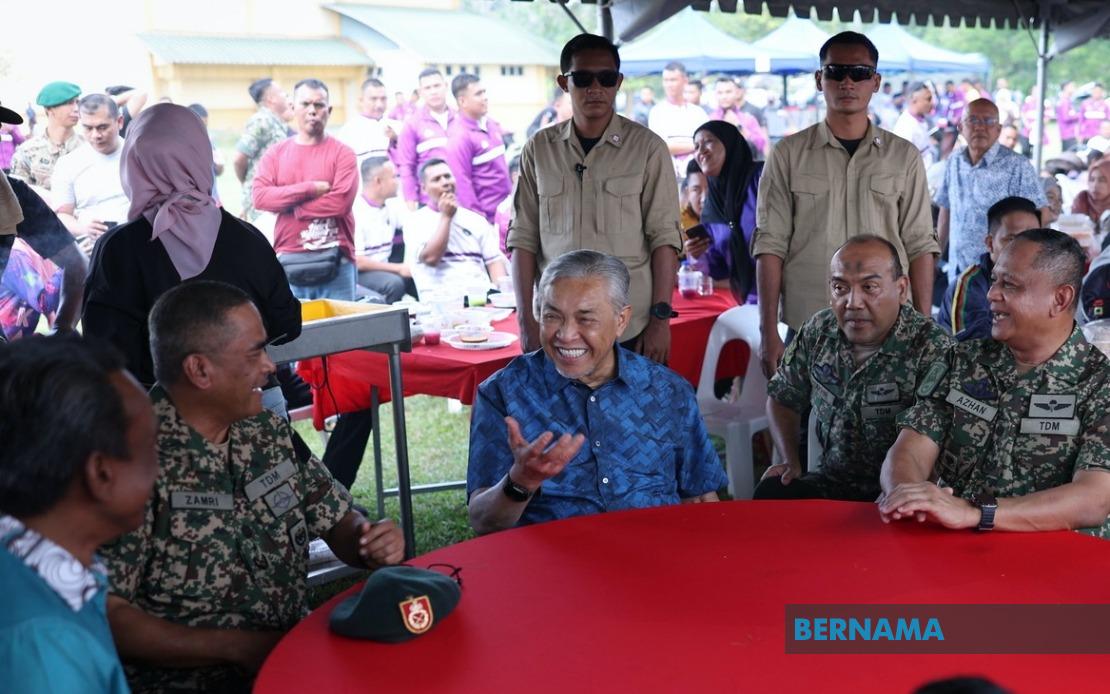
Deputy Prime Minister Datuk Seri Dr Ahmad Zahid Hamidi has made an unequivocal statement that no individual, regardless of position or status, will be exempt from legal consequences if their involvement is revealed in the forthcoming Royal Commission of Inquiry report into the governance and operations of Lembaga Tabung Haji. Speaking at a gathering of military personnel and their families at Kem Syed Sirajuddin in Gamas, the UMNO president and Barisan Nasional chairman emphasized that the inquiry's conclusions must be disclosed to the public without reservation or selective editing.
The Deputy Prime Minister's assertion carries particular weight given the sensitivity surrounding the Tabung Haji inquiry and the public's heightened expectations for institutional accountability. Ahmad Zahid elaborated that once the RCI findings are revealed, appropriate mechanisms within Malaysia's legal framework would be activated to investigate and prosecute any identified misconduct. He referenced the potential invocation of multiple legal avenues, including the filing of police reports related to commercial crimes, abuse of power, irregular conduct, and criminal breach of trust. His language suggests a readiness to pursue comprehensive investigations across both criminal and civil domains, a positioning that appears designed to reassure stakeholders and the broader public that the government intends to take findings seriously.
The timing of Ahmad Zahid's remarks is strategically significant, occurring as Malaysia approaches the Negeri Sembilan state election scheduled for August 1, with early voting set for late July. The release of the RCI report could potentially overshadow the electoral campaign, though Ahmad Zahid expressed confidence that voters in the state possess the maturity and judgment to evaluate political choices independently of the inquiry's disclosures. His characterization of Negeri Sembilan voters as wise and discerning appears intended to insulate the ruling coalition from any electoral damage that the report's contents might generate.
Prime Minister Datuk Seri Anwar Ibrahim, who also serves as Finance Minister, had previously signaled that the Cabinet would likely endorse public release of the RCI findings once formally presented for consideration. Anwar's earlier hesitancy about disclosure, which he attributed to concerns about undermining public confidence in Tabung Haji, has shifted now that the institution has undergone significant structural reforms and garnered international accreditation. This recalibration suggests that the government's institutional confidence has improved sufficiently to withstand the scrutiny that publication would inevitably generate.
The Tabung Haji Royal Commission inquiry represents a critical juncture in Malaysia's governance narrative, as the pilgrimage fund has historically operated with considerable operational discretion and minimal transparency. The establishment of the commission itself reflected public and parliamentary pressure following years of concerns about the institution's financial management, investment decisions, and the extent to which accumulated savings of Muslim pilgrims were being deployed. For many Malaysian Muslims who contribute regularly to the fund throughout their working lives, the RCI represents a potential mechanism for understanding whether their accumulated wealth has been properly stewardarded.
The pathway that Ahmad Zahid outlined for handling any substantiated misconduct mirrors established precedent in Malaysia's investigative and prosecutorial apparatus. Commercial crime investigations typically fall under the jurisdiction of specialized units within law enforcement agencies, while abuse of power allegations would engage the Malaysian Anti-Corruption Commission. The reference to criminal breach of trust invokes specific statutory offences that carry substantial penalties. This institutional layering means that any serious findings would activate multiple investigative streams simultaneously, complicating any potential efforts to contain or minimize the inquiry's implications.
Ahmad Zahid's emphatic statement that no one stands above the law may be interpreted as an implicit response to historical criticisms that high-ranking officials have sometimes escaped accountability despite credible allegations of wrongdoing. By explicitly rejecting the notion that status provides immunity, he is attempting to reposition the government as committed to equitable application of legal standards. Whether this rhetorical commitment translates into substantive prosecutorial action will ultimately determine the credibility of his assurances.
The inquiry's potential revelations carry implications extending beyond the immediate institutional sphere of Tabung Haji. Given the fund's role in Malaysia's Islamic financial ecosystem and its significance to the pilgrimage sector, any systemic problems identified could influence regulatory frameworks governing similar institutions. Foreign investors and international rating agencies monitoring Malaysia's governance architecture will likely scrutinize both the inquiry's findings and the government's subsequent response as indicators of institutional accountability capacity.
For the broader Southeast Asian region, Malaysia's handling of the Tabung Haji inquiry signals something about the region's commitment to transparent governance in religiously significant institutions. Other countries in Southeast Asia with substantial Muslim populations manage comparable pilgrimage-related financial mechanisms, and the standards Malaysia establishes through its response to the RCI will influence expectations and precedents across the region. If accountability is demonstrated robustly, it may encourage similar investigations elsewhere; conversely, if the process becomes mired in political considerations, it may reinforce skepticism about governance accountability in religiously aligned institutions.
Ahmad Zahid's framing of transparency as a prerequisite for institutional restoration suggests that the government recognizes that selective disclosure or minimized findings would likely trigger greater reputational damage than comprehensive exposure followed by demonstrable remedial action. The fund's receipt of international recognition provides political cover for transparency, as the government can argue that institutional strengthening creates conditions in which honest assessment becomes prudent rather than damaging. This reasoning appears to have influenced the shift in the government's posture regarding public disclosure of the RCI report, transforming what had been presented as a vulnerability into an opportunity to demonstrate institutional reform capacity.

