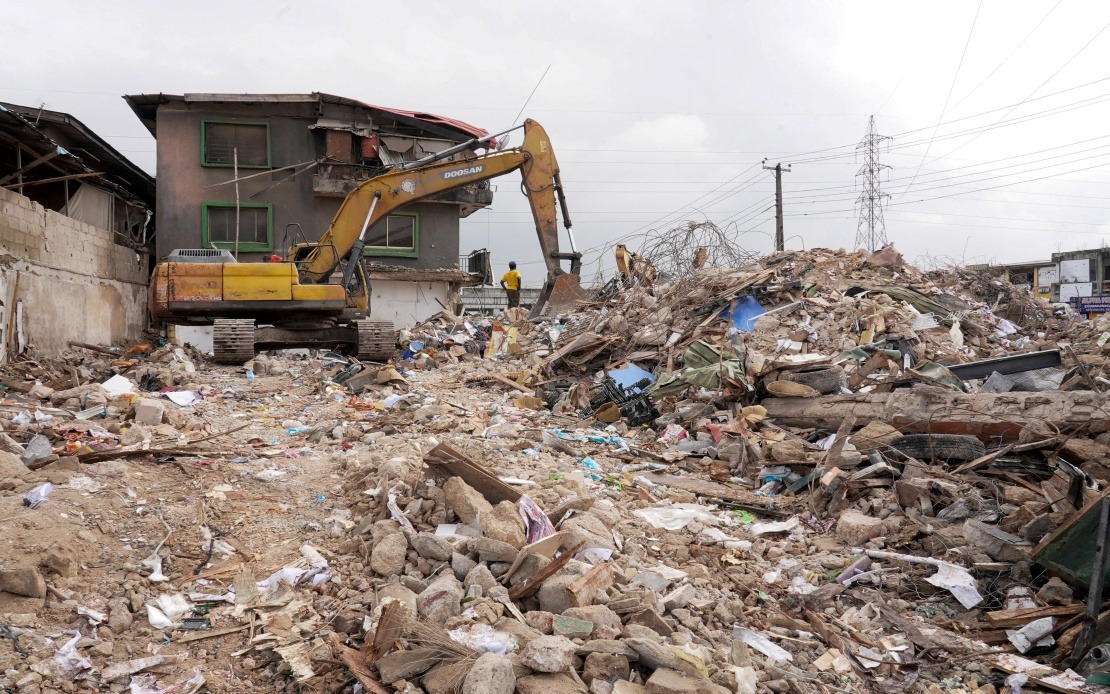
A devastating building collapse in Nigeria's commercial heartland has claimed nine lives, with rescue operations concluding Friday after emergency teams successfully evacuated 27 survivors from the rubble of a three-story shopping complex in Alakija, a rapidly expanding satellite community along the Lagos-Badagry Expressway. The incident underscores the persistent infrastructure challenges facing Lagos and broader structural safety concerns across West Africa's most populous nation.
Emergency responders from multiple agencies launched intensive rescue efforts immediately after the structure gave way on Thursday morning, working continuously through the night to locate and extract individuals trapped beneath tonnes of concrete and steel. The coordinated response demonstrated the capacity of Nigeria's emergency management systems when properly mobilised, though the final casualty toll reflects the severity of the structural failure and the building's occupancy at the time of collapse.
Olufemi Oke-Osanyintolu, the permanent secretary of the Lagos State Emergency Management Agency, confirmed via telephone that rescue teams operated around the clock to systematically search the debris field. The 27 individuals pulled from the wreckage sustained injuries ranging from minor to severe, with all transferred to medical facilities for treatment and observation. Oke-Osanyintolu stressed that all people trapped in the rubble had been recovered, allowing authorities to formally conclude the rescue phase early Friday morning.
Eye-witness accounts and preliminary investigations indicate the shopping complex was actively occupied when it collapsed. Business owners and customers conducting routine commercial transactions became trapped in the disaster, whilst nearby residents were also caught in the building's failure. The mixture of commercial activity and residential proximity highlights the haphazard urban development patterns common in Lagos's outlying areas, where zoning regulations often remain inconsistently enforced and mixed-use development occurs organically rather than through planned infrastructure.
Remarkably, the China Civil Engineering Construction Corporation, currently executing a railway infrastructure project in the vicinity, mobilised equipment and personnel to assist in the rescue operation. This unexpected partnership between a foreign construction enterprise and local emergency services reflects the interconnected nature of Lagos's development landscape, where major projects often coordinate with municipal authorities during crises. Such collaboration, whilst commendable in this instance, also raises questions about the quality control and oversight of construction activities across the city's numerous ongoing projects.
Authorities have indicated that the root cause of the collapse remains undetermined pending formal investigation. This investigative phase will prove critical for establishing whether structural defects, maintenance failures, or construction deficiencies caused the disaster. Understanding the failure mechanism becomes particularly important given similar collapses elsewhere in Lagos and across Nigeria, which collectively suggest systemic problems rather than isolated incidents.
Structural failures in Nigeria occur with troubling regularity, a pattern that engineers and building safety experts consistently attribute to interconnected factors. Ageing infrastructure inherited from previous decades often lacks proper maintenance and structural reinforcement necessary to accommodate contemporary usage loads. Additionally, widespread violations of established building codes—whether through ignorance, negligence, or deliberate cost-cutting—undermine structural integrity. The pervasive use of substandard construction materials, often sourced from unregulated suppliers, further compromises building safety and longevity.
For Malaysian readers, the Lagos collapse offers important comparative insights. Whilst Malaysia maintains more rigorous building code enforcement and construction oversight through established institutions such as the Construction Industry Development Board, the Lagos experience serves as a cautionary reminder of what can transpire when regulatory frameworks weaken or fall into disrepair. The incident also demonstrates that rapid urbanisation, without corresponding infrastructure investment and quality control mechanisms, creates dangerous conditions for residents and workers.
The broader West African context matters too. As cities across the region experience unprecedented population growth, the pressure to rapidly expand housing, commercial, and industrial capacity often overwhelms existing safety mechanisms. Lagos, as a megacity of over twenty million people, operates at the frontline of this challenge, balancing development aspirations against the fundamental imperative to protect citizen safety. The collapse in Alakija represents a failure of this delicate equilibrium.
Investigators will likely examine whether the building possessed appropriate engineering certifications, whether its design complied with Lagos State building codes, and whether construction was executed according to approved specifications. These questions become especially pertinent given that the structure was a three-story commercial complex—a modest height that should theoretically present no structural challenges if properly engineered and constructed. The fact that such a fundamentally simple building failed catastrophically suggests either grossly inadequate design, severely substandard materials, or severe structural deterioration.
The human dimension cannot be overlooked. Each of the nine deceased individuals represented a permanent loss to their families and communities. The 27 injured survivors face varying degrees of physical trauma and potential long-term disability. The psychological impact on those who experienced or witnessed the collapse, as well as on emergency responders confronted with mass casualty scenarios, extends far beyond the immediate casualty figures.
Moving forward, this tragedy should catalyse renewed focus on building code enforcement across Lagos State. Authorities must consider implementing mandatory structural audits of existing commercial and residential buildings, particularly those constructed prior to comprehensive modern building codes. Training programmes for local construction supervisors and materials suppliers could improve overall construction quality. Additionally, investment in emergency response capacity—medical trauma centres, specialised rescue equipment, and trained personnel—remains essential for managing inevitable future incidents whilst prevention mechanisms are strengthened.
The Alakija collapse represents a preventable disaster. Similar buildings in comparable stages of disrepair likely exist throughout Lagos and across Nigeria's other major urban centres, creating ongoing risk. Unless systematic approaches to building safety, regulatory enforcement, and construction quality take priority, such tragedies will continue recurring with depressing regularity.

