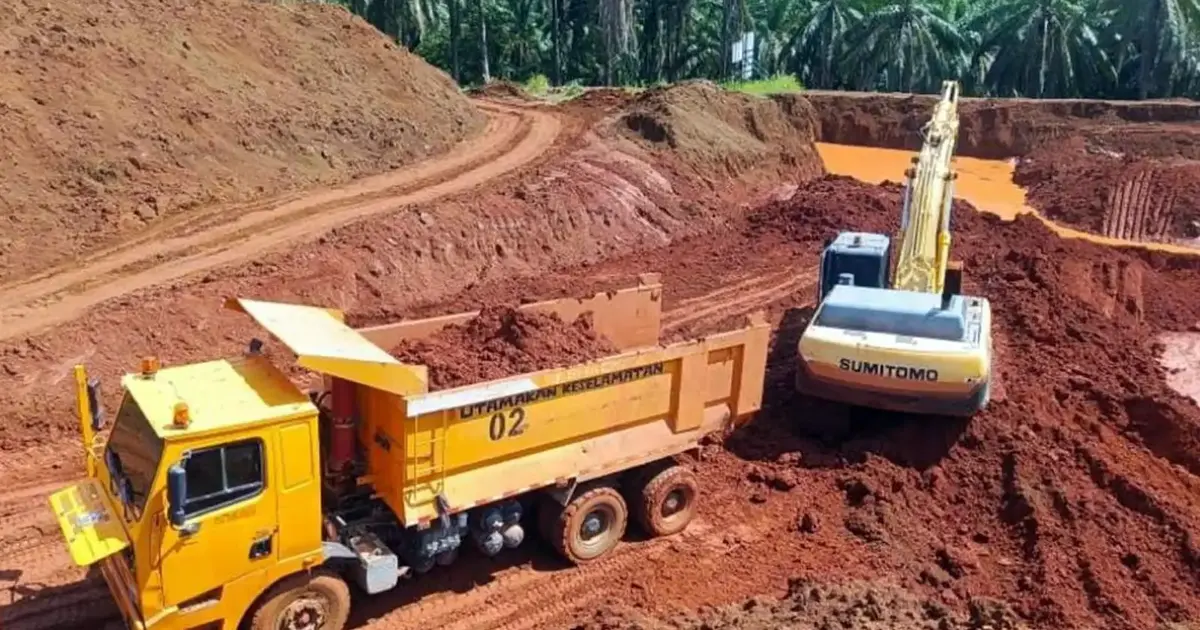
A coordinated law enforcement operation has dismantled what authorities describe as a sophisticated illegal bauxite mining network operating within a Felda plantation, resulting in the arrest of nine individuals and the confiscation of assets worth RM3.75 million. The General Operations Force, which led the operation, indicates that those detained—comprising both Malaysian and foreign nationals—were actively engaged in unauthorised extraction and processing of bauxite, a mineral crucial for aluminium production.
The raid represents a significant enforcement action against informal mining activities that have proliferated across Malaysia's agricultural estates in recent years. Bauxite mining has become an increasingly lucrative but unregulated industry, particularly in states where monitoring of land use remains challenging. The fact that operations were occurring within a Felda holding underscores how mining syndicates exploit both government-owned and private agricultural land, often with minimal resistance from local communities dependent on employment or informal economic arrangements.
The seized assets paint a picture of a well-resourced operation. Beyond the headline figure of RM3.75 million, the confiscated materials would have included heavy machinery, processing equipment, storage facilities, and likely transportation assets necessary to extract and move bauxite to refineries or export channels. Such equipment investment suggests the network had achieved operational scale, possibly serving multiple buyers and generating substantial revenue streams for its operators.
The involvement of foreign nationals in the operation reflects a broader pattern seen across Southeast Asia, where transnational criminal syndicates leverage loose border controls and weak enforcement to establish regional mining networks. These foreign participants typically bring expertise, capital, and crucial connections to downstream buyers, particularly in China and India, where bauxite demand remains insatiable. Their presence in Malaysian mining operations indicates international coordination rather than isolated local enterprise.
For Malaysia, illegal bauxite extraction represents both an environmental liability and an economic leakage. The mining process generates substantial tailings and causes landscape degradation that renders agricultural land unsuitable for cultivation for years afterward. Felda, designed to provide smallholders with sustainable livelihoods, becomes compromised when illegal operations strip mineral value while leaving residents to manage environmental consequences. The RM3.75 million in seized assets also represents revenue that never entered government coffers through legitimate mining permits and taxation.
Enforcement challenges remain substantial. Malaysia's bauxite sector sits at the intersection of multiple regulatory frameworks—agricultural land policy, mining regulations, environmental standards, and customs enforcement—yet coordination between agencies responsible for these domains often proves inadequate. Mining syndicates exploit jurisdictional gaps, operating in border regions or areas where local authorities lack resources to conduct sustained monitoring. The seasonal nature of some bauxite operations, combined with corrupt relationships with local officials, enables networks to resume activity shortly after enforcement actions conclude.
The scale of this particular operation, judged by the asset seizure magnitude, suggests authorities may have been tracking the network for considerable time before executing the raid. Successful busts typically require intelligence gathering, surveillance, and coordination with multiple agencies. The fact that nine individuals were taken into custody indicates the network possessed a defined hierarchy and operational structure, rather than representing casual small-scale extraction. Subsequent investigations may reveal connections to other mining sites and downstream buyers, potentially expanding the scope of prosecutions.
For investors and traders in legal bauxite operations, such enforcement actions create mixed signals. While rigorous prosecution of illegal competitors might theoretically improve conditions for legitimate players, the reality is that legal mining remains heavily regulated and taxed, making it less profitable than black-market alternatives. Companies holding proper licenses often find themselves undercut by illegal producers who incur no compliance costs. This dynamic suggests that enforcement alone, without complementary policy reforms—such as simplified licensing procedures or reduced tax burdens on legitimate operators—will struggle to displace informal mining.
The implications for Felda are particularly significant given the government agency's mandate to support smallholders. If resident farmers leased land or tacitly permitted mining operations, they may face consequences, though enforcement against individual farmers typically proves difficult. More broadly, the incident highlights vulnerabilities in land governance within Felda schemes, suggesting the organization may need to strengthen perimeter monitoring and security infrastructure. Intelligence-sharing between Felda management and law enforcement agencies requires strengthening to prevent future incursions.
Moving forward, this case will likely feature prominently in regional discussions about mining governance and transnational organised crime. Malaysian authorities will need to demonstrate that initial enforcement translates into sustained pressure, with successful prosecutions and asset forfeiture that deters future operations. Intelligence agencies should investigate the downstream destinations of bauxite, potentially revealing buyer networks and enabling targeted disruption at export points. Cooperation with Customs authorities and port operators becomes essential to intercept shipments before they reach international markets.
The broader context sees Malaysia grappling with the tension between controlling informal mineral extraction and managing its resource wealth. Bauxite remains valuable, with global demand driven by renewable energy infrastructure and transportation electrification. Rather than viewing bauxite solely as a problem requiring enforcement, policymakers might consider how legalised, regulated, and sustainably managed extraction could generate government revenue while providing economic opportunities. Until governance frameworks improve, however, operations like the one disrupted in this Felda raid will continue emerging, with enforcement remaining reactive rather than preventive.

