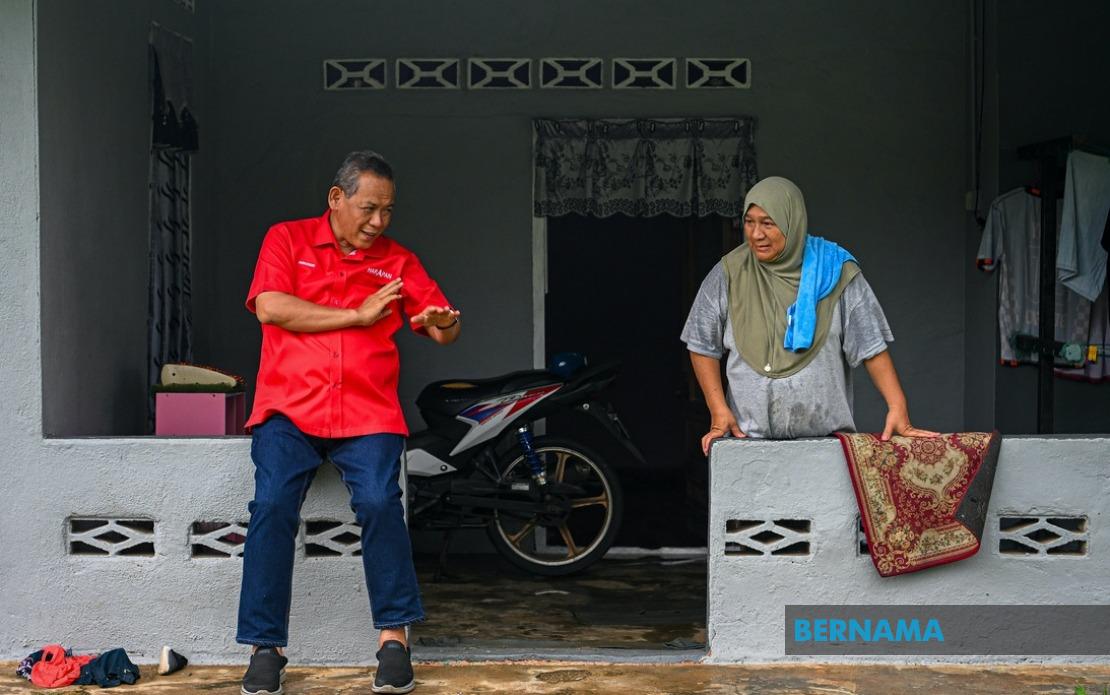
Pakatan Harapan enters the Negeri Sembilan state election campaign with its central message anchored to the governance credentials of incumbent Menteri Besar Datuk Seri Aminuddin Harun, betting that his nearly two terms in office have earned sufficient voter confidence to deliver the coalition another electoral mandate. The coalition's strategy represents a deliberate pivot towards emphasising stability and clean administration rather than grand policy pronouncements, reflecting a broader recognition that state-level governance increasingly hinges on perceptions of competence and integrity rather than federal political dynamics alone.
PH election director Datuk Seri Amirudin Shari, who simultaneously serves as Selangor Menteri Besar, disclosed that the opening phase of campaigning has generated considerably positive sentiment among grassroots supporters. Over the first three days of canvassing, party workers reported consistent favourable responses to messaging centred on accountable leadership and service delivery, suggesting that the coalition's emphasis on clean governance has found traction beyond traditional urban constituencies. This feedback loop—from party machinery to leadership—indicates that PH perceives genuine alignment between its campaign theme and voter sentiment on the ground.
The credibility factor looms particularly large in the coalition's calculus. Aminuddin's dual position as both Menteri Besar and Port Dickson Member of Parliament has afforded him visibility across multiple constituencies and administrative layers, allowing him to cultivate a personal brand less tethered to partisan volatility. Amirudin highlighted that the absence of major corruption scandals or administrative failures during PH's tenure in the state has fundamentally altered voter perception, effectively neutralising one of the opposition's traditional attack vectors. When a political coalition can credibly claim that its government has delivered governance untainted by major controversies, the resulting electoral advantage proves substantial, particularly among swing voters increasingly fatigued by political instability.
The campaign machinery itself appears well-resourced and coordinated. Amirudin emphasised that PH's organisational infrastructure at grassroots level represents a structural advantage, built through sustained engagement over nearly two electoral cycles. Such ground-level presence translates to more effective voter mobilisation, superior intelligence gathering regarding constituency-specific issues, and faster response capacity to opposition attacks. In Malaysian electoral contests, this organisational difference between establishment coalitions and challengers frequently determines outcomes in marginal constituencies where elections are genuinely contested.
Federal leadership, particularly Prime Minister Datuk Seri Anwar Ibrahim's continued endorsement, features prominently in the coalition's strategy. Amirudin explicitly referenced the Johor state election outcome, noting that public confidence in Anwar translated into electoral gains for PH candidates. This federal spillover effect remains particularly relevant in Negeri Sembilan, a state geographically proximate to the federal capital and thus exposed to national political discourse. Anwar's personal credibility—hard-won through his premiership performance over recent months—potentially confers electoral benefits to state-level coalition candidates, though this advantage carries inherent fragility should federal performance deteriorate or national sentiment shift markedly.
PH's manifesto, scheduled for launch during the campaign period, represents the coalition's platform for securing a fresh mandate. By design, it bridges ongoing initiatives from the previous state government with newly proposed development and economic schemes. This balanced approach acknowledges voter expectations that re-elected administrations should deliver continuity of proven programmes whilst simultaneously proposing fresh initiatives demonstrating forward momentum. The manifesto's emphasis on the people's economy aligns with broader Malaysian electoral trends favouring tangible economic benefits and household income support over abstract governance principles.
The electoral arithmetic fundamentally constrains PH's ambitions. In the 2023 state election, the coalition captured 17 seats against Barisan Nasional's 14 and Perikatan Nasional's five seats. This configuration means PH controls the state decisively but lacks the overwhelming majority that would insulate it from internal defections or coalitional fragmentation. Every seat contests matters considerably, as even modest swings could alter the legislative balance and complicate government formation. Consequently, PH cannot assume that incumbency advantage alone guarantees victory; the coalition must actively defend its traditional support base against opposition advances.
The electoral register has expanded considerably, with 889,490 registered voters now eligible to participate. This figure comprises 867,151 ordinary voters alongside 16,884 military personnel and their spouses and 5,455 police personnel participating as early voters. Early voting on July 28 precedes general polling on August 1, a schedule that provides PH several advantages: military and police voting blocs historically demonstrate different demographic and regional characteristics than the general population, often favouring establishment coalitions, and early voter turnout patterns frequently offer reliable indicators of broader electoral trends.
The state legislative assembly dissolution on June 5 initiated the formal electoral calendar, establishing a compressed campaign period requiring efficient resource deployment and messaging discipline. For PH, this condensed timeframe necessitates rapid conversion of positive grassroots feedback into actual votes, a conversion process that frequently encounters complications as campaigns progress and opposition narratives gain resonance. The coalition's reliance on Aminuddin's personal credibility paradoxically introduces vulnerability, as any negative news regarding the Menteri Besar—however marginal—could undermine the consistency of messaging upon which the entire campaign architecture rests.
Regionally, Negeri Sembilan's election carries significance extending beyond state boundaries. The outcome will shape perceptions regarding PH's electoral trajectory as the federal coalition approaches mid-term, providing either reinforcement or challenges to the narrative that Anwar's government has restored public confidence after years of political turbulence. A decisive PH victory would validate the coalition's claim that it retains voter support, whilst any narrowing of margins or unexpected opposition advances would inject uncertainty into federal political calculations and potentially embolden internal coalition critics questioning the federal government's direction.
The opposition remains diffuse and without clear strategic focus. Barisan Nasional's campaign necessarily emphasises BN's historical governance record whilst attempting to distinguish itself from current federal arrangements, a delicate positioning requiring careful messaging. Perikatan Nasional's presence, though marginal, could fragment opposition consolidation by competing for anti-establishment voters, potentially benefiting PH if opposition votes split across multiple challengers. However, PH cannot assume fractionalised opposition will automatically translate into victory; disciplined opposition coordination could substantially complicate the coalition's path to retaining its mandate.
Ultimately, the Negeri Sembilan election will test whether governance performance and administrative competence resonate sufficiently with voters to overcome partisan fatigue and opposition mobilisation. PH's strategy—centring on Aminuddin's track record rather than broader ideological appeals—represents a pragmatic recognition that state-level elections increasingly hinge on evaluations of tangible administrative delivery rather than national partisan narratives. Whether this emphasis on clean governance translates into sustained voter support across diverse constituencies remains the fundamental question driving campaign strategies through early August.

