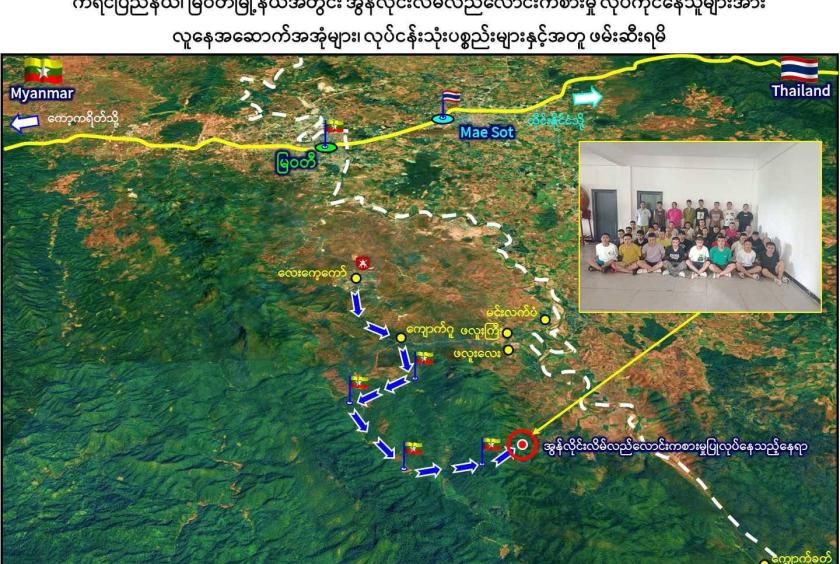
Myanmar's military and security forces have launched one of their largest operations against organized cybercrime, detaining 777 individuals accused of orchestrating online fraud and illegal gambling schemes in the Kyauk Khat area of Myawaddy Township in Kayin State. The scale of the arrest—alongside the seizure of sophisticated communications and computing equipment—underscores the region's persistent struggle with transnational criminal networks that exploit digital infrastructure to defraud victims across Asia and beyond.
The detained individuals reflect the deeply international character of these operations. Among those arrested, 631 are Chinese nationals, three are Thai, and 143 are Myanmar nationals. This composition reveals a pattern long observed by regional law enforcement: major scam hubs in Myanmar and other parts of Southeast Asia typically operate as franchises controlled by organized crime syndicates based in China, who recruit local participants as operational staff and middle management. The presence of Thai nationals suggests coordination across multiple border regions, a concern that extends beyond Myanmar's immediate geography.
The equipment recovered during the raid provides concrete evidence of the sophistication these criminal enterprises have achieved. Security forces secured a Starlink satellite terminal—a crucial piece of infrastructure for maintaining communications when conventional internet connections are monitored or restricted. Additionally, authorities confiscated 85 computers and 183 mobile phones, devices that would have been deployed to manage victim databases, coordinate multiple fraud schemes simultaneously, and maintain operational security against law enforcement detection. The recovery of such technology indicates these were not amateur operations but well-resourced criminal organizations with substantial capital investments.
According to government accounts, the raid occurred after intelligence suggested illegal scam compounds were operating in the region with minimal interference. Myanmar's leadership has repeatedly expressed concern about these operations, particularly because they generate foreign currency for armed groups and undermine the nation's international reputation. The timing and scale of this operation suggest sustained pressure from higher levels of government to demonstrate commitment to dismantling these networks, a message reinforced through public announcements of the arrests.
The operation unveiled a troubling dimension often obscured in official statements: the nexus between criminal enterprises and armed resistance groups. Authorities claim that during the raid, personnel from the Karen National Liberation Army (KNLA) and the People's Defence Force (PDF) actively engaged security forces in combat, allegedly having been paid to provide protection to scam compounds. This allegation—that armed groups opposing Myanmar's military government were accepting payment to shield criminal networks—raises uncomfortable questions about the sources of funding for these militias and the extent of coordination between transnational crime and regional conflict dynamics.
The military reported 13 casualties among armed group members, along with the seizure of nine firearms, ammunition supplies, and bunker fortifications. These figures, while presented as victories, also indicate that scam operators had invested substantially in military-grade defensive infrastructure. The presence of entrenched positions suggests these were not temporary operations but semi-permanent facilities, indicating that local authorities either lacked capacity or will to address the problem independently before this operation.
For Malaysian observers and regional policymakers, this raid illustrates a critical vulnerability in Southeast Asia's cybersecurity landscape. Scam operations based in Myanmar frequently target victims across the region, including Malaysia, Thailand, and Singapore. Fraudsters using these hubs conduct everything from investment scams and cryptocurrency theft to romance fraud and job recruitment schemes. Victims in Malaysia have reported losing significant sums to networks believed to operate from locations precisely like those targeted in Myawaddy. The international nature of these crimes means that disrupting them requires sustained cooperation between neighboring governments and law enforcement agencies.
MyanmarMar's stated commitment to working with international partners and neighboring countries to dismantle scam networks suggests recognition that unilateral action has limited effectiveness. Cross-border criminal operations require intelligence sharing, joint operations, and coordinated prosecution strategies. For countries like Malaysia, maintaining diplomatic channels with Myanmar specifically to address cybercrime has become increasingly important, despite broader political tensions arising from Myanmar's internal instability.
The investigation phase for detainees will prove critical in determining whether this raid becomes a genuine breakthrough or a temporary disruption. Prosecutors will need to establish individual culpability while also mapping the broader organizational structure—identifying leaders, financial flows, and networks extending beyond the immediate facility. Successful prosecutions could pressure criminal syndicates to relocate, though likely only to other permissive environments within the region.
The confiscation of technology and communications infrastructure will temporarily degrade operational capacity, but criminal networks with adequate funding can quickly replace seized equipment. More consequential would be the apprehension of key operational leaders and disruption of financial flows that sustain these enterprises. Intelligence derived from seized devices—including victim lists, transaction records, and communications with handlers—could potentially enable law enforcement across multiple countries to identify and recover funds for Malaysian victims while enabling prosecutions elsewhere in the region.
MyanmarMar's broader security situation complicates long-term efforts to eliminate these scam hubs. The coexistence of multiple armed groups, weak state control over border regions, and limited economic opportunities in peripheral areas creates persistent conditions that criminal syndicates exploit. Until Myanmar achieves greater political stability and extends meaningful governance to border regions, transnational criminal organizations will find willing partners and permissive operating environments. For Southeast Asia more broadly, this raid represents both a tactical success and a reminder of structural challenges that require sustained regional cooperation and economic development strategies to address comprehensively.

