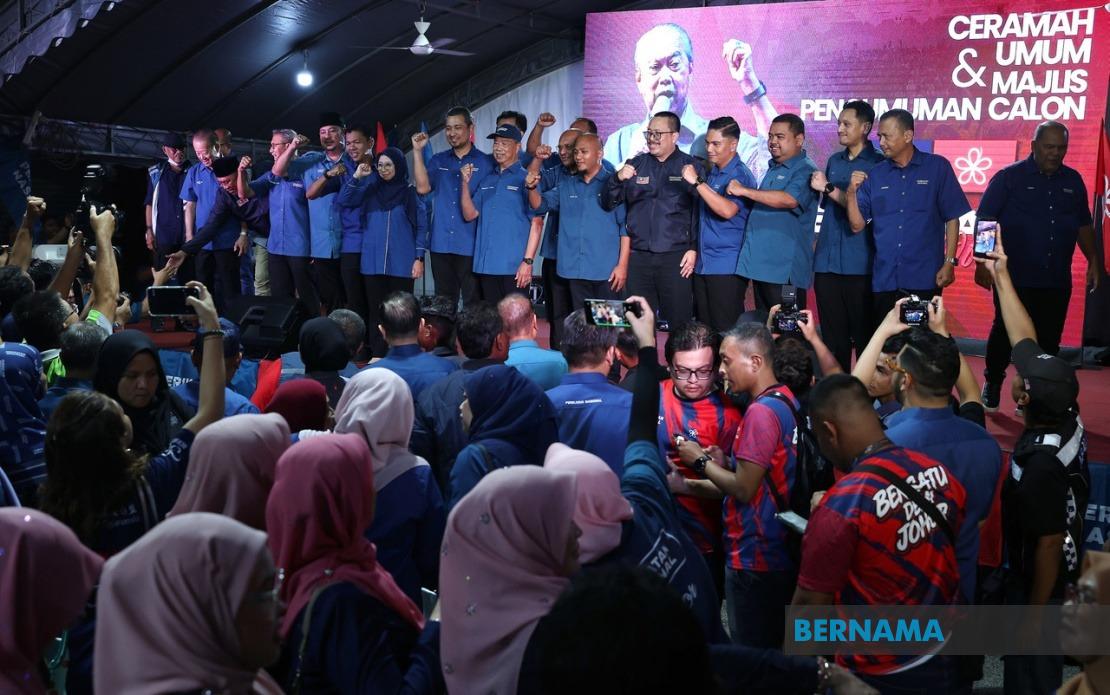
Tan Sri Muhyiddin Yassin, president of Parti Pribumi Bersatu Malaysia, formally presented his party's 16-strong candidate roster for the upcoming Johor State Election at a public gathering in Taman Pagoh Jaya on June 25. The announcement came at a combined candidates presentation and public forum held at the Pagoh Parliamentary Service Centre in Muar, signalling the start of intensive campaigning ahead of the crucial state-level contest that will reshape the political landscape of Malaysia's second-largest state by area.
The revelation of Bersatu's full complement of nominees represents a critical moment for the Malay-Muslim based party, which has positioned itself as a significant player in Johor's fractious political ecosystem. The party's decision to field candidates across all 16 available state seats demonstrates ambitions to capture meaningful representation in the assembly, though the competitive nature of Johor politics means Bersatu will face entrenched rival factions within the broader Malay-Muslim constituency. The inclusion of Mohd Idzharruddin Mohd Nasirruddin as the candidate for N8 Bukit Pasir exemplifies the party's strategy of deploying both established figures and fresh faces to broaden its appeal across different voter demographics and geographic regions.
The Johor State Assembly's dissolution on June 1 set in motion the electoral timetable that culminates in the July 11 polling day. The Election Commission's scheduling of June 27 as nomination day compresses the campaign window into a concentrated ten-day sprint, creating intensity around candidate vetting, manifesto promotion, and voter outreach. This compressed timeframe places particular pressure on state-level parties to mobilise resources efficiently and leverage existing grassroots networks, advantages that established players like Bersatu may exploit more effectively than newer political entrants.
For Malaysian political observers, the Johor election carries significance extending well beyond the state's borders. Johor has traditionally served as a bellwether for national sentiment and as a power base for multiple prime ministers and senior federal leaders. The performance of Bersatu in this contest will provide crucial indicators about the party's grassroots organisation, candidate quality, and voter receptivity following its merger with Umno in 2023 and subsequent navigations of intra-coalition tensions. Success in capturing seats could enhance Bersatu's negotiating position within federal government structures and state-level administration, while disappointment might reinforce perceptions of the party's declining influence.
The formation of Bersatu in 2016 under Muhyiddin's stewardship positioned the party as an alternative voice within Malay-Muslim politics, initially drawing disaffected Umno members and newer political participants. Its subsequent rise to prime ministerial office, if brief, elevated the party's profile significantly. However, Bersatu's standing has undergone considerable fluctuation, shaped by internal leadership contests, coalition recalibrations, and the complex dynamics of Malay-Muslim electoral politics where competing claims to represent Bumiputera interests and Islamic values create substantial internal fragmentation.
Johor's political configuration has become increasingly multipolar, with various Malay-Muslim-based parties, Chinese and Indian-based opposition groups, and independent candidates all competing for voter support. Bersatu's strategy of contesting all 16 state seats signals confidence in its ability to appeal across diverse constituencies, though the party must navigate the reality that its voter base overlaps substantially with Umno, PAS, and other competitors claiming similar constituencies. The tactical positioning of candidates, therefore, becomes crucial for minimising damaging splits in the Malay-Muslim vote while still maintaining distinct party branding.
The public ceramah, or political forum, component of Muhyiddin's announcement reflects traditional Malaysian campaign practices, where party leaders address gathered supporters to articulate policy positions, criticise opponents, and energise party members. These grassroots-level engagements remain important mechanisms for building momentum in state-level contests, particularly where candidates lack the same media saturation and name recognition as federal-level figures. Muhyiddin's personal attendance and direct role in introducing candidates underscores his continued grip on party machinery and his determination to present Bersatu as a cohesive force entering the electoral contest.
Regional observers note that Johor elections frequently reveal broader patterns in Southeast Asian electoral behaviour, particularly regarding the interplay between ethnic-based appeals, religious mobilisation, and socioeconomic messaging. The competition between Bersatu and its rivals will likely illustrate how contemporary Malaysian voters balance traditional identity-based voting with emerging concerns around economic management, infrastructure development, and governance quality. Campaign messaging and candidate positioning during the nomination-to-polling period will reveal whether parties emphasise continuity or transformation.
The July 11 polling date provides sufficient time for campaigns to develop, though the compressed calendar means that candidate credibility, existing political networks, and media engagement will prove disproportionately influential compared to longer election cycles. Bersatu's ability to generate momentum from Muhyiddin's visible leadership and the party's candidate announcements will depend substantially on effective resource deployment, strategic alliance-building with coalition partners, and the party's capacity to articulate a compelling vision distinct from competing alternatives. The coming weeks will test the organisational capacity and strategic coherence that Bersatu has assembled since its formation.

