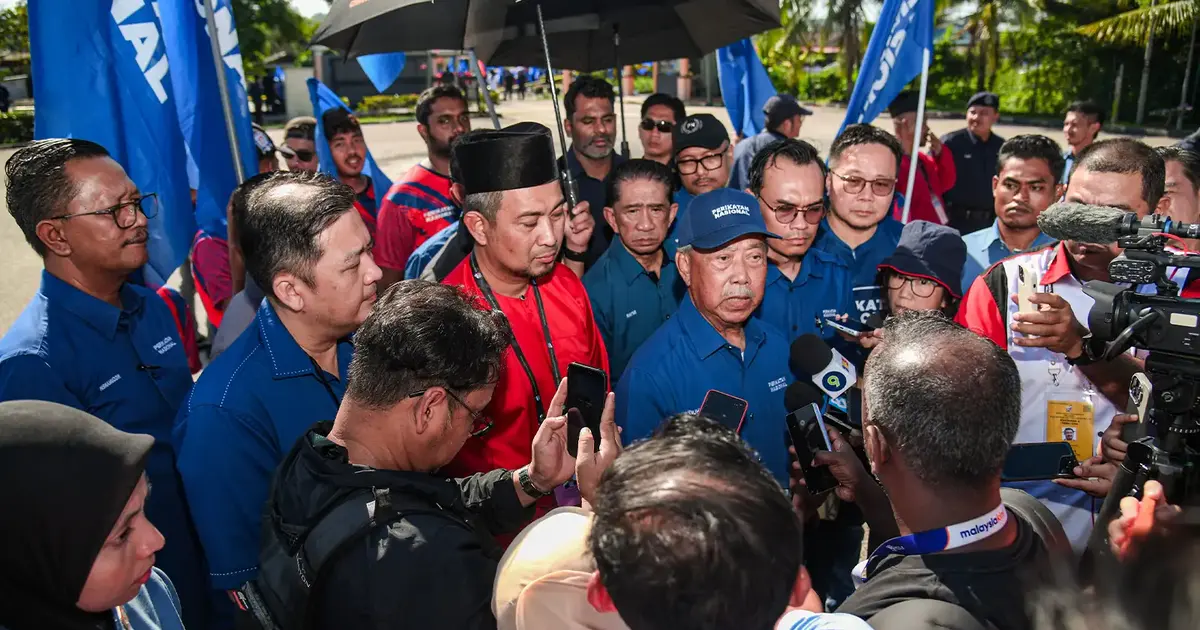
Perikatan Nasional maintains sufficient political firepower to lead a state government formation, according to Bersatu president Muhyiddin Yassin, who underscored the coalition's collaborative relationships extending beyond its formal membership. The statement reflects ongoing calculations within Malaysia's fractured political landscape, where state-level governments increasingly depend on complex multi-party arrangements rather than single-party dominance. Muhyiddin's assertion comes at a moment when Malaysia's political dynamics remain fluid following the 2022 general election, with various coalitions jostling for influence and strategic positioning ahead of potential state-level political transitions.
The Bersatu leader highlighted that Perikatan Nasional's coalition structure has broadened through partnerships with like-minded parties standing outside the formal three-party alliance. Muda, the relatively new political force that contested the 2022 general election, features prominently in Muhyiddin's calculations regarding potential state government configurations. Such alliances demonstrate how Malaysian politics has evolved toward coalition-building that transcends traditional bloc boundaries, with parties capable of negotiating support across ideological and organisational lines. This flexibility in political arrangements has become essential for securing legislative majorities in state assemblies where no single grouping commands overwhelming numbers.
The confidence expressed by Muhyiddin reflects Perikatan Nasional's current standing within Malaysia's complex political ecosystem. The coalition comprises Bersatu, PAS, and Gerakan, representing different constituencies and regional strongholds. While the coalition performed respectably in the 2022 general election, its capacity to translate federal-level performance into state-level dominance remains inconsistent across Malaysia's thirteen state governments. Perikatan Nasional controls several state administrations but faces stiff competition from Pakatan Harapan in others, with Sabah and Sarawak maintaining distinct political dynamics governed by their own established regional parties.
The invocation of external allies, particularly Muda, reveals sophisticated political arithmetic currently underway within Perikatan Nasional's strategic planning. Muda's emergence as a significant political actor, particularly among younger urban voters, provides potential coalition partners with access to demographic segments that traditional parties may struggle to mobilise effectively. By securing Muda's cooperation in hypothetical state government formations, Perikatan Nasional could assemble legislative majorities without requiring cooperation from Pakatan Harapan, effectively consolidating opposition to the incumbent federal coalition across multiple state administrations.
This political maneuvering carries significant implications for Malaysia's constitutional framework and state governance. The ability of various coalitions to form alternative governments depends heavily on the distribution of state assembly seats following elections, defections, and independent alignments. Muhyiddin's statement suggests Perikatan Nasional has conducted thorough assessments regarding potential coalition arithmetic in various states, identifying scenarios where such arrangements could prove viable. The mathematics of state politics have become increasingly complex, with individual representatives capable of commanding premium prices for their support as kingmakers in closely divided assemblies.
The mention of allies beyond the formal coalition structure also signals Perikatan Nasional's awareness that rigid coalition boundaries have become counterproductive in contemporary Malaysian politics. Parties that maintain independence can leverage their pivotal position to extract concessions and cabinet positions, creating incentive structures that reward flexibility over formal alignment. Muda's willingness to negotiate with various coalitions, rather than committing exclusively to any single grouping, exemplifies this emerging pattern where political parties function as strategic actors pursuing specific policy objectives and power-sharing arrangements rather than ideological partners bound by shared vision.
From a regional Southeast Asian perspective, Malaysian coalition politics remain distinctive in their complexity and fluidity. While other democracies in the region experience periodic realignments, Malaysia's system of geographically-defined state governments creates multiple arenas where coalition configurations operate simultaneously. This allows parties to experiment with various partnerships at state level while maintaining different alignments federally, testing viability and compatibility before potentially applying successful models to national politics. Muhyiddin's confidence in Perikatan Nasional's coalition-building capacity reflects this experimental political environment.
The stability of any state government formed under such coalition arrangements remains uncertain. Recent Malaysian political history demonstrates that administrations constructed from loose alliances can prove fragile, particularly when individual assemblymen defect or seek better terms from competing coalitions. Perikatan Nasional's confidence in forming governments must be tempered by recognition that maintaining such arrangements requires continuous negotiation and accommodation of diverse coalition partners' demands. State governments dependent on external allies prove vulnerable to sudden collapses when partner priorities diverge or when competing coalitions offer more attractive terms to wavering assemblymen.
The broader significance of Muhyiddin's statement extends to questions about Malaysia's political future and the structural factors shaping coalition formation. The inability of any single coalition to dominate Malaysian politics decisively has created an environment where multiple governing arrangements remain possible across different states and at the federal level. This pluralistic political configuration reflects deeper social fragmentation along ethnic, religious, regional, and ideological lines that no single party or coalition can effectively bridge. Perikatan Nasional's optimism about state government formation should be understood within this context of limited but real opportunities for alternative political arrangements.
Moving forward, the practical test of Muhyiddin's assertions will arrive when state elections occur or when political circumstances necessitate government formations. At that juncture, the viability of Perikatan Nasional's coalition partnerships will become apparent through concrete negotiations with potential allies. The confidence currently expressed by Bersatu's leadership provides insight into coalition thinking but remains ultimately contingent on electoral outcomes and the strategic calculations of political actors responding to ground-level developments and voter preferences that may diverge from leadership expectations.

