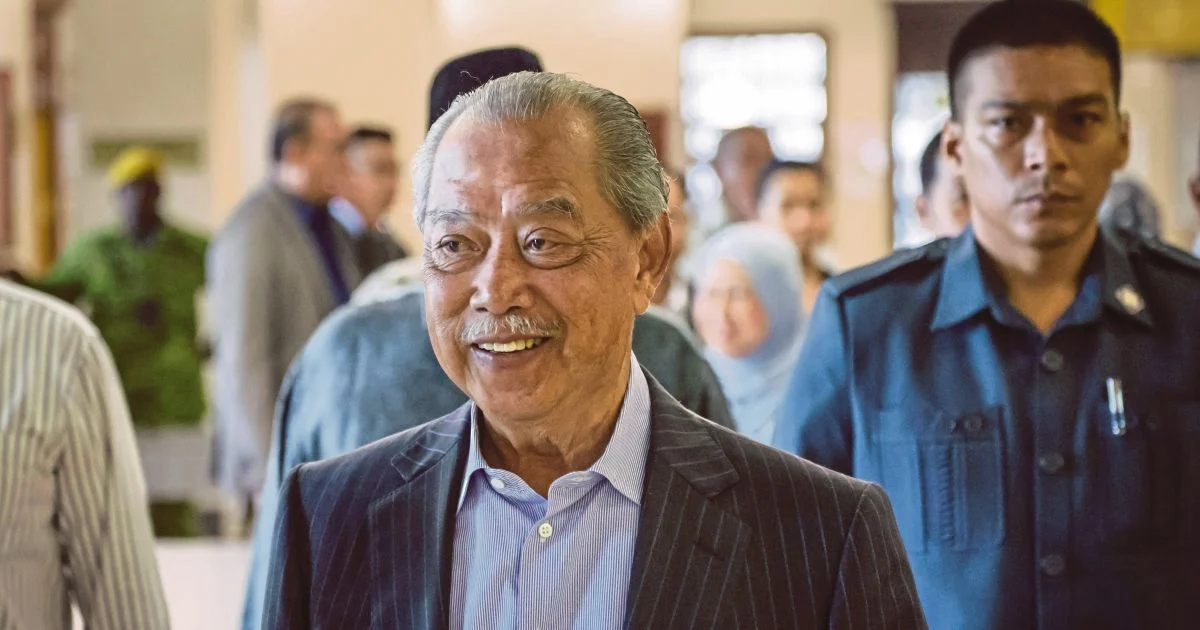
Bersatu president Tan Sri Muhyiddin Yassin has signalled that Perikatan Nasional retains a realistic pathway to power in Johor despite the opposition alliance contesting fewer than two-thirds of the state assembly seats. Speaking in his Pagoh constituency, Muhyiddin suggested that while PN is fielding candidates in just 33 of Johor's 56 seats, the coalition's performance in those contested constituencies could still determine the composition of the next state government.
The strategically selective deployment of candidates reflects a calculated approach to seat allocation within PN's structure, where Bersatu, PAS, and smaller component parties divide the contest across the state. By concentrating resources and campaign momentum on slightly more than half the available seats, PN appears to be prioritizing electoral strength in targeted regions rather than attempting full-slate representation. This targeted strategy has become increasingly common in Malaysian opposition politics, where coalitions seek to maximize vote efficiency in winnable terrain while avoiding dilution of resources across unwinnable ground.
Johor has long been a political prize contested fiercely between federal coalition partners and opposition forces. The state represents a significant prize in the broader political landscape, controlling substantial state revenue and patronage networks that extend across the southern peninsula. Previous state elections have demonstrated the state's tendency to swing significantly between major coalition blocs, making even minority-seat contests potentially decisive for government formation. Muhyiddin's confidence appears anchored in historical precedent rather than any explicit pre-election arrangement.
The dynamics of Johor politics have shifted considerably since the last state election. The state assembly, like most Malaysian legislative bodies, includes seats where particular parties enjoy overwhelming dominance or face near-insuperable obstacles. By avoiding contests in seats where victory appears improbable, PN may be calculating that securing majorities in its chosen battlegrounds is more efficient than spreading campaign personnel and financial resources across the entire state. This mathematical approach treats elections as exercises in constituency-level optimization rather than comprehensive political representation.
Muhyiddin's public confidence serves multiple tactical purposes within the opposition coalition's broader strategic framework. Maintaining member morale during campaign periods requires senior leaders to project optimism and demonstrate conviction that victory remains achievable. Simultaneously, conveying confidence to voters in contested constituencies encourages them to view a PN victory as probable, potentially creating momentum that translates into actual support on polling day. The psychology of electoral contests often proves as consequential as underlying demographic or structural advantages.
The Bersatu leader's remarks also carry implications for inter-coalition negotiations that may follow the election, regardless of its outcome. If PN performs strongly in its contested seats, Muhyiddin can argue that the coalition earned the strongest mandate within the contested terrain, potentially positioning PN to claim the largest share of ministerial positions in any future Johor government. Conversely, if results disappoint, the limited seat count provides a built-in explanation for why broader statewide representation eluded the coalition.
For Malaysian observers, particularly those in Johor, the election carries significance beyond state-level governance. Johor's political direction influences broader peninsular dynamics and sets patterns that other states may follow. A strong PN performance would signal growing opposition momentum in historically significant terrain, while a poor showing would reinforce perceptions of establishment coalition dominance despite its federal-level fragmentation. The state's result will likely shape which parties vie aggressively for support in subsequent state elections across Malaysia.
The strategic decision to contest only 33 seats reflects broader calculations within opposition politics about resource allocation and realistic victory scenarios. While full-slate contests provide symbolism and demonstrate organizational reach, they can dilute campaign effectiveness and inflate defeat tallies when candidates lose badly in hopeless seats. Modern political operators increasingly view elections through management-science frameworks, calculating optimal resource deployment to maximize the desired outcome—in this case, securing sufficient seats for government formation.
Johor's electorate faces a genuine choice between competing visions of state governance, even if the choice is presented across a smaller geographic scope than traditional comprehensive elections. The state has historically served as a policy laboratory where both government and opposition test electoral approaches, administrative innovations, and governance models that subsequently ripple across Malaysia. Results here will influence strategic calculations for parties contemplating their approach to future elections elsewhere.
Muhyiddin's optimism requires unpacking to understand its foundations. The Bersatu president likely bases his confidence on internal polling data, assessment of candidate quality in contested seats, and evaluation of demographic shifts within targeted constituencies. Opposition strategists presumably conducted detailed analysis of which seats represent genuine battlegrounds and which fall more clearly into either government or opposition columns. This sophisticated electoral mapping has become standard practice among Malaysian political organizations with adequate financial and technical resources.
The upcoming Johor election will test whether PN's selective strategy delivers electoral success or proves an overestimation of voter support in contested areas. Should the coalition secure government formation, the approach will be cited as an example of intelligent political strategy; should it fail to reach the majority threshold, questions will inevitably arise about whether broader contestation might have produced different results. For Malaysian democracy, the election represents another data point in the ongoing recalibration of opposition politics against entrenched establishment structures.

