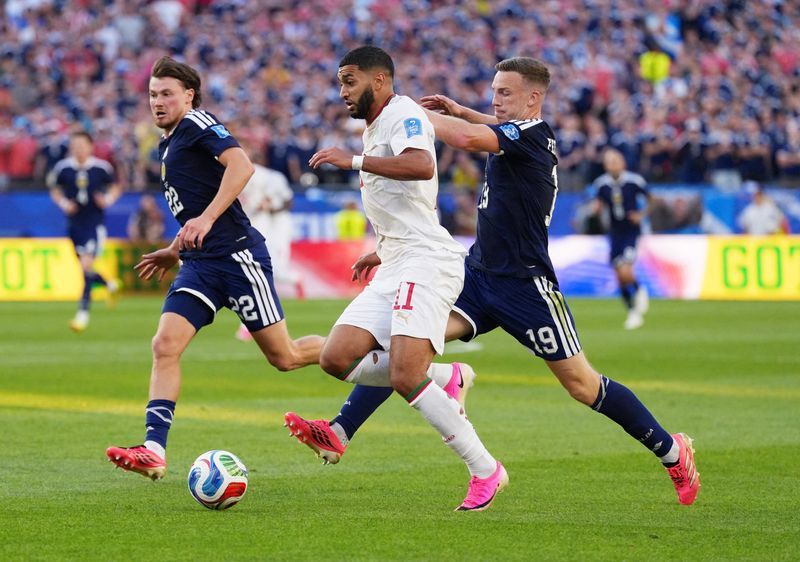
Morocco delivered a masterclass in controlled dominance at Foxborough, Massachusetts, on Friday, brushing aside Scotland with a clinical 1-0 victory that showcased why the North Africans have become genuine contenders in this World Cup. The decisive moment arrived almost before Scotland's supporters had settled in their seats—Ismael Saibari latched onto a Brahim Diaz cross just 71 seconds into the match, accelerating into space after central defender Grant Hanley had stepped out prematurely, and finished with a powerful drive that would prove to be the quickest goal in tournament history.
The victory propels Morocco into the driving seat within Group C with four points accumulated from their opening two encounters, leaving them in prime position to secure automatic qualification for the round of 32 with one match remaining against Haiti on Wednesday. Scotland, meanwhile, find themselves in a precarious position despite having managed three points from two games. Although they enjoyed a morale-boosting 1-0 triumph against Haiti in their opener—their first World Cup victory in 36 years—they now face an uphill battle against five-time champions Brazil on the final matchday, a contest that will determine whether they progress further in the tournament.
What made Morocco's performance particularly impressive was the manner in which they suffocated Scotland's attacking ambitions throughout the contest. The Scottish side entered the match brimming with confidence following their maiden World Cup success in more than three decades, yet they were immediately forced onto the back foot by a Moroccan team that seemed determined to prove their semi-final appearance in Qatar four years ago was no flash in the pan. The visitors demonstrated superior movement, sharper tactical positioning, and an intensity that the Scots struggled to match, transforming the match into a one-directional affair where Scotland was constantly chasing shadows.
Saibari's rapid breakthrough opened the floodgates of opportunity for Morocco, who pressed relentlessly and appeared destined to add further goals throughout the first half. Bilal El Khannouss came close to doubling the advantage in the 36th minute following another intricate attacking move, though his effort drifted over the crossbar. The Scots, by contrast, posed minimal threat and managed to register their first attempt on target only deep into stoppage time of the opening period, a striking statistical indictment of how comprehensively they were outplayed.
The second half continued in similar fashion, with Morocco maintaining their stranglehold on possession and continuing to probe for weaknesses in the Scottish defence. Saibari came agonisingly close to a second goal when his deflected effort struck the post, while El Khannouss drew a fine save from Scottish goalkeeper Angus Gunn with a glancing header shortly after the interval. One particularly memorable sequence saw Azzedine Ounahi charge down the left flank before cutting the ball back for teammates to attack, though the final touch eluded two Moroccan players in what might have been a regulation finish.
Saibari's name has become familiar to European football audiences following his reported agreement to join German champions Bayern Munich, having already etched his name into World Cup folklore by scoring in both of his tournament appearances. His achievement places him in select company as only the second African player to score in his opening two World Cup matches, alongside Egypt's Mohamed Salah, highlighting the emergence of talent within the Moroccan squad that may threaten established continental and global powers throughout this tournament.
The Moroccan camp had already generated headlines before kickoff, with captain Achraf Hakimi enduring boos from the crowd amid the player's ongoing involvement in a legal matter outside football. Despite the distraction and the charged atmosphere surrounding his participation, Hakimi and his teammates focused their energies entirely on the pitch, delivering a performance that spoke volumes about their professional maturity and tournament readiness.
Scotland's attacking efforts intensified as the second half progressed, and they managed to create occasional openings, yet they proved unable to break through Morocco's well-organised defensive structure. The Scottish team's inability to generate meaningful attacking play during the opening 45 minutes ultimately cost them dearly, as they could never quite muster the sustained pressure necessary to unsettle their opponents or engineer an equaliser. This result represents a sobering reality check for the Scots after their historic opening victory, reminding them that this tournament will punish any team that fails to match the intensity and cohesion displayed by superior opponents.
Morocco's showing also validated pre-match ambitions articulated by Azzedine Ounahi, who had stated confidently that his team was targeting the final itself. While such declarations might appear presumptuous, the manner in which the North Africans dismantled a competitive Scotland side suggests that aspirations reaching that far are perhaps not entirely fanciful. Having already proven themselves capable of competing against Brazil in their previous encounter, which ended in a 1-1 draw, Morocco has demonstrated the technical quality and mental fortitude required to progress through successive rounds against quality opposition.

