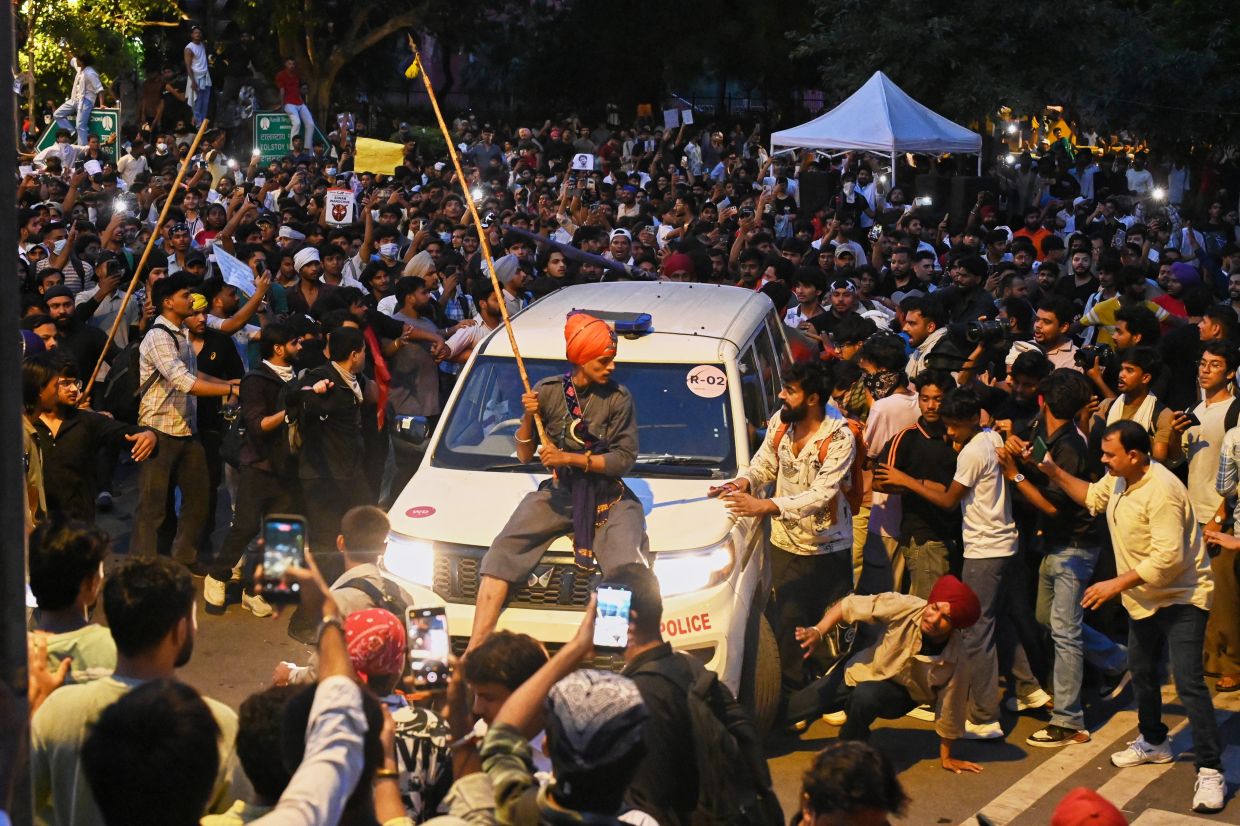
Indian Prime Minister Narendra Modi confronted an unprecedented groundswell of public anger on Thursday as he issued his first direct response to sweeping student-led protests that have destabilised the nation's capital and spread to major cities nationwide. Speaking through social media, Modi promised tough action and the establishment of expedited courts to prosecute those responsible for leaked examination papers, a crisis that has undermined faith in India's education system and galvanised youth across the country into organised dissent.
The protests underscore a significant fracture between Modi's government and India's younger electorate, who face mounting frustrations over both institutional failures and what they perceive as broader governance concerns. The demonstrations, which intensified after police deployed tear gas and batons against marchers attempting to reach parliament on Monday, represent the most substantial street mobilisation in New Delhi in approximately five years. Officers confirmed that at least 178 people sustained injuries during the confrontations, including police personnel themselves, as escalating tension transformed what began as focused activism into volatile street confrontations.
Central to the uprising is the Cockroach Janta Party, a social media-driven movement that originated as satirical commentary in May following remarks by Chief Justice Surya Kant, who allegedly compared young people to "cockroaches" and "parasites" during judicial proceedings. What started as internet humour has crystallised into a potent political force commanding millions of digital followers and channelling youth frustration into substantive demands. The movement has evolved beyond its satirical origins to encompass systemic concerns including endemic joblessness, limited career prospects for university graduates, and what participants characterise as authoritarian tendencies within Modi's administration.
The precipitating factor for recent demonstrations stems from cascading failures within India's examination apparatus. A leaked medical entrance examination question paper forced more than two million candidates to rewrite their tests, while concurrent irregularities in the online evaluation of examinations taken by nearly two million secondary school students compounded the sense of institutional breakdown. These technical and procedural failures have shattered public confidence in assessment systems that determine educational and professional trajectories for millions of Indians annually.
Wednesday's escalation witnessed renewed confrontations outside Jantar Mantar, a traditional protest site in the capital, where crowds clashed with police into the night hours. The Cockroach Janta Party alleged authorities inflicted brutal treatment on demonstrators whilst simultaneously restricting internet access, a tactic frequently employed by the government to suppress dissent. Delhi Police countered these allegations by asserting that protesters attacked officers with stones and plastic bottles, resulting in injuries to security personnel.
The political opposition has seized the moment to amplify criticism of Modi's administration. Congress Party leader Rahul Gandhi explicitly accused the Prime Minister of destroying the nation's education infrastructure and shielding culpable officials from accountability. Opposition lawmakers have disrupted parliamentary sessions, demanding a formal apology from Modi regarding Monday's police response and leveraging the moment to challenge the government's broader record on youth welfare and institutional governance.
Most significantly for Modi, these disturbances represent the gravest domestic challenge to his authority since winning a third consecutive election term in 2024. The movement's spread beyond Delhi to financial hub Mumbai, technology centre Bengaluru, and other major metropolitan areas indicates that discontent has transcended the capital's activist circles to resonate with youth populations across India's economic landscape. Demonstrations in Bangladesh expressing solidarity with Delhi's protesters suggest the movement carries regional significance, particularly given that Bangladesh experienced its own youth-led upheaval in 2024 that toppled Prime Minister Sheikh Hasina's government.
Modi's public commitment to punish those culpable for examination irregularities represents a calculated effort to contain the crisis through promises of expedited accountability mechanisms. His statement emphasising that "nothing is more important than the welfare and future of our youth" appears designed to address central grievances, though the sincerity of such assurances remains contested by opposition figures and protest organisers. The establishment of fast-track courts signals an attempt to demonstrate decisive action without fundamentally addressing the systemic governance issues that have animated broader discontent.
For Malaysian observers and the wider Southeast Asian region, these developments warrant careful attention. India's educational institutions and examination systems represent crucial pathways for regional students pursuing higher qualifications, whilst India's political stability carries implications for trade, investment, and regional architecture. The emergence of organised youth movements capable of mounting sustained challenges to established governments reflects demographic and technological shifts affecting all of Southeast Asia's major democracies, where younger populations increasingly utilise social media to mobilise around institutional failures and governance concerns.
The protests underscore tensions between rapid modernisation and institutional capacity across South Asia. Examination systems serving massive candidate pools have struggled to maintain integrity whilst delivering results at scale, a challenge familiar to education authorities across the developing world. Modi's administration now faces pressure to demonstrate that accelerated legal remedies can restore institutional credibility whilst simultaneously addressing the deeper anxieties animating youth engagement with politics.
As events continue unfolding, the trajectory of these demonstrations will significantly influence Modi's political standing heading into his third term. The government's capacity to prosecute examination fraud cases swiftly whilst substantively addressing youth unemployment and educational access will likely determine whether the current mobilisation evolves into sustained political pressure or gradually dissipates. The Cockroach Janta Party's maturation from satirical commentary into coherent political voice represents a notable shift in how digital-native Indian youth engage with institutional failures and state accountability.

