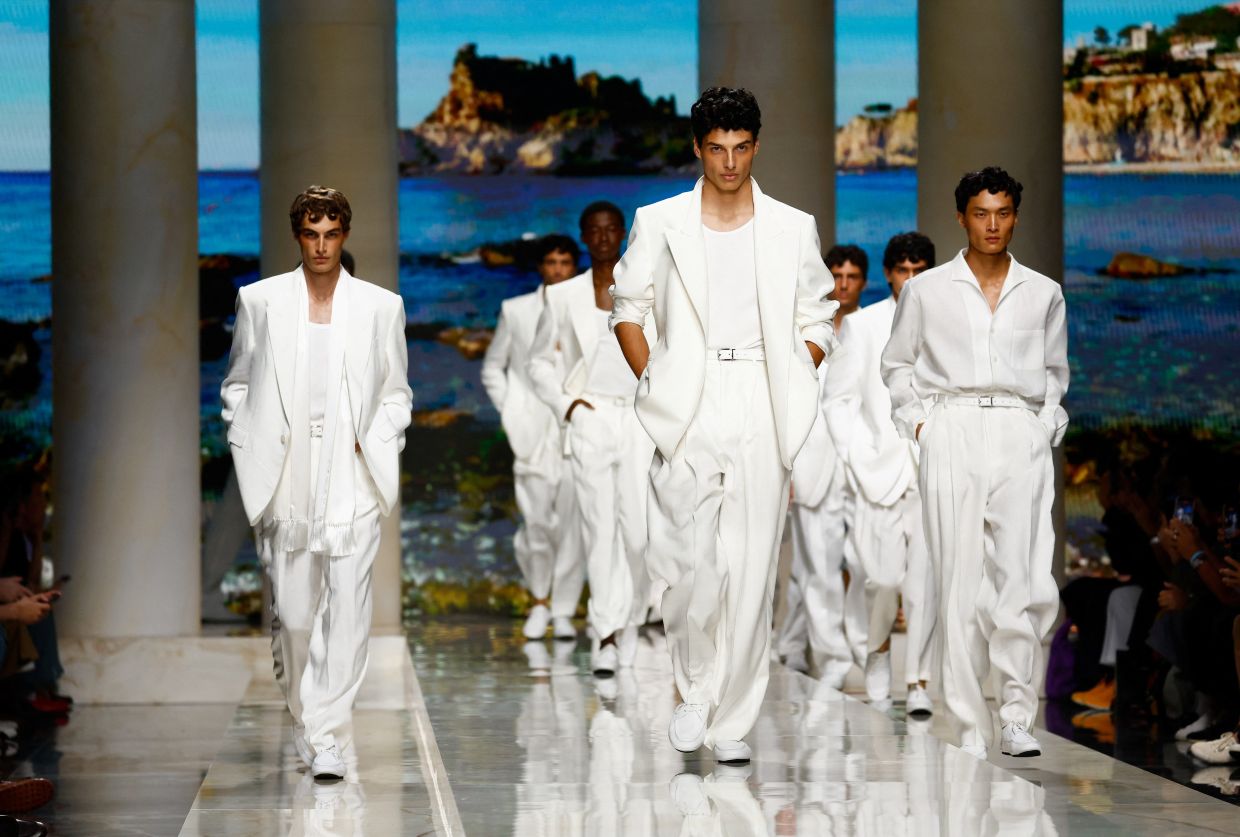
The message emanating from Milan's menswear showcases this month was unmistakable: in a world wracked by economic anxiety and political turbulence, fashion's leading designers are retreating from excess towards restraint. As temperatures soared during Milan Fashion Week, which concluded on June 22, the collections unveiled for Spring/Summer 2027 revealed a unified appetite for pared-down elegance and simplified proportions, even if the commitment to this lighter aesthetic did not always extend to the materials themselves. The shift represents a marked departure from several seasons of oversized silhouettes, suggesting that the industry recognises contemporary consumers may be seeking understated sophistication rather than bold proclamation during uncertain times.
Prada, under the collaborative vision of co-creative directors Miuccia Prada and Raf Simons, crystallised this philosophy most explicitly, championing a return to familiar garment archetypes reconsidered through innovative proportioning and novel fabric treatments. Their approach demonstrated that restraint need not mean blandness; instead, it offered a pathway to refinement where each element serves a clear purpose. This conceptual framework appears to have resonated across the Milanese fashion establishment, with designers broadly embracing the notion that contemporary menswear should distil clothing to its essential components while elevating execution through technical precision and material quality. The dominant narrative was not one of radical reinvention but rather of intelligent curation and thoughtful editorial choices.
Paradoxically, the season's clearest and most surprising trend contradicted the summer context entirely: the pervasive use of leather. Milan's runways featured leather in abundance for a season ostensibly designed for warmth and ease, creating an amusing tension between aspirational fashion ideation and practical wearability. Designers appeared willing to overlook climatic realities in favour of leather's inherent associations with luxury, rebellion, and sculptural possibility. Prada's leather offerings drew conceptual inspiration from the democratic ubiquity of denim, translating that democratic ethos into slim five-pocket trousers paired with cropped, flat-pocketed jackets functioning as shirts—a grammar of familiarity rendered fresh through minimalist tailoring. Beyond Prada's offerings, other houses deployed woven and perforated techniques to engineer breathability into leather itself, attempting to reconcile material choice with meteorological necessity through technical innovation.
The broader reconciliation between luxury aspiration and practical necessity became the season's central creative tension. After years during which menswear embraced loose, voluminous silhouettes that prioritised comfort and ease of movement, designers signalled a decisive return to body-conscious dressing that acknowledges and contours the male form. There appeared to be consensus that the well-tailored suit remains foundational to masculine formal dress, yet the challenge lay in reimagining this inherently structured garment for contemporary heat. The solution, pursued across multiple houses, centred on strategic ventilation: dress shirts were left unbuttoned, rendered transparent, or omitted entirely, creating visual lightness while maintaining the architectural framework of formal tailoring. The dominance of long trousers persisted, yet there emerged a pronounced shift towards closer-fitting silhouettes that clung to the body rather than billowing around it.
Dolce & Gabbana pursued this body-conscious direction to its logical extreme, introducing microshorts that dramatically exposed the legs whilst maintaining the formality of high-fashion tailoring, whilst several other designers experimented with bare-chested presentations and minimal coverage. These provocative choices suggested that menswear's conversation with masculinity and the display of the male physique is evolving, with younger and more daring houses willing to challenge conservative notions of appropriate masculine dress. Simultaneously, the season witnessed a softening of traditional tailoring's rigid construction—necklines opened, shoulder seams relaxed, and fabric choices tilted towards materials and weaves that permitted greater airflow without entirely abandoning the silhouette's formality. The resulting aesthetic represented tailoring for an era of rising temperatures, a category of clothing designed to accommodate environmental reality without surrendering elegance.
Thom Browne, the American designer now operating under the ownership structure of Zegna, returned to Milan for his first presentation since 2008, bringing with him layered suiting constructed from seersucker and pleated skirts—traditionally summer-friendly materials that have long anchored the brand's aesthetic vocabulary. His presentation underscored that innovation in formal menswear need not involve wholesale abandonment of established codes but rather might emerge through intelligent reconsideration of archival techniques and forgotten materials. The cumulative effect of Milan's collections was thus to demonstrate that the suit, that most conservative of masculine garments, possesses surprising capacity for reinvention when approached with creative intelligence and technical skill. The message crystallised across multiple designers: formality endures, but it must adapt to evolving environmental, economic, and cultural circumstances.
Yet not every designer subscribed to the season's predominant philosophy of reduction and restraint. Philipp Plein presented a crystal-encrusted denim ensemble requiring days of handwork to complete, whilst Dolce & Gabbana eagerly embraced maximalist embellishment, incorporating beaded accents evoking coral formations and undersea imagery. These defiantly decorative offerings served as counterpoint to Prada's minimalism, suggesting that menswear currently accommodates multiple competing aesthetics and customer sensibilities. For certain consumers and occasions, evidently, glamour and spectacle remain more compelling than restraint, and the fashion establishment's openness to this plurality suggests maturity in its approach to contemporary diversity. Maximalism and minimalism coexisted without apparent contradiction, each addressing different aspects of contemporary masculine desire.
The lighter-than-usual Milan calendar created unexpected opportunities for emerging and lesser-known designers to achieve visibility alongside the industry's established powerhouses. Martin Quad made his Milan debut with unconventional tailoring techniques that had previously garnered attention within Copenhagen's design community, gaining exposure to the broader international press and professional buyers. Similarly, Domenico Orefice presented a co-educational collection embracing leather and richly textured woven fabrics, whilst Japanese designer Shinya Kozuka's label Shinyakozuka achieved its Milan debut with what may have been the season's most genuinely poetic and summery offering: a bare-chested male model wearing a billowing teal sheer coat paired with baggy white trousers, a composition that balanced exposure with concealment, formality with ease, in ways that captured the season's essential creative preoccupation.
For Southeast Asian fashion observers and industry professionals, Milan's Spring/Summer 2027 menswear collections carry particular significance. The region's tropical climate creates perpetual relevance to questions about dressing formally in heat, suggesting that the solutions Milan designers have developed—breathable leather, open necklines, lighter tailoring—carry direct applicability to markets from Singapore to Manila. Furthermore, the season's embrace of restraint and simplified luxury aligns with growing consumer sophistication across Southeast Asia, where rising middle-class populations increasingly seek quality and authenticity over obvious logomania. The emphasis on technical excellence and material innovation also reflects the manufacturing capabilities increasingly concentrated in the region, positioning Southeast Asian producers as potential partners in executing the detailed, labour-intensive construction methods these collections demand. Milan's direction thus possesses resonance extending well beyond European runways.

