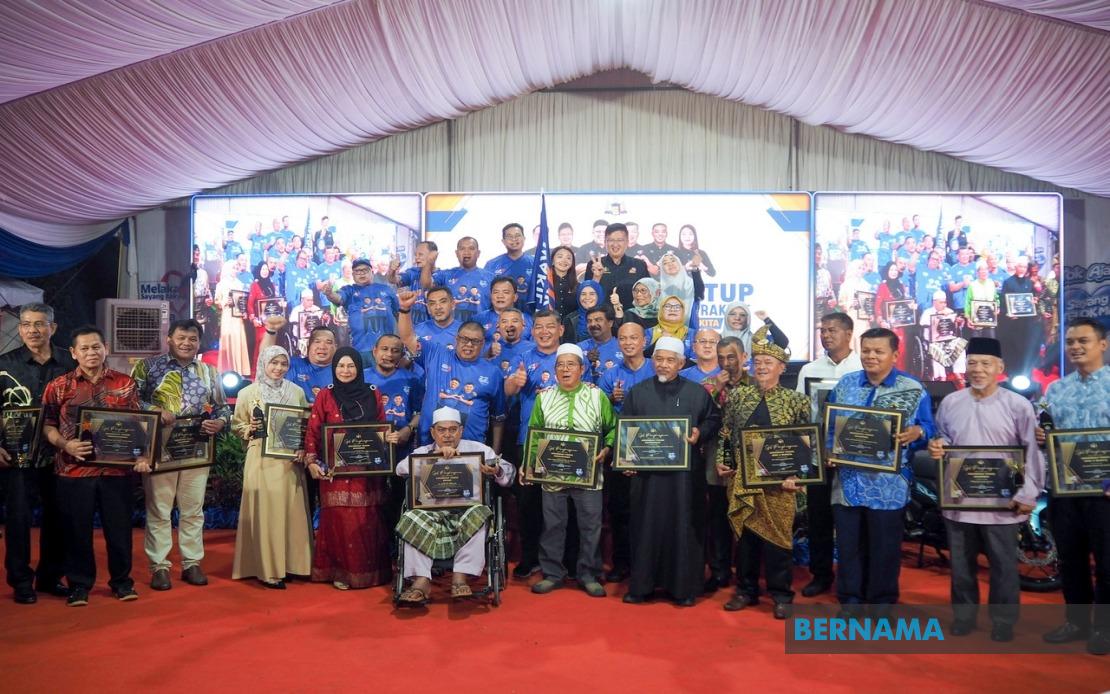
Melaka Chief Minister Datuk Seri Ab Rauf Yusoh has reframed how success should be assessed for the Wakil Rakyat Untuk Rakyat (WRUR) programme, arguing that policymakers must look beyond the raw number of schemes implemented and instead focus on whether ordinary citizens' lives have genuinely improved. Speaking at the closure event for WRUR's Kota Melaka parliamentary constituency initiative, Ab Rauf stressed that the state government's evaluation framework prioritises addressing the substantive grievances raised by residents across all demographics and geographic areas, signalling a shift in governance philosophy toward outcomes rather than metrics that simply inflate programme counts.
The WRUR approach fundamentally rests on a decentralised complaint-resolution mechanism designed to capture issues at the grassroots, ensuring that each grievance—regardless of the complainant's political affiliation or location—receives documented attention and systematic follow-up. This bottom-up architecture contrasts with traditional top-down policymaking, embedding accountability within the administrative apparatus by requiring government agencies to track and resolve public complaints in a transparent manner. By elevating the lived experience of residents as the primary performance indicator, the programme attempts to restore faith in government responsiveness at a time when citizens across Southeast Asia increasingly demand accountability from elected representatives.
Since its rollout across 19 state constituencies in Melaka, WRUR has accumulated approximately 4,027 complaints from the public sector. Of these, 2,633 complaints—representing more than 65 per cent—have been resolved satisfactorily. This resolution rate, while substantial, reveals that a significant minority of complaints remain outstanding or in processing stages, illustrating the administrative challenges inherent in implementing large-scale grievance-redressal systems. The metric becomes more meaningful when contextualised within the Malaysian governance landscape, where citizen engagement through formal complaint mechanisms remains relatively underdeveloped compared to more mature democracies, making this resolution rate a significant achievement in institutional capacity.
Kota Melaka represents the third parliamentary constituency to host the WRUR initiative, following Alor Gajah and Hang Tuah Jaya. During its four-week implementation window, the programme facilitated over 500 individual activities spanning five state constituencies, reaching more than 200,000 residents. Within Kota Melaka specifically, authorities logged 470 complaints, with 31 resolved during the active programme period and the remainder classified according to urgency and complexity. Significantly, Ab Rauf committed to sustained monitoring beyond the formal programme conclusion, instructing relevant agencies to maintain resolution efforts indefinitely rather than treating the end of the programme as a natural terminus for government responsibility.
This continuity commitment is particularly important for Malaysian governance contexts, where programme-based governance often creates administrative gaps when initiatives formally conclude. By institutionalising post-programme complaint resolution, the state government signals that WRUR's grassroots-engagement model should become embedded within regular administrative procedures rather than remaining a time-bound exercise. Such sustainability measures address a chronic weakness in Malaysian development programming, where initiatives frequently lapse upon completion, leaving half-resolved community issues to languish in bureaucratic limbo.
The Telok Mas state assemblyman, Datuk Abdul Razak Abdul Rahman, provided supplementary data on local development investments that contextualise the broader development strategy underlying WRUR. Over the preceding five years, 328 local development projects worth nearly RM68 million have been implemented across Telok Mas's 12 constituent areas. These investments span conventional infrastructure improvement—road upgrades, drainage system enhancements, and sewerage modernisation—alongside social housing programmes, community facility renovations, and educational infrastructure strengthening. This parallel investment narrative illustrates that WRUR functions as a complementary mechanism to identify service gaps and citizen dissatisfaction with existing programmes, rather than operating in isolation.
Welfare and health assistance programmes have reached 6,098 Telok Mas residents with aggregate aid exceeding RM1.2 million, while 213 medical beds have been distributed to households in need. These initiatives address the immediate material vulnerabilities of lower-income populations, functioning as social safety nets that operate beyond formal welfare schemes. Additionally, since 2022, the Jualan Rahmah and Jualan Murah programmes have conducted 70 market operations offering subsidised foodstuffs and consumer goods, directly mitigating cost-of-living pressures. The Free Petrol Programme has channelled RM177,000 in fuel assistance to approximately 15,000 residents, representing a regressive but politically resonant subsidy approach to managing inflation concerns among working-class families.
Education remains a targeted investment area, with 1,694 students receiving examination preparation support for the Sijil Pelajaran Malaysia and 255 high-achieving students receiving RM244,200 in educational incentives. These human capital investments signal recognition that long-term development outcomes depend substantially on education quality and opportunity access, aligning with Malaysia's broader national development priorities articulated in the National Development Plan. By directing state resources toward examination support and merit-based scholarships, Telok Mas authorities address both equity concerns and competitive ability to attract talent.
Tourism sector development emerging from this governance framework reflects strategic attempts to diversify local economic bases beyond traditional industries. The Ministry of Tourism, Arts and Culture has allocated RM2.4 million to upgrade tourism infrastructure in Sungai Punggor and Alai, with completion targeted for 2027, while Dataran Telok Mas will receive RM300,000 for conversion into a centralised tourism and traditional products marketplace. These investments recognise tourism's potential as a revenue-generating sector capable of creating employment and preserving cultural heritage. The identification of Bukit Larang geosite for National Geopark recognition demonstrates sophisticated positioning within Malaysia's broader geotourism strategy, leveraging geological uniqueness as a differentiated tourism asset.
The WRUR programme's evolution toward impact-focused evaluation rather than volume-based metrics represents a meaningful philosophical shift in Melaka's governance approach. By institutionalising citizen grievance resolution and ensuring transparent tracking of public complaints, the initiative creates accountability mechanisms that operate independently of traditional political patronage networks. For other Malaysian states and federal policymakers, WRUR's emphasis on measurement through tangible community outcomes rather than programme proliferation offers a replicable model for governance reform. The integration of WRUR's complaint resolution mechanism with broader development investments—infrastructure, welfare, education, and tourism—creates a more holistic policy framework addressing multiple dimensions of citizen welfare simultaneously.
Nevertheless, the programme's ultimate success remains contingent on sustained administrative capacity and political commitment to genuine grievance resolution even when complaints challenge incumbent political interests or expose government failures. The 65 per cent resolution rate, while respectable, indicates that administrative capacity constraints or unresolved policy contradictions prevent complete issue closure for a substantial minority of complaints. Malaysian policymakers implementing similar grievance-redressal mechanisms in other states should remain attentive to these implementation challenges and invest in strengthening inter-agency coordination mechanisms necessary for comprehensive complaint resolution. WRUR's framework demonstrates that governance effectiveness increasingly depends on citizens' perception that their concerns receive serious attention and substantive redress, making the programme's outcome-focused philosophy increasingly essential for maintaining institutional legitimacy.

