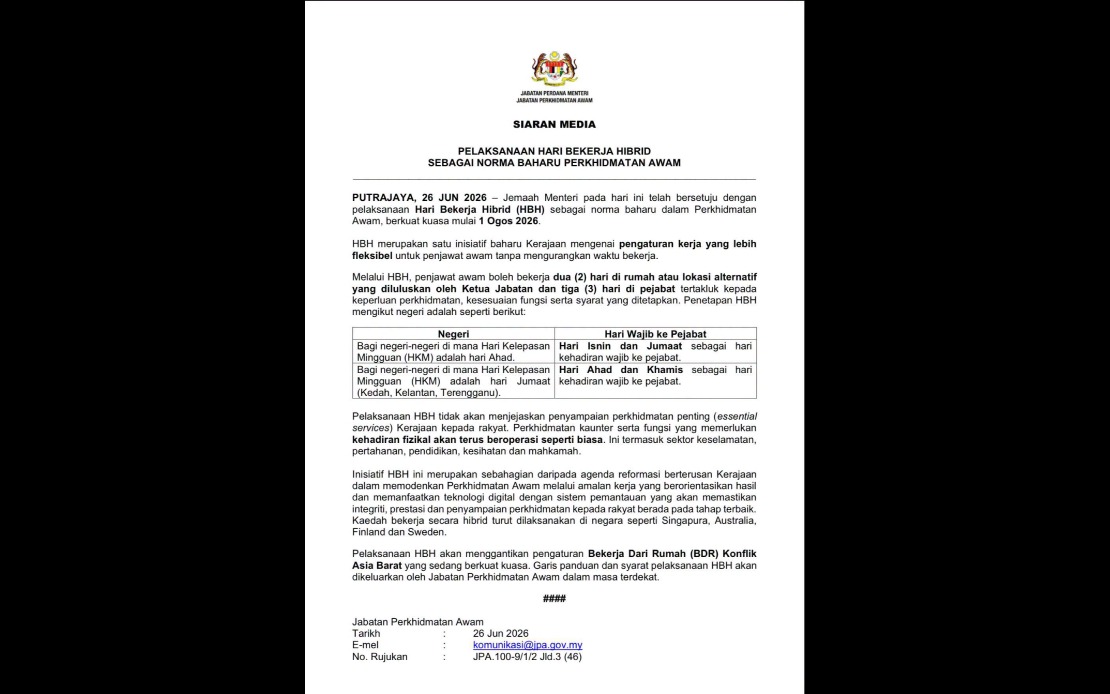
Malaysia's government has formally embraced hybrid work as the new standard across the civil service, with the Public Service Department confirming Cabinet approval for the Hybrid Work Day arrangement to commence on August 1. The decision represents a significant shift in how the country's 1.6 million public sector employees will balance workplace attendance with remote flexibility, marking one of the most substantial structural changes to Malaysia's bureaucratic operations in recent years.
Under the new framework, civil servants will split their weekly schedules between two days working from home or other department-approved locations and three mandatory days at their offices. This arrangement applies across government ministries and agencies, though exceptions exist for roles requiring consistent physical presence. The Public Service Department emphasized that the transition maintains full working hours—the shift is architectural rather than reductive, designed to modernise work practices while preserving productivity standards that citizens depend upon.
The hybrid model effectively replaces the pandemic-era Work From Home system that became widespread across Malaysia's public sector from 2020 onwards. Rather than retreating to emergency measures, the government has codified flexibility into permanent policy, signalling confidence that remote work has proven viable for administrative functions. This represents a maturation of pandemic-era experiments into deliberate strategic practice, reflecting findings from multiple jurisdictions that flexible arrangements can enhance employee satisfaction without compromising service delivery.
Critically, the Public Service Department has built safeguards into the framework to protect essential services that Malaysians rely upon daily. Counter services in healthcare facilities, schools, courts, and security agencies will maintain standard operating schedules regardless of the hybrid arrangement. States observing different weekly rest days will have tailored mandatory office attendance schedules—Monday and Friday for states with Sunday as the weekly holiday, while Kedah, Kelantan, and Terengganu will designate Sunday and Thursday as compulsory office days. This granular approach acknowledges Malaysia's religious and administrative diversity without creating confusion or service gaps.
The government has anchored this policy within broader modernisation initiatives aimed at reshaping how the public service operates. Rather than presenting hybrid work as merely an employee benefit, officials have positioned it as part of comprehensive reform toward outcomes-based performance measurement and expanded digital infrastructure adoption. This framing suggests that the true objective extends beyond work-life balance—the government is using workplace flexibility as a vehicle to accelerate technological integration and results-oriented management systems across ministries.
A monitoring mechanism will oversee implementation to ensure that flexibility does not erode the integrity, performance standards, and service quality that define Malaysia's public sector. This supervisory layer reflects institutional caution; the government recognises that widespread remote work requires robust accountability mechanisms to prevent abuse or performance degradation. Department heads will retain approval authority over alternative work locations, maintaining hierarchical control while granting flexibility—a compromise between autonomy and oversight.
The decision positions Malaysia within a global trend toward hybrid arrangements. Singapore, Australia, Finland, and Sweden have already adopted similar models, lending credibility to the approach. However, Malaysia's implementation differs meaningfully from these precedents. While Nordic countries pioneered trust-based work cultures, and Australia has emphasised flexibility in vast geographic contexts, Malaysia must implement hybrid work across a diverse bureaucracy spanning rapidly urbanising regions, rural administrative centres, and special economic zones. This contextual complexity requires customisation beyond simply importing foreign models.
For Malaysian private sector employees and businesses, the government's embrace of hybrid work at civil service scale carries indirect implications. The policy signals official confidence in remote work sustainability, potentially influencing corporate sector attitudes toward flexible arrangements. Malaysian companies frequently observe government practices as benchmarks; formalising hybrid work in the public service may accelerate similar moves in private organisations competing for talent. This ripple effect could reshape Malaysia's broader employment landscape beyond immediate public service boundaries.
Implementation details remain pending formal release of comprehensive guidelines and operational conditions from the Public Service Department. These forthcoming documents will determine practical success—how departments handle schedule conflicts, which roles qualify for remote work, how performance will be assessed, and what technological infrastructure will support remote teams. The gap between policy announcement and detailed implementation often determines whether reforms achieve stated objectives or become bureaucratic theatre.
The arrangement also reflects Malaysia's post-pandemic economic considerations. By reducing necessary office space, utilities, and infrastructure costs, hybrid work potentially frees government resources for other priorities—though the extent of these savings remains unquantified. Simultaneously, the policy acknowledges employee preferences revealed during pandemic lockdowns; many Malaysian civil servants experienced remote work and demonstrated capacity for unsupervised productivity, creating political pressure to formalise such arrangements rather than forcing wholesale returns to traditional office culture.
Regional implications merit consideration as Southeast Asian governments adopt varying approaches to post-pandemic work norms. Thailand, Indonesia, and the Philippines have experienced less formalised hybrid transitions, maintaining more traditional office-centric cultures. Malaysia's decisive policy shift positions the country as a regional leader in flexible work modernisation, potentially influencing neighbouring governments' administrative modernisation agendas. This soft power dimension—demonstrating that Malaysia's bureaucracy can evolve with contemporary workplace expectations—extends beyond personnel management into broader institutional competitiveness narratives.
The August 1 implementation date provides a two-month window for departments to prepare systems, train supervisors, and establish monitoring protocols. This timeline balances rapid implementation against the complexity of coordinating changes across diverse agencies employing millions. Success will ultimately depend on whether the hybrid framework improves both public service quality and employee wellbeing, or whether it creates scheduling chaos and accountability gaps. Malaysia's experience will likely inform how other Southeast Asian governments calibrate their own workplace modernisation strategies.

