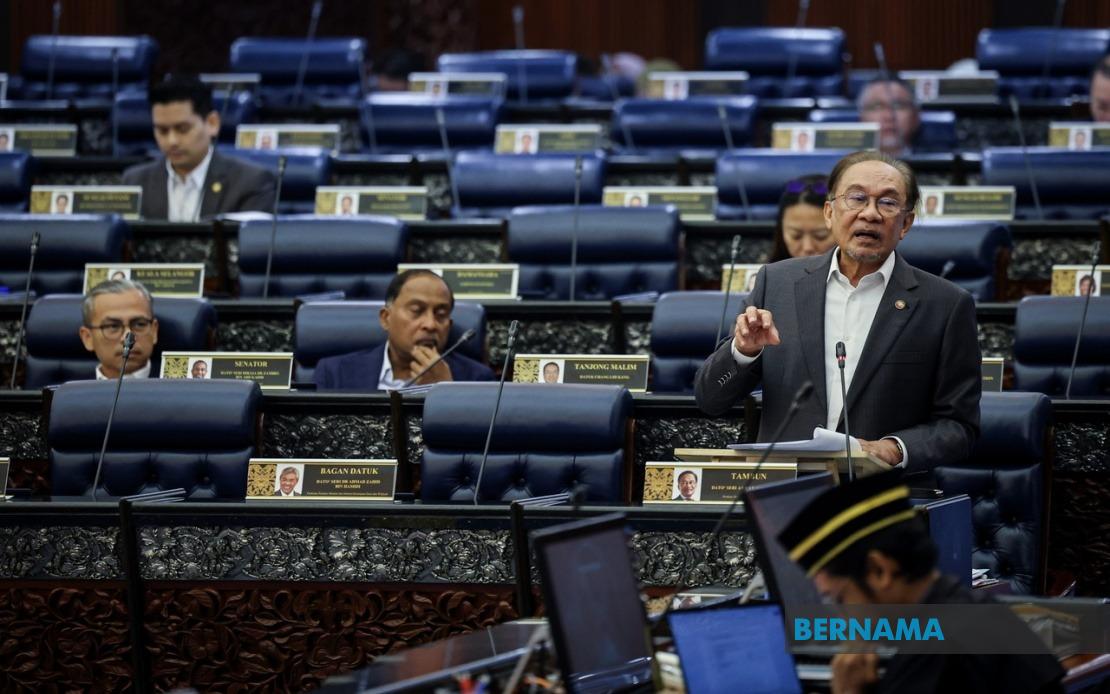
Prime Minister Datuk Seri Anwar Ibrahim has clarified that Malaysia's slip in this year's World Press Freedom Index stems from multiple international assessment criteria, with enforcement actions against several news organisations playing a significant role in the downward shift. Speaking during Minister's Question Time in Parliament on July 7, the Prime Minister acknowledged that the country's ranking has declined to 95th place from 88th the previous year, a development that has drawn scrutiny from media watchdogs and press freedom advocates worldwide.
The government's enforcement decisions, particularly those involving major newsrooms, have attracted international attention and contributed substantially to Malaysia's lower standing in the rankings calculated by Reporters Without Borders (RSF). However, Anwar stressed that these actions were narrowly targeted and purpose-driven rather than blanket suppression of media operations. The enforcement measures, he explained, were specifically directed at content touching on the three sensitive pillars of religion, race, and the royal institution—collectively referred to as the 3R issues—alongside matters deemed to pose threats to national security. This distinction is critical to understanding the government's position on media regulation in the Malaysian context.
Two high-profile cases have prominently featured in international criticism and assessments of Malaysia's press freedom environment. The action taken against Sin Chew Daily over the publication of an inaccurate illustration of the Jalur Gemilang prompted particular concern from the international media community, which viewed the enforcement as a serious breach of press freedom principles. Separately, Sinar Harian faced enforcement over its publication of the Inspector-General of Police's biography, an incident that also influenced the country's lower ranking in global assessments. Anwar acknowledged that the Sin Chew Daily case was viewed particularly seriously abroad, noting that while international observers questioned the proportionality of the response to a flag-related illustration error, the Malaysian government considers matters involving national symbols with considerable gravity.
The Prime Minister's remarks reveal a fundamental tension between domestic regulatory priorities and international standards for media freedom. He observed that when enforcement action targets established, well-known media organisations with significant reach and credibility, the immediate effect on international press freedom indices is pronounced and measurable. This visibility amplifies the impact of such decisions when foreign analysts assess Malaysia's media environment. Anwar acknowledged this dynamic directly, indicating that the government understands how enforcement actions register in the global assessment framework, even as officials maintain that such actions remain necessary and justified within Malaysia's particular constitutional and social context.
Anwar clarified that the government's approach distinguishes sharply between factual inaccuracies coupled with sensitive content and mere political criticism or disagreement. The administration takes no enforcement action against content containing political criticism alone, he stated, emphasising that the government has instead prioritised public clarification mechanisms over punitive measures. This includes providing detailed explanations and responses within Parliament itself, allowing elected representatives to address inaccurate reporting through legislative debate and official channels. The emphasis on transparency and clarification rather than suppression reflects an effort to reconcile press regulation with democratic accountability.
A significant legislative development underpins the government's stated commitment to balancing security concerns with media freedom. Amendments to Section 233 of the Communications and Multimedia Act 1998 have substantially altered the legal framework governing online speech and media conduct. These amendments specifically ensure that satirical remarks directed at the Prime Minister or other political leaders are no longer treated as criminal offences—a notable shift that seeks to protect political commentary and humour from overly broad enforcement. This legislative adjustment signals an attempt to narrow the scope of prohibited speech while maintaining restrictions on genuinely dangerous or destabilising content.
The role of the Conference of Rulers in guiding media regulation has become increasingly prominent in the government's public messaging. Anwar stated that the administration remains bound by positions agreed upon by the Conference of Rulers, which exercises close oversight of reports involving perceived insults or disrespect toward the royal institution and content that might inflame racial or religious tensions. This constitutional arrangement places media regulation within a broader framework of institutional governance rather than treating it as a purely executive function. The involvement of the Conference of Rulers in setting standards and priorities reflects Malaysia's constitutional monarchy and the special status accorded to the institution of royalty within the Malaysian system.
Reporters Without Borders' assessment methodology encompasses far broader considerations than enforcement actions alone, Anwar noted, pointing to multiple indicators that influence the annual rankings. These include the overall political environment in the country, the quality and restrictiveness of the legal framework, economic conditions affecting media viability, socio-cultural attitudes toward press freedom, and security challenges. By emphasising the multifactorial nature of the assessment, Anwar suggests that Malaysia's ranking decline cannot be attributed solely to government enforcement decisions, though such actions remain a measurable component of the overall evaluation. This contextualisation attempts to situate media regulation decisions within a more complex landscape of interconnected factors.
An often-overlooked dimension of Malaysia's press freedom ranking involves the role of private technology platforms rather than direct government action. Anwar highlighted that significant content removal occurs through decisions made by social media platforms responding to user complaints, not government directives—a distinction that complicates any simple narrative of state censorship. The Prime Minister himself has experienced this dynamic, with his own posts related to Hamas removed by social media platforms despite government disagreement with those removal decisions. This points to the power wielded by international technology companies in shaping the information environment in Malaysia, a phenomenon that extends beyond the reach of government regulation or responsibility.
The relationship between the Malaysian Communications and Multimedia Commission (MCMC) and social media platforms further illustrates the complexity of content governance in the digital age. Anwar explained that requests issued by the MCMC for content removal are not automatically accepted by platform operators; the final decision remains with the respective platforms themselves, which apply their own terms of service and community guidelines. This means that the government's regulatory capacity, while significant, is constrained by the operational autonomy of private companies controlling major distribution channels. The distinction between government requests and actual content removal creates space between Malaysia's regulatory intentions and their practical implementation on global platforms.
The Prime Minister's parliamentary intervention underscores the government's sensitivity to international criticism while defending the necessity of certain enforcement actions. By distinguishing between permissible political criticism and impermissible content targeting the 3R issues, Anwar attempts to demonstrate that Malaysia's regulatory approach follows a coherent logic rather than amounting to blanket suppression. However, this explanation also reveals the challenge facing Malaysian policymakers: how to maintain social cohesion and protect sensitive national institutions while operating within international norms that increasingly prioritise minimal restrictions on speech. The tension between these competing objectives continues to shape Malaysia's position in global press freedom assessments and in the broader regional conversation about media freedom in Southeast Asia.

