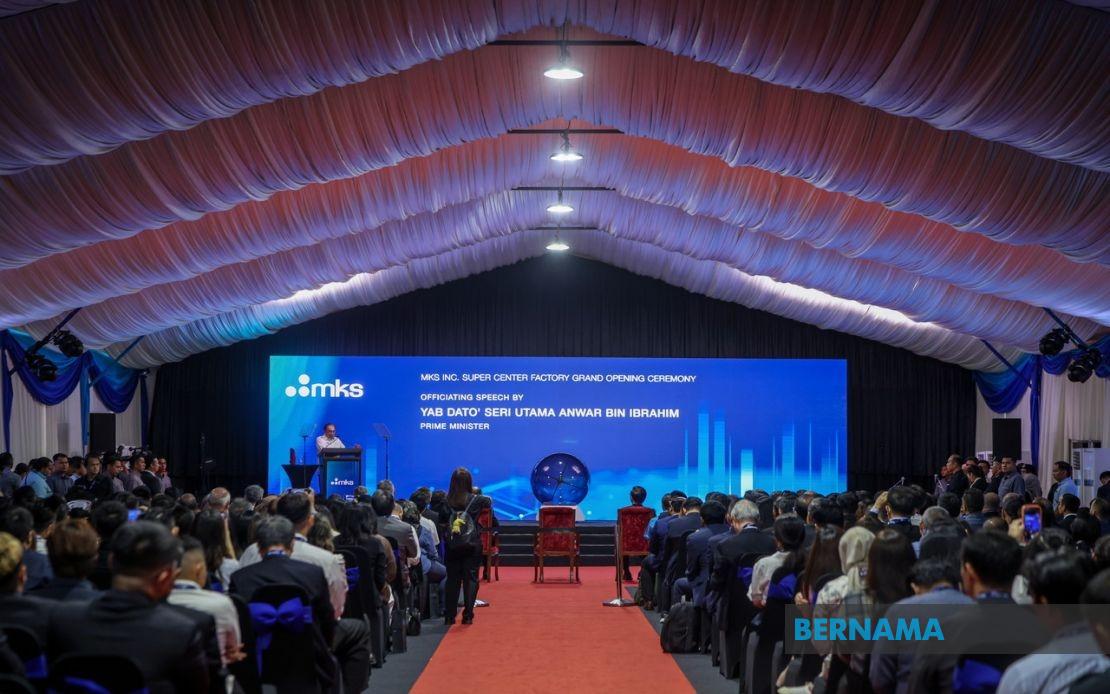
Prime Minister Datuk Seri Anwar Ibrahim has credited Malaysia's unwavering commitment to diplomatic neutrality and engagement with nations across all geopolitical spheres as a foundational driver of the country's expanding economic prospects and rising international standing. Speaking at the opening of the MKS Super Centre factory at Bandar Cassia Technology Park in Batu Kawan on June 20, Anwar underscored how this carefully calibrated approach has positioned Malaysia as a trustworthy partner capable of fostering productive relationships with diverse powers, from the United States to China, India, and Russia.
The Prime Minister's remarks come at a time when Malaysia faces mounting pressure from global powers seeking to secure influence across Southeast Asia. By maintaining what Anwar described as a position of "centrality," Malaysia refuses to align exclusively with any single bloc, instead leveraging its geographic location and diplomatic flexibility to attract investment and cooperation from multiple directions. This strategy represents a deliberate rejection of zero-sum geopolitical thinking, allowing Malaysian policymakers to capitalize on economic opportunities that bilateral and multilateral partnerships present without sacrificing the nation's autonomy.
One concrete manifestation of this approach is Petronas's recent agreement in Turkmenistan, which Anwar highlighted as evidence that neutrality generates tangible commercial returns. The state-owned energy giant's ability to negotiate across different political landscapes exemplifies how Malaysia's non-aligned posture creates space for Malaysian companies to operate and expand internationally. For resource-dependent economies like Malaysia, such diversification of partnerships reduces vulnerability to pressure from any single power and ensures sustained market access.
Anwar also referenced recent high-level diplomatic engagements with the United States, including a significant visit by President Donald Trump last year, as benchmarks of Malaysia's diplomatic reach. Simultaneously, the Prime Minister's mention of recent engagement with Russia signals Malaysia's willingness to maintain channels of communication and cooperation even with nations facing international sanctions or criticism. This delicate balancing act requires sophisticated statecraft, as Malaysia must demonstrate commitment to international norms while avoiding rhetorical overreach that might alienate trading partners or investors.
The neutrality doctrine has particular resonance for Southeast Asia, where smaller nations historically sought to protect their sovereignty by avoiding entrapment in great-power rivalries. Malaysia's adherence to this principle—articulated through ASEAN's foundational commitment to non-interference—positions the country as a model of pragmatic diplomacy in an era of resurgent superpower competition. However, the approach also demands that Malaysia maintain credibility by articulating clear positions on contentious international issues when necessary, even while preserving the flexibility to work with countries holding differing views.
Foreign investors increasingly value political stability and predictability in their host nations. Malaysia's consistent application of non-aligned principles reduces uncertainty about potential sanctions, trade wars, or sudden policy shifts tied to great-power disputes. This stability advantage has manifested in Malaysia's ability to attract manufacturing investments from multiple countries simultaneously—a competitive edge that nations perceived as openly tilting toward particular powers may lack.
The factory opening ceremony where these remarks were delivered also reflected the government's broader investment attraction strategy. The presence of Penang Chief Minister Chow Kon Yeow and Deputy Minister of Investment, Trade and Industry Sim Tze Tzin underscored the alignment between federal and state-level efforts to leverage Malaysia's diplomatic positioning for economic gain. Such coordination is essential for translating diplomatic advantage into sustained job creation and technology transfer.
Malaysia's middle-power status makes neutrality both feasible and desirable. Unlike superpowers, Malaysia lacks the military or economic capacity to impose its will globally, necessitating diplomacy as its primary tool. Unlike truly small nations, Malaysia possesses sufficient economic weight and strategic location to warrant attention from major powers, meaning that even-handed engagement strategies command respect rather than derision. This positioning allows Malaysian policymakers to host investments and maintain partnerships without the reputational costs that exclusive alignment might entail.
The challenge ahead lies in sustaining this balancing act as geopolitical tensions intensify. Rising Sino-American competition, particularly over technology, semiconductors, and defense supply chains, increasingly forces countries to make choices that appear to compromise neutrality. Malaysia must navigate these pressures while maintaining the diplomatic ambiguity that has served it well. Anwar's emphasis on Malaysia's commitment to expressing positions on contentious issues while remaining open to engagement with all parties suggests the government recognizes that genuine neutrality requires principled clarity alongside pragmatic flexibility.
For investors and trading partners, Malaysia's approach offers predictability combined with openness. Companies seeking to diversify manufacturing bases away from single-country dependencies find Malaysia attractive precisely because the nation's foreign policy reduces the risk of sudden international isolation or sanctions contagion. Similarly, governments valuing stable regional relationships appreciate Malaysia's refusal to become a proxy battleground for superpower competition.
Anwar's articulation of Malaysia's diplomatic strategy also reflects broader regional trends. ASEAN members increasingly resist pressure to choose sides in U.S.-China competition, collectively emphasizing their right to engage all partners. Malaysia's explicit framing of this position as economically advantageous—rather than merely politically principled—provides intellectual scaffolding for sustained commitment to this approach despite external pressures.
Moving forward, Malaysia's economic prospects remain substantially tied to its ability to convince investors, trading partners, and development financiers that neutrality enhances rather than compromises reliability. The Petronas agreement and factory investments Anwar referenced serve as proof points in an ongoing conversation about whether non-alignment remains viable and valuable in an era of competing visions for global order.

