Malaysia's higher education institutions have delivered a landmark performance in the latest international university rankings, reinforcing the country's emergence as a credible player in the global education landscape. The achievement comes at a time when competition for academic excellence across Asia has intensified, with regional institutions increasingly investing in research infrastructure and faculty development to elevate their standing on world rankings.
Higher Education Minister Datuk Seri Dr Zambry Abd Kadir acknowledged the significance of these results in a statement released on June 21, emphasizing that while university rankings should not be viewed as the sole measure of institutional success, they do serve as a meaningful barometer of quality, reputation, and international competitiveness. His remarks reflect a balanced perspective held by education policymakers worldwide—one that recognizes ranking systems as important communication tools without reducing educational excellence to numerical scores alone.
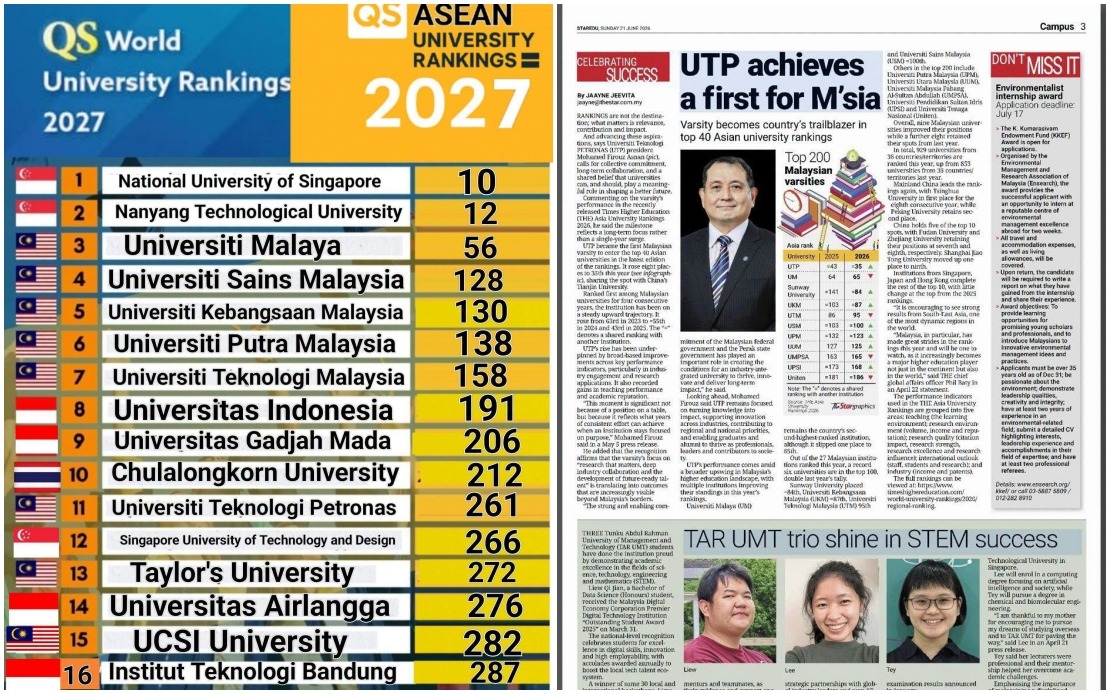
The standout achievement came from Universiti Teknologi Petronas (UTP), which became the first Malaysian university to break into Asia's top 40, landing at 35th position in the Times Higher Education (THE) Asia University Rankings 2026. This represents a significant climb from its previous 43rd-place position, demonstrating that strategic investments in research, industry partnerships, and academic talent are yielding measurable returns. For a Malaysia-based institution to achieve this milestone carries particular weight in a region where institutions from Singapore, South Korea, and China have traditionally dominated the upper echelons of Asian rankings.
The broader Malaysian performance also reflects institutional maturity across the sector. The country now has six universities positioned within Asia's top 100, a record figure that suggests systemic improvements rather than isolated success stories. Furthermore, 11 Malaysian institutions secured places within the top 200 across Asia, demonstrating that excellence is becoming increasingly embedded across different types of higher education establishments—both flagship research universities and specialized institutions.
The minister's public recognition extended beyond UTP to encompass the diverse Malaysian university ecosystem. Universiti Malaya (UM), the country's oldest and historically most prominent institution, maintains its position alongside newer competitors. Meanwhile, institutions such as Sunway University, Universiti Kebangsaan Malaysia (UKM), Universiti Teknologi Malaysia (UTM), Universiti Sains Malaysia (USM), Universiti Putra Malaysia (UPM), Universiti Utara Malaysia (UUM), Universiti Malaysia Pahang Al-Sultan Abdullah (UMPSA), Universiti Pendidikan Sultan Idris (UPSI), and Universiti Tenaga Nasional (UNITEN) have all strengthened their international profiles. This diversity is significant—it shows that Malaysian universities across different specializations and funding models are competing effectively on the global stage.
The achievements are ultimately rooted in the commitment of academic and professional communities within these institutions. Datuk Seri Dr Zambry attributed the success to collective effort spanning multiple constituencies: academic staff who pursue research excellence, researchers developing new knowledge, students engaging in high-quality learning, alumni extending institutional networks globally, university employees supporting operations, and industry partners providing real-world context and resources for education and research. This ecosystem approach reflects how modern universities function—not as isolated ivory towers but as interconnected networks drawing strength from external relationships.
For Malaysia specifically, these rankings carry strategic implications. The country has explicitly positioned higher education as an economic pillar and regional differentiator. With growing competition from Thailand, Indonesia, and Vietnam in attracting international students, the visibility that comes from strong international rankings becomes a tangible asset in marketing Malaysian education. International students often use rankings as a primary filter when considering tertiary options, meaning improved positions can translate into enrollment and revenue increases.
The regional context amplifies the significance further. Southeast Asia's higher education landscape has undergone rapid transformation over the past decade, with increased government funding, greater industry engagement, and expanded international collaborations becoming the norm rather than the exception. Malaysia's consistent advancement suggests that local institutions have successfully adapted to these evolving expectations and competitive pressures. The presence of six institutions in Asia's top 100 positions Malaysia alongside countries with much larger populations and more extensive research infrastructure, indicating punch-above-weight performance.
Looking forward, Datuk Seri Dr Zambry's appeal to maintain momentum acknowledges the dynamic nature of university rankings. Positions are not permanent; they reflect current performance across multiple indicators including teaching quality, research output, international reputation, and industry engagement. Maintaining and improving rankings requires sustained commitment to excellence, continuous investment in facilities and talent, and adaptation to evolving metrics and expectations within the global academic community.
The timing of these announcements also matters politically and socially. Education remains a priority concern for Malaysian families, and evidence that national institutions compete internationally can bolster public confidence in the higher education system. For policymakers, these rankings provide justification for continued public investment in universities despite competing fiscal priorities. For the institutions themselves, the recognition serves as both validation of current strategies and motivation to push further in pursuit of excellence.
These achievements should be viewed not as an endpoint but as evidence of institutional capacity and strategic direction. The question facing Malaysian universities now is whether they can consolidate these gains, deepen their research capacity, and extend their impact beyond rankings into tangible contributions to knowledge creation, innovation, and human capital development. The international recognition provides a foundation; sustained excellence requires continuous effort.

