A 30-year-old Malaysian has been handed a 16-month-and-two-week prison sentence for his brief and ultimately unproductive involvement with a sophisticated scam operation based in Cambodia. Yip Chee Ming's case, which concluded in Singapore's courts on June 26, underscores both the reach of transnational organised crime affecting the region and the sometimes absurd outcomes when amateur fraudsters encounter seasoned criminal enterprises.
Yip's journey into organised crime began innocuously enough when a friend named Jason approached him in October 2024 with an unusual job proposition. Jason, who had been recruited into a scam operation based in Phnom Penh, was looking for company and persuaded Yip to consider joining the venture. The pair were subsequently brought into contact with Tang Soon Wah, identified as one of the syndicate's leadership figures, who extended an invitation for them to visit the operation's physical compound in Cambodia. The prospect of examining the facilities in person—a five-storey secure building complete with stationed security guards—lent an air of legitimacy to what was unmistakably an illegal enterprise.
The syndicate Yip had agreed to join was substantial in both scope and criminal reach. Operating from their Phnom Penh headquarters, the network specialised in government official impersonation scams targeting Singaporean residents. Between September 2024 and September 2025, the criminal group was linked to at least 528 reported cases, with victims collectively losing approximately S$52.5 million. The operation itself was highly structured, with clear hierarchical levels: senior leadership overseeing strategic direction and commission payments to operational staff, a layer of supervisors and trainers who provided scripts and coaching, callers like Yip who conducted the actual fraud, and dedicated money launderers who converted illicit proceeds into cryptocurrency to complicate asset tracing.
Yip and Jason travelled to Cambodia on November 21, 2024, and commenced employment the following day. The compensation package offered to Yip reflected the syndicate's confidence in its business model: US$1,800 (approximately S$2,333) monthly in cryptocurrency, supplemented by a one per cent commission on each victim successfully defrauded. His assigned role required him to impersonate bank officials during calls to Singaporean targets, using carefully prepared scripts provided by the trainers. The syndicate had refined its approach to persuasion, with trainers offering practical guidance on delivery techniques—including advice to adopt a Singaporean accent to enhance credibility during conversations.
What followed was an unexpectedly humorous chapter in a fundamentally serious criminal narrative. Despite having access to professionally crafted scripts and expert guidance on manipulation tactics, Yip proved entirely incapable of deceiving anyone. His first day of attempted fraud yielded no victims. He tried again the following day with identical results. The syndicate, accustomed to operational efficiency and measurable returns on every recruited member, could not tolerate continued non-performance. On November 23, 2024—after a tenure of merely three days—Tang Soon Wah terminated Yip's employment and destroyed their electronic communications to obscure the brief arrangement.
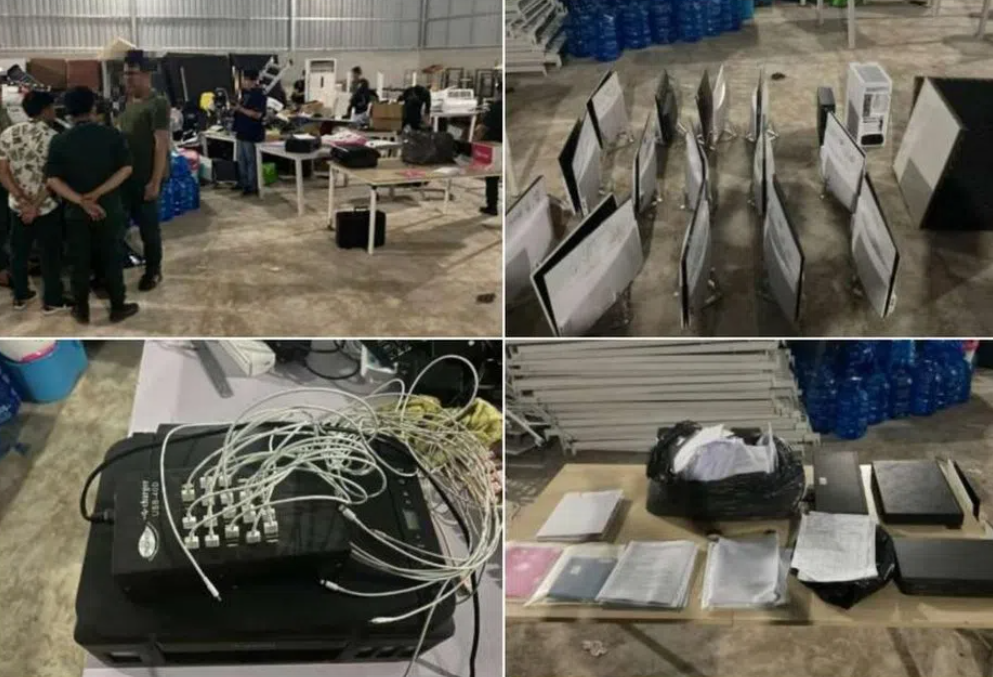
Yip's subsequent whereabouts and movements during the months following his dismissal remain unclear from court documents, but his freedom proved temporary. In September 2025, Singapore police and the Cambodian National Police conducted a coordinated enforcement operation against the scam network. Yip was apprehended in Singapore on September 9, 2025, becoming one of twelve individuals charged in connection with the syndicate. He ultimately pleaded guilty to a single count of membership in an organised crime group, with an additional charge related to cheating taken into consideration during sentencing calculations.
The broader cohort arrested alongside Yip reveals the multinational character of modern scam operations. Nine of the twelve accused are Singaporean nationals: Deon Tan Ke Yuan, 25; Lester Ng Jing Hai, 29; Christy Neo Wei En, 29; Heiqal Lee, 30; Tay Jun Xiang, 32; Ng Wei Kang, 33; Zachary Lee Jia An, 35; Melvin Tan Wenzheng, 35; and Lau Haoxiang, 39. The remaining defendants comprise Yip himself, fellow Malaysian Muhamad Asyraf Anuar, 29, and Filipina De Villar Rizalyn Panganiban, 34. The presence of Singaporean nationals operating within a Cambodia-based scam apparatus indicates how participation in such networks transcends simple recruitment from abroad—domestic actors are actively complicit in schemes targeting their own communities.
The government official impersonation scam category represented a growing security concern across the region during 2025. Although the overall volume of reported scam cases in Singapore declined compared to 2024, cases specifically involving impersonation of government officials more than doubled, surging from 1,504 incidents to 3,363 cases. This category had risen to become the fifth most prevalent scam type by year's end, reflecting the increasing sophistication and effectiveness of such schemes. The dramatic expansion despite general reductions in other scam categories suggests that criminal networks have identified government impersonation as a particularly lucrative and reliable fraud vector.
The legal consequences Yip now faces under Singapore's organised crime legislation are substantial. Section provisions permit sentences of imprisonment for up to five years, fines reaching S$100,000, or both in combination. Yip's 16-month-and-two-week sentence, while less than the maximum available, represents a serious penalty that carries implications for his professional future and personal circumstances. However, his case also inadvertently illustrates a crucial vulnerability within large-scale criminal operations: their dependence on consistent recruiter quality and individual performer capability. Unlike legitimate organisations where underperforming employees might be retrained or reassigned, criminal networks operating on tight margins cannot afford to subsidise non-productive members. Yip's brief and unsuccessful stint serves as an unintended cautionary tale about the operational realities of transnational organised crime, even as his arrest and conviction demonstrate law enforcement's capacity to pursue participants across borders and prosecute complex, multinational criminal conspiracies.

