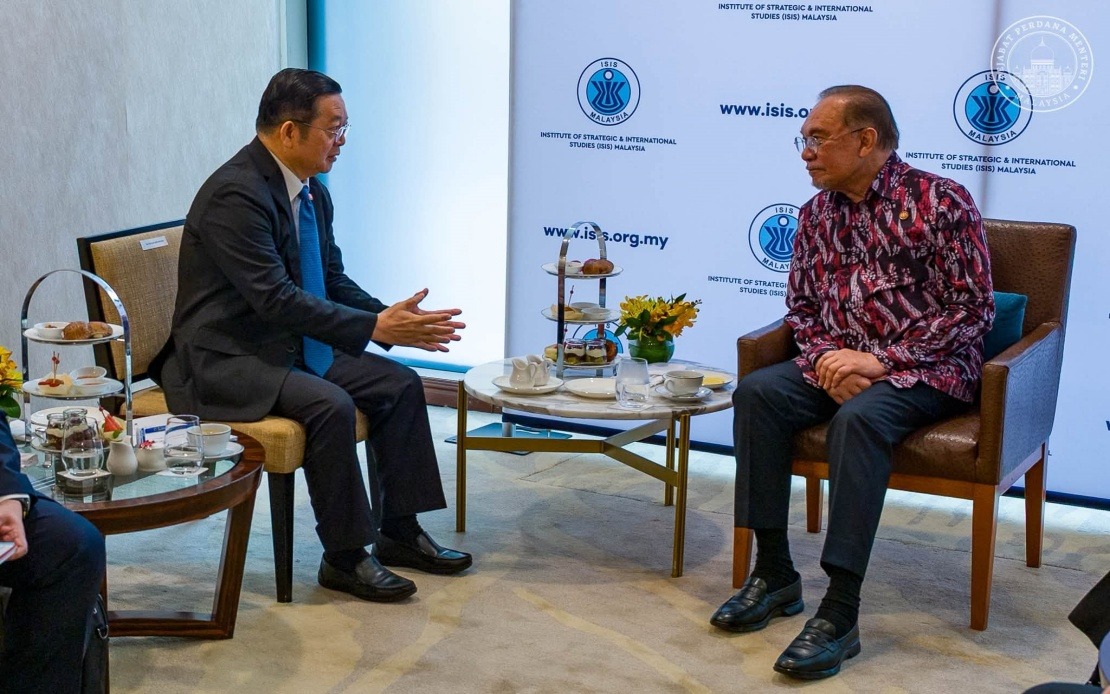
Prime Minister Datuk Seri Anwar Ibrahim has pledged Malaysia's unwavering commitment to bolstering ASEAN's role as a cohesive and inclusive regional community that can effectively serve the aspirations of its diverse population. Speaking following a meeting with ASEAN Secretary-General Dr Kao Kim Hourn at the 39th Asia-Pacific Roundtable in Kuala Lumpur, Anwar underscored that Malaysia remains dedicated to advancing the bloc's agenda across multiple strategic domains and emerging challenges that threaten regional equilibrium.
The encounter came immediately after Anwar delivered the keynote address at the roundtable gathering, where he also fielded questions on pressing regional matters. His engagement with the ASEAN Secretary-General signals Malaysia's proactive approach to multilateral diplomacy at a time when the Southeast Asian organisation faces mounting pressures from competing geopolitical interests and rapidly shifting economic dynamics across the Indo-Pacific.
During their discussions, Anwar and Dr Kao Kim Hourn explored a range of interconnected issues shaping ASEAN's strategic environment. Myanmar's deteriorating internal crisis remained high on the agenda, reflecting the bloc's ongoing concern about instability within its membership and the humanitarian toll of political upheaval on the country's population. The situation in Myanmar continues to challenge ASEAN's consensus-based diplomacy and its principle of non-interference, forcing members to balance solidarity with pragmatism.
The South China Sea remained another focal point of their conversation, underscoring persistent tensions over maritime sovereignty and resource rights in one of the world's most strategically vital waterways. This issue remains particularly sensitive for Malaysia, which has its own territorial claims in the disputed waters and has sought to balance its relationships with major powers while advocating for peaceful resolution mechanisms. Anwar's engagement on this matter reflects Kuala Lumpur's effort to position itself as a voice for regional stability without alienating any major stakeholder.
Beyond traditional security concerns, the pair exchanged perspectives on artificial intelligence and its implications for ASEAN economies and societies. As AI technology rapidly reshapes industries from manufacturing to services, Southeast Asian nations grapple with workforce adaptation, regulatory frameworks, and ensuring equitable access to technological benefits. Malaysia's participation in these discussions positions the country as engaged with contemporary challenges that will define the region's competitiveness over the coming decade.
Anwar also highlighted Timor-Leste's recent admission to ASEAN as a full member, noting that the bloc must address implementation questions arising from this significant expansion. The inclusion of Southeast Asia's newest nation brings fresh perspectives and challenges, requiring mature institutional responses as ASEAN integrates its eleventh member into established mechanisms, protocols, and decision-making structures. This transition period demands diplomatic finesse and commitment from existing members like Malaysia.
The Prime Minister emphasised that ASEAN's vision through 2045 remains a guiding framework for collective development and integration. This long-term blueprint seeks to forge deeper economic linkages, enhance people-to-people connections, and build institutional capacity to address transnational challenges from climate change to pandemics. Malaysia's continued constructive engagement ensures that the nation's development priorities align with broader regional objectives and that smaller members' voices receive adequate consideration.
Regional implications of the conflict in West Asia also featured prominently in their exchange, reflecting ASEAN's concern about how Middle Eastern instability might reverberate through global supply chains, energy markets, and security arrangements affecting Southeast Asia. The bloc has compelling interests in maintaining open sea lanes, stable energy supplies, and predictable international order—all potentially threatened by escalating Middle Eastern tensions.
Fundamentally, Anwar stressed that ASEAN must remain anchored to principles of unity, centrality, and intensive cooperation to preserve the region's peace, stability, and prosperity. The principle of ASEAN centrality—the idea that the bloc should drive its own regional agenda rather than being shaped by external powers—has come under increasing strain as major powers expand their presence and influence in Southeast Asia. Malaysia's reaffirmation of this principle signals its commitment to defending ASEAN's strategic autonomy.
For Malaysian stakeholders, Anwar's engagement underscores Kuala Lumpur's diplomatic activism and its role as a consequential voice within ASEAN deliberations. As both Prime Minister and Finance Minister, Anwar brings economic expertise to ASEAN's broader agenda, particularly relevant given the bloc's ongoing efforts to deepen economic integration through mechanisms like the ASEAN Economic Community. Malaysia's constructive posture helps shape regional outcomes on issues ranging from trade to security that directly affect the nation's prosperity and citizens' wellbeing.

