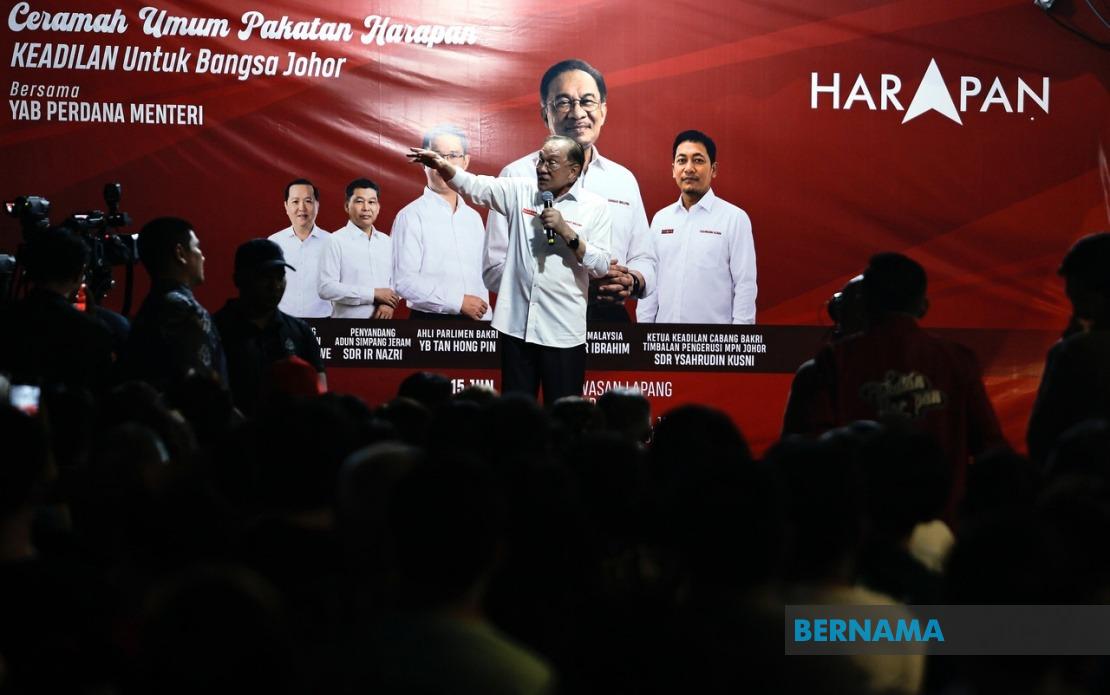
Prime Minister Datuk Seri Anwar Ibrahim has called for a fundamental shift in how the nation approaches its development, urging political leaders and citizens alike to prioritise technological advancement and economic growth over the contentious issues that have historically fragmented Malaysian politics. Speaking at a PKR rally in Muar on June 15, Anwar positioned artificial intelligence and quantum computing as the twin pillars upon which Malaysia's future prosperity must rest, framing this strategic pivot as essential for securing the wellbeing of younger generations who will inherit the consequences of today's policy decisions.
The Prime Minister's remarks underscore a growing frustration with what he characterises as an endless cycle of divisive political rhetoric that consumes public discourse without advancing tangible improvements in citizens' lives. By juxtaposing endless bickering over communal and religious sensitivities against the urgency of technological competition, Anwar articulated a vision of national development that transcends conventional identity-based politics. His rhetorical question—"when are we going to take care of this country?"—served as a sharp rebuke to political actors across the spectrum whom he views as prioritising electoral advantage and ideological posturing over constructive governance.
Malaysia's recent diplomatic and commercial efforts reflect this technology-forward strategy in concrete terms. During his recent visit to Japan, Anwar explored practical pathways for integrating quantum computing capabilities into Malaysian research and industrial sectors, a move that positions the country at the frontier of next-generation computational technology. Simultaneously, the government has been actively engaged in attracting major foreign investments in artificial intelligence infrastructure and data centres, recognising that Southeast Asia's digital economy will be substantially shaped by which nations successfully capture these high-value sectors in coming years.
The geopolitical context surrounding these initiatives cannot be overlooked. As regional competitors, particularly Singapore and increasingly Vietnam, consolidate their positions as technology hubs within Southeast Asia, Malaysia faces a critical window to establish itself as an alternative destination for international technology investors. Anwar's emphasis on foreign investment flows reflects an understanding that competitive positioning in AI and quantum computing requires not merely domestic commitment but international partnership and capital infusion. The reference to global investors already seeking Malaysian opportunities suggests that the nation possesses underlying advantages—human capital, geographic location, regulatory frameworks—that, when properly leveraged, can attract multinational technology enterprises.
The Prime Minister's call for inter-communal cooperation represents a deliberate recalibration of political messaging away from identity-based appeals toward inclusive economic nationalism. Rather than speaking to specific demographic groups, Anwar addressed Malaysians collectively, framing technological advancement and national competitiveness as shared interests transcending ethnic and religious boundaries. This approach acknowledges that economic opportunity and technological capability constitute the material basis for social cohesion far more durably than appeals to historical grievance or cultural preservation.
Critically, Anwar's argument contains an implicit acknowledgment that Malaysia's political culture has, in recent decades, become increasingly defined by zero-sum competition over symbolic issues and resource distribution along communal lines. By positioning AI and quantum computing as existential priorities rather than peripheral concerns, he attempted to redirect political energy toward domains where national interest and individual advancement converge. The observation that international investors are already examining Malaysia without requiring domestic promotional campaigns suggests that the nation's reputation and structural appeal remain relatively intact despite domestic political turbulence.
The gathering in Muar, attended by PKR Vice-President Datuk Seri Dr. Zaliha Mustafa and Johor PH Chairman Aminolhuda Hassan, demonstrated the leadership coalition's unified commitment to this strategic orientation. This unity in messaging across senior Pakatan Harapan figures indicates that technology-driven development has become a core policy commitment, not merely rhetorical flourish by the Prime Minister. For Malaysian voters and international observers, this consistency signals that the government intends to translate the technology agenda into budgetary allocations, regulatory reforms, and institutional development.
The challenge confronting this vision lies in its implementation across competing political pressures and entrenched interests. While Anwar's articulation of the technology agenda possesses considerable force and apparent popular appeal, actually embedding quantum computing research and AI capabilities throughout Malaysian educational, commercial, and government institutions requires sustained commitment beyond electoral cycles. Equally, cultivating the specialist workforce necessary for these sectors demands substantial, long-term investment in STEM education at secondary and tertiary levels, investments that generate political returns only over extended timeframes.
For neighbouring Southeast Asian nations, Anwar's emphasis on technology-driven development through foreign investment carries implications for regional competition and cooperation. Should Malaysia successfully position itself as a quantum computing and AI hub, it could catalyse broader technology ecosystem development throughout the region, potentially raising competitive pressures on other ASEAN members while creating collaborative opportunities. Conversely, if Malaysia's domestic political divisions undermine investor confidence or hinder the institutional coordination necessary for technology sectors, the competitive advantage may shift to rival destinations.
The implicit criticism of political leaders who exploit communal sentiments assumes particular weight given Malaysia's history of electoral competition organised substantially around ethnic identity and communal representation. Anwar's exhortation to political figures to reject hate-mongering and sentiment exploitation represents a direct challenge to established patterns of political mobilisation. Whether this appeal resonates with voters and translates into sustained political reward for leaders who emphasise substantive development over symbolic struggle remains an open question, but it signals a deliberate attempt to reshape the terrain of political competition itself.