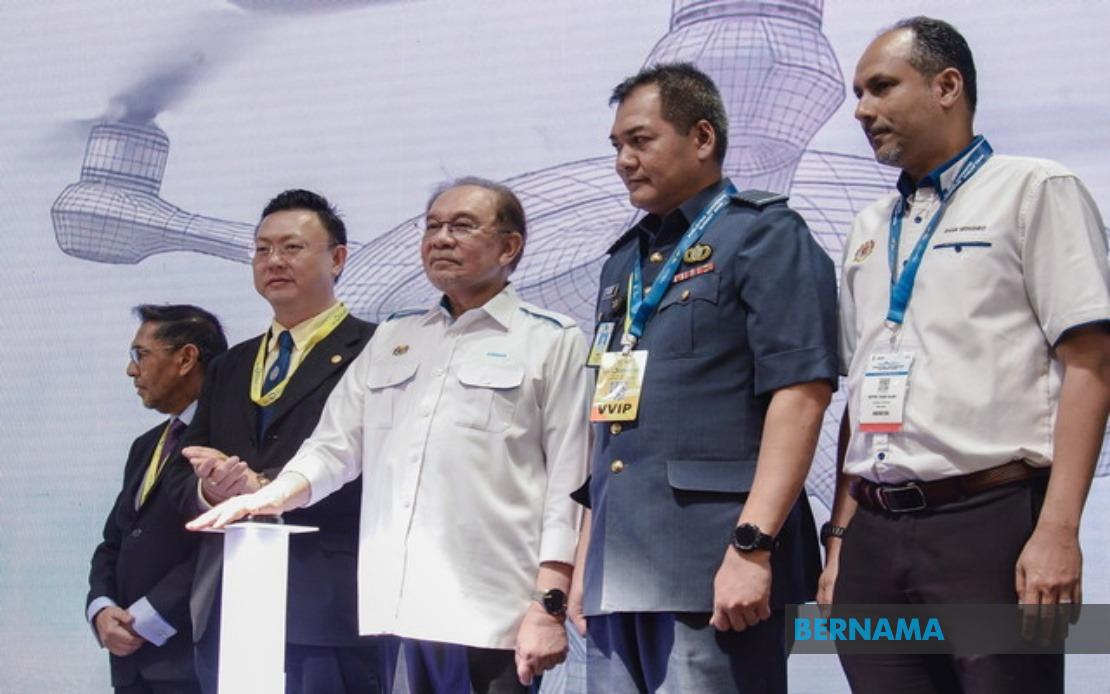
Prime Minister Datuk Seri Anwar Ibrahim has stressed the urgency of Malaysia moving swiftly to develop and commercialise unmanned aerial vehicle technologies, positioning the nation to capitalise on what he describes as a transformative economic opportunity. Speaking at the closing ceremony of MyDrone Expo 2026 in Sepang, Anwar outlined a strategic vision that places drone innovation at the intersection of artificial intelligence and digital transformation—sectors increasingly recognised as fundamental to modern competitive advantage. His intervention signals a high-level political commitment to scaling an industry that remains nascent across most of Southeast Asia.
The global commercial drone market presents a compelling case for Malaysian intervention. Industry projections estimate the worldwide UAV sector will surpass USD55 billion by 2030, while the emerging low-altitude economy—encompassing logistics, agricultural monitoring, infrastructure inspection, and emergency response—represents a rapidly expanding investment frontier. For a middle-income economy seeking to diversify beyond traditional sectors, the timing aligns favourably with Malaysia's broader digitalisation agenda. Anwar framed the opportunity not merely as a niche technology play but as an essential component of maintaining economic relevance in an increasingly technology-driven global marketplace.
The MyDrone Expo 2026, organised jointly by the World UAV Federation Malaysia Chapter and the Malaysia UAV Development Association, demonstrated the sector's capacity to attract international interest and participation. The three-day event exceeded organisational expectations with over 100 exhibition booths and drew thousands of visitors alongside industry delegates representing 46 countries. This turnout suggests both domestic enthusiasm and international confidence in Malaysia's potential as a regional hub for drone development and integration. The breadth of international participation indicates that Malaysia is perceived as a credible venue for serious industry engagement, a perception that can be leveraged through strategic policy and investment.
Anwar's directives to Cabinet ministers, policymakers, research institutions and relevant government agencies underscore an administrative approach to drone sector development that combines regulatory reform with ecosystem cultivation. The government has committed to strengthening the regulatory framework, increasing research funding, and establishing robust testing and certification infrastructure. These foundational elements are critical because investor confidence in emerging technology sectors depends substantially on transparent, efficient regulatory pathways and access to independent verification mechanisms. Malaysia's advantage lies in its ability to implement such frameworks faster than competitors, provided bureaucratic coordination is effective and political commitment remains consistent.
The prime minister specifically endorsed drone applications across both defence and civilian sectors, signalling a comprehensive industrial strategy. While military and aerospace applications typically capture headlines, the civil dimension represents the largest long-term market opportunity. Agricultural applications stand out as particularly relevant to Malaysia's economic structure. Precision agriculture, enabled by drone-based monitoring and data analytics, can enhance productivity on palm oil estates, rubber plantations, and other agricultural holdings. Similarly, application in infrastructure inspection, urban logistics, and environmental monitoring aligns with Malaysia's urban development and sustainability imperatives. This dual-use approach maximises the addressable market while building constituencies across different parts of the economy.
The absence of a robust talent pipeline represents a persistent constraint on drone sector expansion across Southeast Asia. Recognising this challenge, Anwar called for strengthened collaboration between private industry, government research establishments and universities to develop comprehensive human capital development programmes. The reference to existing faculties in artificial intelligence and quantum computing suggests a model where drone technology becomes integrated into broader engineering and computer science curricula rather than treated as a standalone specialism. This integration approach leverages existing academic infrastructure while ensuring graduates possess transferable skills applicable across technology sectors.
Malaysia's regional context deserves consideration. The drone sector has attracted investment and policy attention across Southeast Asia, with countries including Singapore and Vietnam pursuing their own development strategies. Malaysia's combination of established aerospace credentials through Petronas and Malaysia Airlines, a growing tech talent base, and geographic positioning as a regional logistics hub provides competitive advantages. However, regulatory harmonisation within ASEAN remains underdeveloped, creating opportunities for Malaysia to establish itself as a standards-setting centre if policies are sufficiently forward-thinking and collaborative. The MyDrone Expo's international participation suggests receptivity to Malaysia occupying such a role.
Implementation challenges should not be minimised. Successfully building a drone industry ecosystem requires sustained coordination across government departments, universities, research institutions and private companies—a level of bureaucratic coherence that remains difficult to achieve consistently in Malaysia. Funding commitments must be substantial and stable across political cycles to attract long-term private investment. Regulatory frameworks, while necessary, risk becoming barriers to innovation if designed too conservatively or implemented inflexibly. The government's framing of drones as integral to Malaysia's economic future represents necessary political backing, but operational success depends on translating ambition into executable policy and adequate resource allocation.
For Malaysian businesses and investors, Anwar's positioning of the drone sector signals an opening for entrepreneurial activity and capital deployment. Companies with relevant technological expertise, particularly those capable of addressing regional agricultural and logistics challenges, may find growing government support and market opportunity. The explicit government backing reduces investment risk, at least in the medium term, though sustainable industry growth ultimately depends on commercial viability and genuine market demand rather than subsidy alone. International companies considering Malaysian regional headquarters or research facilities for drone development may view the current policy environment as increasingly receptive.
The broader strategic significance extends beyond drones themselves. Anwar's emphasis on rapid technological adoption and ecosystem development reflects awareness that Malaysia's economic future depends on competing successfully in knowledge-intensive sectors rather than relying on low-cost manufacturing or commodity extraction. The drone sector serves as a visible proxy for this strategic reorientation. Whether Malaysia can successfully execute this transition—moving from policy announcements to sustained industrial capability—will shape economic opportunities for decades. The MyDrone Expo's success and the Prime Minister's high-profile intervention suggest conditions may be favourable, but execution will ultimately determine outcomes.

