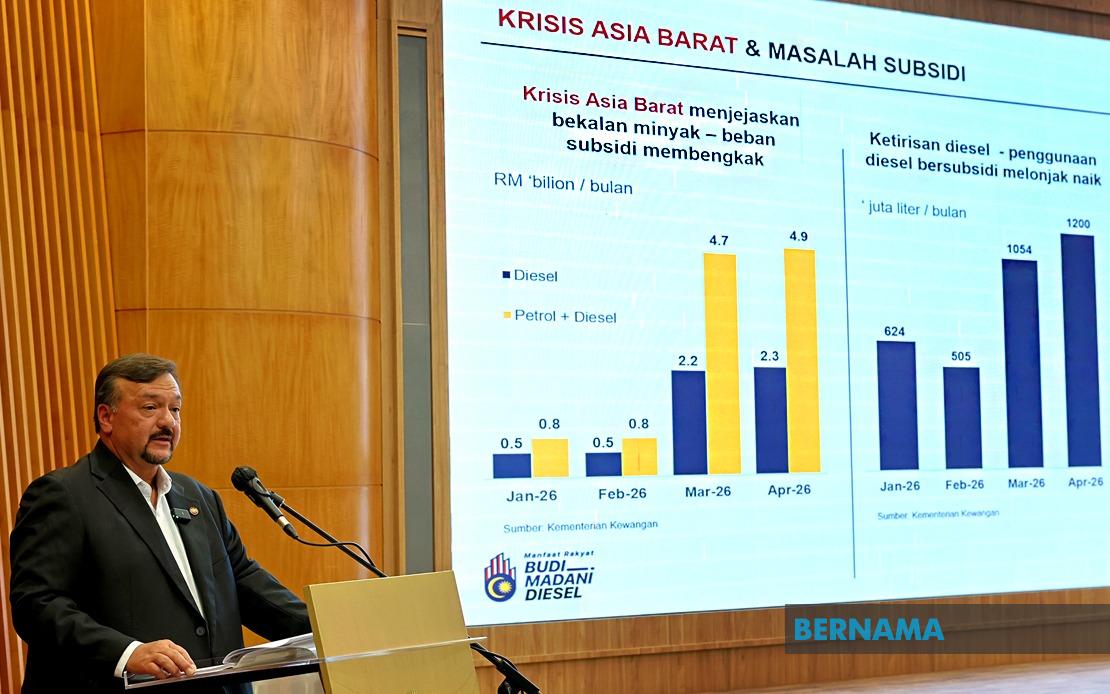
The Malaysian government has decided to keep the monthly BUDI MADANI RON95 subsidy quota fixed at 200 litres, ruling out an immediate return to the previous 300-litre allowance. Finance Minister II Datuk Seri Amir Hamzah Azizan made this announcement in Putrajaya on June 22, signalling that any future adjustment hinges entirely on how regional geopolitical tensions evolve and their consequent ripple effects on international crude oil markets. The holding pattern reflects a cautious approach driven by uncertainty surrounding the recent ceasefire agreement between the United States and Iran, which remains fragile and untested in its capacity to stabilise energy markets.
The timing of this policy decision underscores Malaysia's sensitivity to external shocks in the oil sector. The government's reluctance to immediately raise the quota stems from the need to gather conclusive evidence about whether the preliminary ceasefire will genuinely translate into sustained peace or merely provide temporary relief. A 60-day negotiating window has been established for deeper talks between Washington and Tehran, creating an extended period of ambiguity. During this interval, Malaysian policymakers prefer to maintain the status quo rather than commit to higher subsidies that might prove unsustainable should crude prices spike unexpectedly.
Amir Hamzah explained that the government's overarching concern is safeguarding citizens' purchasing power while managing fiscal pressures. He noted that the reduction from 300 to 200 litres represents a manageable adjustment, with nearly 80 per cent of programme participants consuming less than the current monthly threshold anyway. This data-driven observation suggests that for the majority of beneficiaries, the quota cut does not impose genuine hardship. The subsidy scheme continues to serve its primary function of providing affordable fuel access to lower and middle-income Malaysians, albeit within tighter parameters.
Prime Minister Datuk Seri Anwar Ibrahim had expressed measured optimism just days earlier regarding the US-Iran Memorandum of Understanding, viewing it as a potential pathway toward regional stability. However, optimism alone cannot justify expanding fiscal commitments when crude prices remain volatile and unpredictable. The preliminary 14-point agreement represents only a starting point; substantial work remains to transform it into a comprehensive, legally binding accord that actually constrains the region's military posturing.
For Malaysian consumers and businesses dependent on fuel subsidies, the announcement carries mixed implications. Those relying on personal vehicle use for work face continued budget constraints, though government data suggests most drivers fall comfortably within the 200-litre monthly envelope. The subsidy remains valuable compared to unsubsidised global prices, but the ceiling does impose discipline on fuel consumption patterns. The Finance Ministry has simultaneously encouraged voluntary conservation measures, including flexible work-from-home arrangements, underscoring that lower fuel usage serves both household budgets and broader environmental objectives.
The geopolitical dimension of this decision deserves emphasis. Malaysia, as a net energy importer, has considerable exposure to Middle Eastern instability and the oil price shocks it triggers. Unlike neighbouring Brunei or Indonesia, which produce crude domestically, Malaysia must navigate global energy markets as a price-taker. The West Asia region's volatility directly translates to import bills and subsidy costs, making cautious energy policy prudent. By waiting for concrete evidence that regional tensions have genuinely eased, the government avoids overcommitting to spending it may struggle to sustain.
The BUDI95 programme itself represents a relatively targeted approach to fuel subsidies compared to broader universal schemes. By capping benefits at 200 litres monthly for lower-income Malaysians, the government balances equity concerns with fiscal responsibility. This approach contrasts with earlier subsidy regimes that distributed benefits more broadly and expensively. The current framework forces beneficial reallocation: those with lowest fuel needs receive full protection, while higher consumers bear proportionally greater unsubsidised costs, creating incentives for efficient transport choices.
Regional context matters significantly for understanding Malaysia's position. Other Southeast Asian economies face comparable pressures, though with differing subsidy structures. Thailand, Vietnam, and the Philippines each employ distinct mechanisms to shield citizens from oil-price volatility while managing government finances. Malaysia's decision to hold the quota steady reflects broader regional caution about oil market unpredictability. Should the US-Iran situation stabilise decisively and crude prices fall sustainably, neighbouring governments might also reconsider more generous subsidy arrangements; conversely, if tensions reignite, regional energy costs could spike dramatically, making Malaysia's conservative stance appear prescient.
The government's emphasis on monitoring rather than immediate action reflects sophisticated understanding of geopolitical risk assessment. The 60-day negotiation window provides a natural review point; policymakers can gather three months of market data before reconsidering quota levels. This staged approach reduces the risk of either premature relaxation of fiscal discipline or unnecessarily prolonged constraints on consumer welfare. The announcement essentially signals that Malaysia is neither panicking nor complacent, but rather maintaining vigilant oversight of a situation with genuine capacity to affect household finances and national economic stability.
Looking ahead, several factors could prompt future quota adjustments. A conclusive peace agreement between the US and Iran would likely trigger downward pressure on crude prices, creating fiscal space for higher subsidies. Conversely, renewed regional conflict would justify maintaining or even tightening current limits. Economic data showing that consumers have adapted successfully to 200-litre quotas might make policymakers more comfortable with the permanent adjustment. Ultimately, the government has positioned itself to respond flexibly while avoiding costly over-commitments, balancing social protection with long-term fiscal sustainability in an inherently uncertain global energy landscape.

