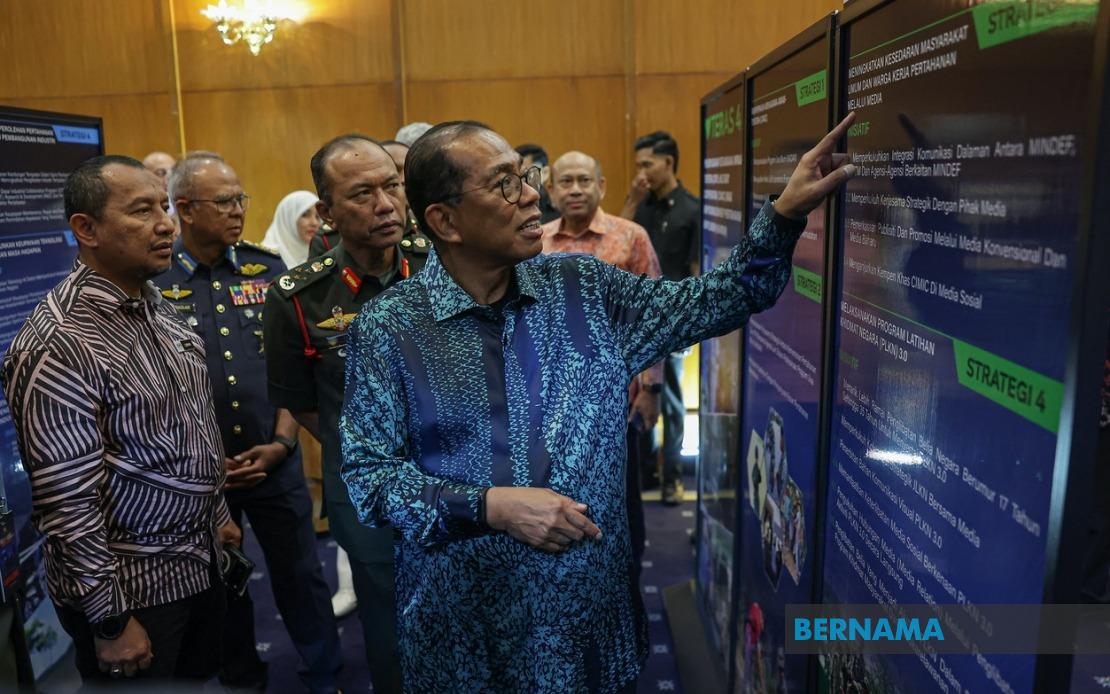
Malaysia's Defence Ministry has rolled out an integrated strategic framework aimed at fortifying the nation's security architecture against a spectrum of contemporary and future threats. The National Defence Strategic Plan and the Defence Capacity Blueprint for 2026–2030, unveiled in Kuala Lumpur on June 25, represent a coordinated effort to translate long-term defence objectives into concrete operational and institutional capacity. Defence Minister Datuk Seri Mohamed Khaled Nordin positioned both documents as complementary instruments designed to operationalise the broader Defence White Paper, ensuring that strategic vision translates into implementable reality across Malaysia's security establishment.
The global security environment has undergone profound transformation in recent years, characterised by intensifying geopolitical competition, particularly in Southeast Asia where maritime disputes and great-power competition intersect with regional interests. The Malaysian defence leadership explicitly acknowledged that artificial intelligence, automation, and other disruptive technologies are reshaping military doctrine and operational requirements worldwide. Concurrently, non-traditional security threats—ranging from cyber attacks and terrorism to transnational crime and climate-related instability—demand defensive postures that extend far beyond conventional military preparedness. The Mid-Term Review of the Defence White Paper, which informed both new documents, sought to systematically identify gaps within existing frameworks and recalibrate Malaysia's defensive strategy to remain relevant amid this fluid landscape.
The National Defence Strategic Plan is anchored upon seven strategic pillars that collectively address the full spectrum of defence obligations. These pillars encompass operational readiness of the Malaysian Armed Forces, the systematic enhancement of defence capabilities, personnel welfare and veteran support, defence technology and innovation, and complementary structural dimensions. Rather than treating these elements in isolation, the strategic plan recognises their interdependence and synergy. Operational readiness, for instance, depends fundamentally upon technological modernisation, human capital development, and adequate resourcing. The framework's sophistication lies in its systemic approach, acknowledging that military effectiveness requires alignment across hardware acquisition, personnel training, institutional culture, and budget allocation.
The Defence Capacity Blueprint functions as the implementation mechanism that translates strategic intent into tangible institutional and resource capabilities. This distinction is crucial: whilst the strategic plan articulates destination and direction, the capacity blueprint addresses the structural, financial, and human prerequisites for reaching those objectives. The blueprint emphasises that capacity encompasses not merely funding allocation but also human capital development, professional competency advancement, technological expertise acquisition, institutional leadership quality, and horizontal coordination mechanisms spanning multiple government agencies. This comprehensive framing reflects evolved thinking within defence establishments globally, recognising that military effectiveness in the 21st century requires sophisticated civil-military coordination and inter-agency synergy extending beyond traditional defence ministry boundaries.
A pivotal aspect of both documents is their explicit commitment to a whole-of-government and whole-of-society approach to national defence. This represents a significant conceptual shift, treating security not as a specialised government function confined to uniformed personnel and defence bureaucracies but as an integrated national endeavour engaging diplomatic, economic, technological, and social dimensions. For Malaysia, a maritime nation confronting multiple security dimensions simultaneously, this integrated perspective proves particularly germane. Cybersecurity threats do not respect traditional ministry jurisdictions; maritime security requires coordination among defence, maritime agencies, and coastal development authorities; terrorism prevention demands intelligence integration across civilian and military establishments. By explicitly endorsing this broader conception, the Defence Ministry signals institutional readiness to function within networked security ecosystems rather than siloed defence structures.
Capacity building across the defence establishment demands sustained financial commitment, a point that underscores ongoing budgetary negotiations within Malaysia's fiscal framework. The blueprint's emphasis upon financial resources as foundational capacity reflects acknowledgment that strategic ambition without corresponding budgetary allocation remains aspirational rhetoric rather than operational reality. Malaysia's defence spending, whilst increasing, remains constrained relative to regional peers confronting comparable security challenges. The interplay between strategic ambition and financial reality will determine implementation success; the blueprint's explicit foregrounding of financial capacity suggests defence planners understand this constraint and are advocating for commensurate resource allocation.
Human capital constitutes perhaps the most critical yet often underempresented capacity dimension. Professional military establishments require sustained investment in training, education, and professional development to maintain effectiveness amid technological change and operational complexity. The blueprint's inclusion of human capital, leadership development, and professional competency acquisition signals recognition that personnel quality directly determines strategic implementation success. For Malaysia, where defence sector employment represents significant career opportunity and social mobility pathway, investment in professional development also carries broader social implications. The framework's emphasis upon personnel welfare and veteran support, incorporated within the strategic pillars, reinforces this people-centric approach to defence capacity.
Technological modernisation represents both opportunity and challenge within Malaysia's defence context. The acquisition of three ANKA Medium Altitude Long Endurance Unmanned Aircraft Systems, deployed operationally at Labuan Air Base by March 2024, exemplifies concrete platform modernisation. These systems enhance surveillance and reconnaissance capabilities across Malaysia's maritime domains, addressing critical gaps in persistent area coverage. The anticipated receipt of FA-50M light combat aircraft, maritime patrol aircraft, and the second batch of Littoral Mission Ships reflects a deliberate strategy to enhance multi-domain operational capability. However, platform acquisition alone insufficient; operators must develop genuine expertise in advanced systems utilisation, maintenance protocols, and integration with broader operational networks. The Defence Capacity Blueprint's emphasis upon technological expertise acquisition suggests planners recognise that equipment acquisition requires accompanying institutional capability development.
Southeast Asia's strategic environment presents particular challenges and opportunities for Malaysian defence planning. The region's maritime complexity, involving overlapping territorial claims, significant sea lane traffic, and competing great-power interests, demands sophisticated maritime security capabilities integrated with diplomatic engagement and institutional coordination. China's military modernisation and expansion in the South China Sea creates a backdrop against which Malaysian defence planning occurs. Simultaneously, ASEAN's commitment to non-interference and consensus decision-making constrains the region's collective security responses. Within this context, Malaysia's strategy emphasises enhanced autonomous capability, technological sophistication, and inter-agency coordination rather than alliance-dependent security arrangements. The strategic plan and capacity blueprint reflect this orientation toward self-reliant security posture.
The relationship between the Defence White Paper, the National Defence Strategic Plan, and the Defence Capacity Blueprint establishes a hierarchical planning architecture designed to align vision, strategy, and implementation. The White Paper provides overarching strategic vision and broad policy framework; the strategic plan operationalises that vision through clearly defined pillars and objectives; the capacity blueprint specifies institutional, financial, and human requirements necessary for strategic realisation. This cascading framework represents mature strategic planning methodology, reflecting evolution within Malaysia's defence governance structures. However, implementation effectiveness depends upon systematic monitoring, periodic adjustment, and sustained commitment across multiple budget cycles and governmental administrations. Strategic plans divorced from implementation reality become exercises in bureaucratic documentation rather than instruments of strategic change.
For Malaysian policymakers and defence stakeholders, these documents signal commitment to systematic, forward-looking security planning grounded in realistic assessment of capability requirements and institutional constraints. The five-year timeframe provides sufficient duration for meaningful capacity development whilst remaining sufficiently near-term to maintain strategic relevance. The explicit whole-of-government framing creates opportunities for enhanced coordination across agencies historically operating within distinct jurisdictions. Success ultimately depends upon sustained political commitment, adequate resource allocation, and institutional ability to execute complex capability development programmes whilst managing immediate operational requirements. The framework is strategically coherent; whether implementation matches ambition will determine actual impact upon Malaysia's defence preparedness.

