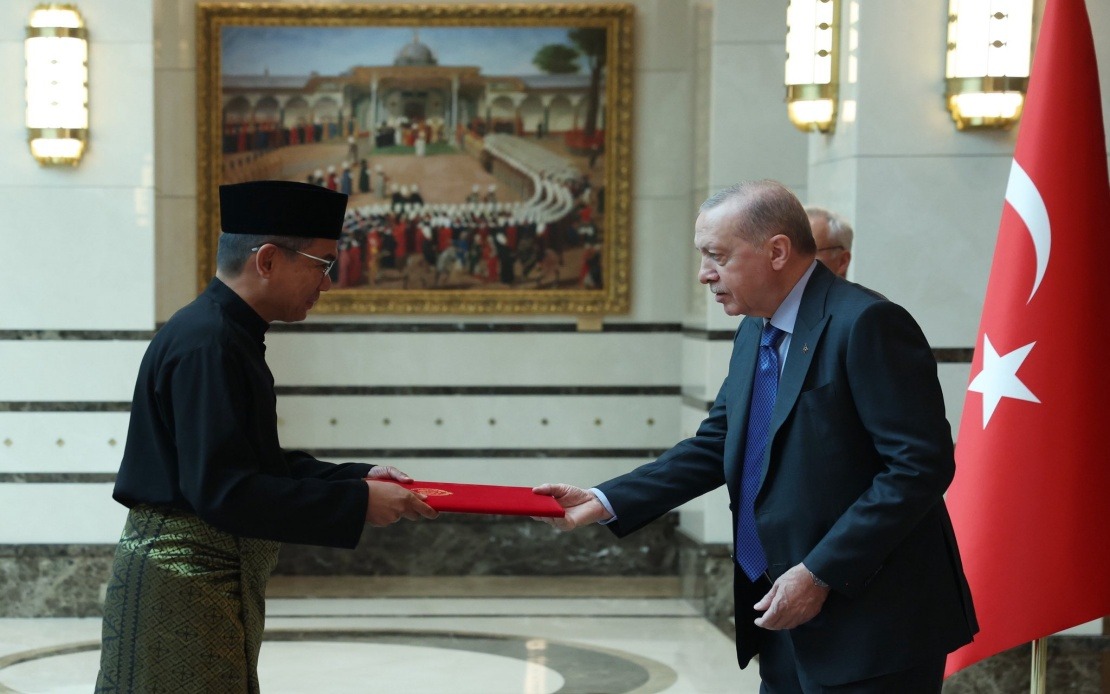
Malaysia has formally thrown its weight behind Türkiye's aspirations to secure ASEAN Dialogue Partner status, signalling strengthened commitment to broadening Southeast Asia's international partnerships. The endorsement came during a high-level diplomatic exchange in Ankara, when newly-accredited Malaysian Ambassador Adlan Mohd Shaffieq presented his credentials to Turkish President Recep Tayyip Erdoğan at the Presidential Complex on June 17, underscoring the ceremonial importance attached to the initiative.
The ambassador's remarks, delivered on behalf of the Malaysian government, positioned Türkiye as a progressively significant actor within the Asian geopolitical landscape. His characterisation of the country as increasingly engaged through economic initiatives, strategic positioning, and interpersonal connections with ASEAN capitals reflects a deliberate diplomatic narrative: that Ankara has earned recognition through tangible contributions rather than mere aspiration. This framing matters for regional audiences evaluating which external powers merit closer institutional ties with the bloc.
Personal relations between key leaders appear central to the Malaysian initiative. Shaffieq conveyed formal greetings and best wishes from Sultan Ibrahim, the reigning Malaysian monarch, and Prime Minister Datuk Seri Anwar Ibrahim to Erdoğan. The explicit mention of these exchanges suggests that Malaysia views the relationship as sufficiently elevated to warrant royal-level communication, a diplomatic protocol reserved for partners deemed strategically valuable. For Ankara, securing backing from Malaysia—a moderate Muslim-majority nation with considerable regional standing—validates its credentials as a serious partner worthy of deeper institutional engagement.
Malaysia emphasised the historical depth and institutional substance of bilateral ties with Türkiye. The two nations maintain what officials characterise as a longstanding friendship bolstered by strategic partnership frameworks, sustained through consistent engagement at senior governmental levels. Rather than presenting this as a new arrangement, the ambassador framed Malaysia's support for ASEAN partnership status as a natural extension of existing cooperation architecture, suggesting organic institutional development rather than abrupt diplomatic pivoting.
Sectoral collaboration provides concrete foundation for the relationship. Education represents a traditional avenue through which Malaysian and Turkish institutions have fostered exchange, with thousands of Malaysian students historically studying in Turkish universities whilst Turkish professionals have engaged with Malaysian academic institutions. Defence cooperation, meanwhile, signals security dimension to ties, positioning Ankara as a credible partner in regional stability discussions. The explicit mention of the halal industry underscores an often-overlooked dimension of Malaysia-Türkiye engagement: Türkiye's emergence as a significant halal producer and exporter, with interests closely aligned to Malaysian certification standards and market access aspirations.
The diplomatic language surrounding this initiative reveals calculation on both sides. Malaysia's framing of shared values—mutual trust, respect, peace, prosperity, development—constructs a narrative of alignment extending beyond transactional economics. This foundational emphasis on values may signal to other ASEAN members that supporting Türkiye's bid represents commitment to principle-based international relations rather than narrow national advantage. Such positioning matters within ASEAN's consensus-driven decision-making framework, where justifications for institutional changes must resonate across diverse member interests.
Ambassador Shaffieq specifically referenced the personal rapport between Erdoğan and Prime Minister Anwar Ibrahim as catalyst for deepening collaboration. This personal dimension has proven significant in Malaysian foreign policy under the current administration, with Anwar's individual relationships often translating into accelerated institutional cooperation. The suggestion that presidential and prime ministerial chemistry should drive sectoral expansion across education, defence, economics, and cultural domains reflects Malaysia's diplomatic approach of leveraging elite networks for policy advancement.
Turkey's reciprocal commitment emerged when President Erdoğan expressed confidence regarding bilateral trade trajectory. His articulation of a US$10 billion trade target demonstrates serious commercial ambition underpinning the diplomatic overture. This figure establishes measurable expectations for economic collaboration, transforming abstract partnership rhetoric into quantifiable objectives. For Malaysian exporters and investors, Türkiye's emphasis on expanding trade relationships signals market opportunities, particularly in sectors where Malaysian businesses possess competitive advantages such as palm oil derivatives, electronics components, and halal-certified products.
The timing of this diplomatic initiative reflects broader regional recalibration. ASEAN's engagement patterns with major powers have evolved considerably, with dialogue partnerships now serving as intermediate institutional frameworks between full membership and ordinary state relations. Türkiye's pursuit of this status represents its strategic calculation that deeper formal ties with Southeast Asian institutions enhance its positioning in Indo-Pacific affairs whilst providing member states with diversified partnerships beyond traditional Western and Chinese engagement frameworks.
Malaysia's backing carries particular weight given its rotating ASEAN chairmanship dynamics and influence within regional decision-making forums. The country's explicit endorsement potentially catalyses support from other member states currently evaluating Türkiye's candidacy. For Malaysian policymakers, supporting this initiative aligns with broader foreign policy objectives centred on diversifying partnerships, supporting Muslim-majority nations' international standing, and maintaining Malaysia's positioning as bridge between developed and developing economies.
Looking forward, Türkiye's pursuit of dialogue partner status represents testing ground for ASEAN's institutional adaptability. Whether the bloc formally incorporates Ankara into its engagement architecture depends partly on consensus building among all ten members, where Malaysia's early advocacy provides important groundwork. The emphasis on economic targets, sectoral cooperation, and elite-level rapport construction suggests both parties envision substantial institutional relationship extending well beyond symbolic recognition.

